



Kinetic Look Without Moving Parts: 5 Cladding Systems That Create Motion With Light
29-10-26 | Facade Innovations
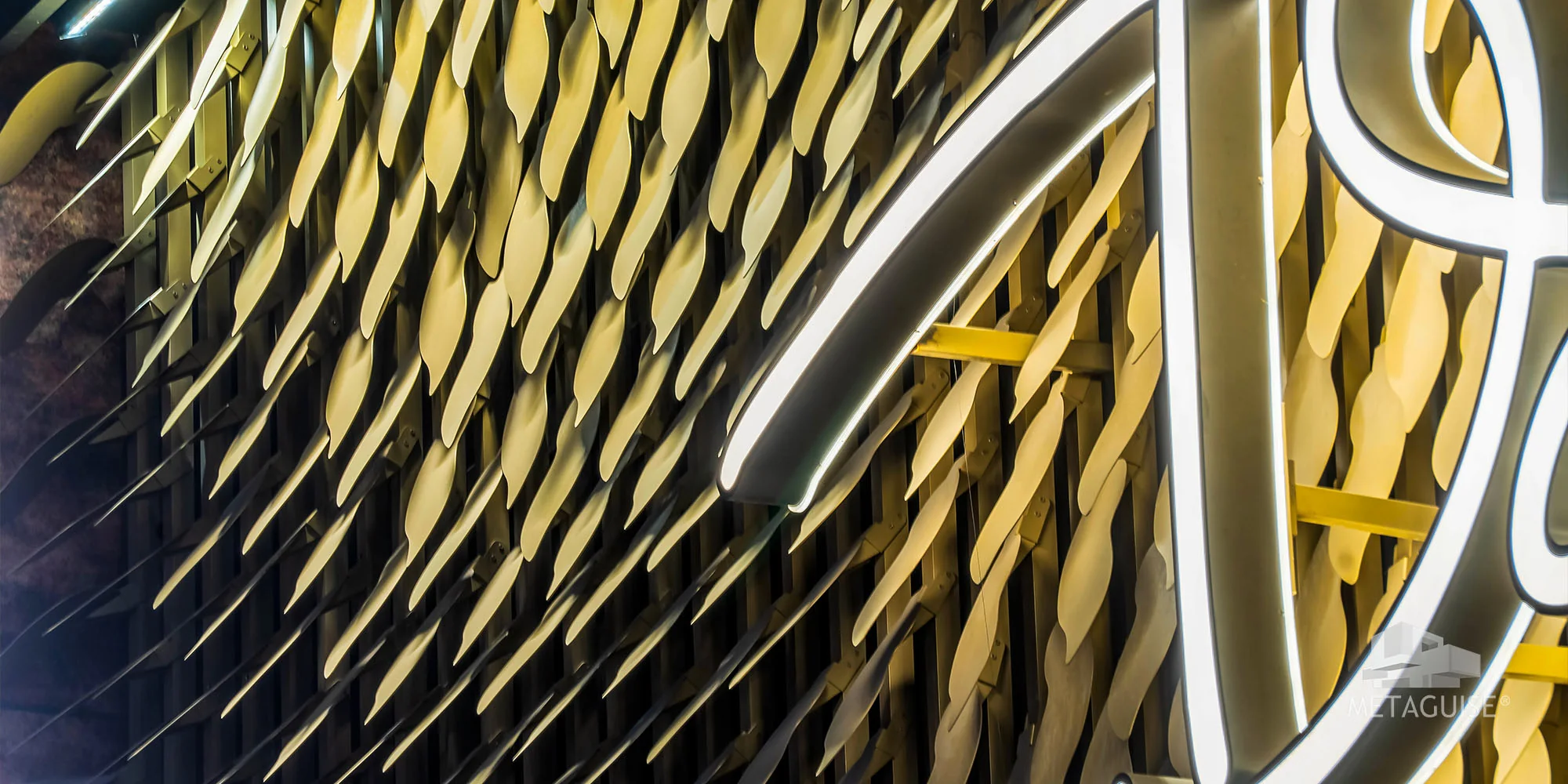
Everyone loves a facade that seems to move. Light ripples across it, shadows slide, the surface changes as you walk past. But a truly moving facade means motors, sensors, cables and a maintenance contract that never ends. In dust, heat and monsoon, every moving part is a part that can fail. There is another way. Some cladding systems have no moving parts at all, yet create the feeling of motion. The movement comes from you, the sun and the sky, not from a motor. This guide explains how it works and presents five systems that deliver a kinetic look with no mechanism to maintain.
Real Kinetic vs Kinetic Look
A real kinetic facade has parts that physically move, driven by wind, motors or manual adjustment. Our guide to what a kinetic facade is and how movable facade technology works cover that. A kinetic look is different. The panels are fixed. The motion is an optical effect created by:- Changing sun angle through the day
- The viewer moving past the facade
- Depth and relief, so shadows shift as light changes
- Reflective surfaces that catch and release light
- Repeating modules with small variations that create a ripple or wave
The result feels alive, but there is nothing to oil, recalibrate or replace.
Why Choose a Static Kinetic Look?
| Factor | Moving kinetic facade | Kinetic look with fixed panels |
|---|---|---|
| Motors and controls | Required | None |
| Running cost | Power and servicing | None |
| Upkeep | Regular mechanical checks | Washing and finish checks |
| Failure points | Many | Very few |
| Wind and storm risk | Needs special design | Handled like normal cladding |
| Visual effect | Real movement | Optical movement from light and viewer |
| Best for | Landmarks with a large budget | Most commercial and residential projects |
For many buildings, especially in India's dusty and monsoon heavy conditions, a static system gives 80 percent of the drama with a fraction of the risk. See also our guide on kinetic facade price in India to compare costs.
5 Cladding Systems That Create Motion With Light
1. Coin and Sequin Modules
Small circular metal modules arranged across a surface catch light individually. As you move or as the sun shifts, each module flashes, so the whole wall shimmers like water or fabric. Variations in tilt, size or colour create waves and gradients. See the MetaCoin system and the MetaSequin panel, and read about MetaCoin facades and MetaSequin metal panels.2. 3D Pyramid and Faceted Panels
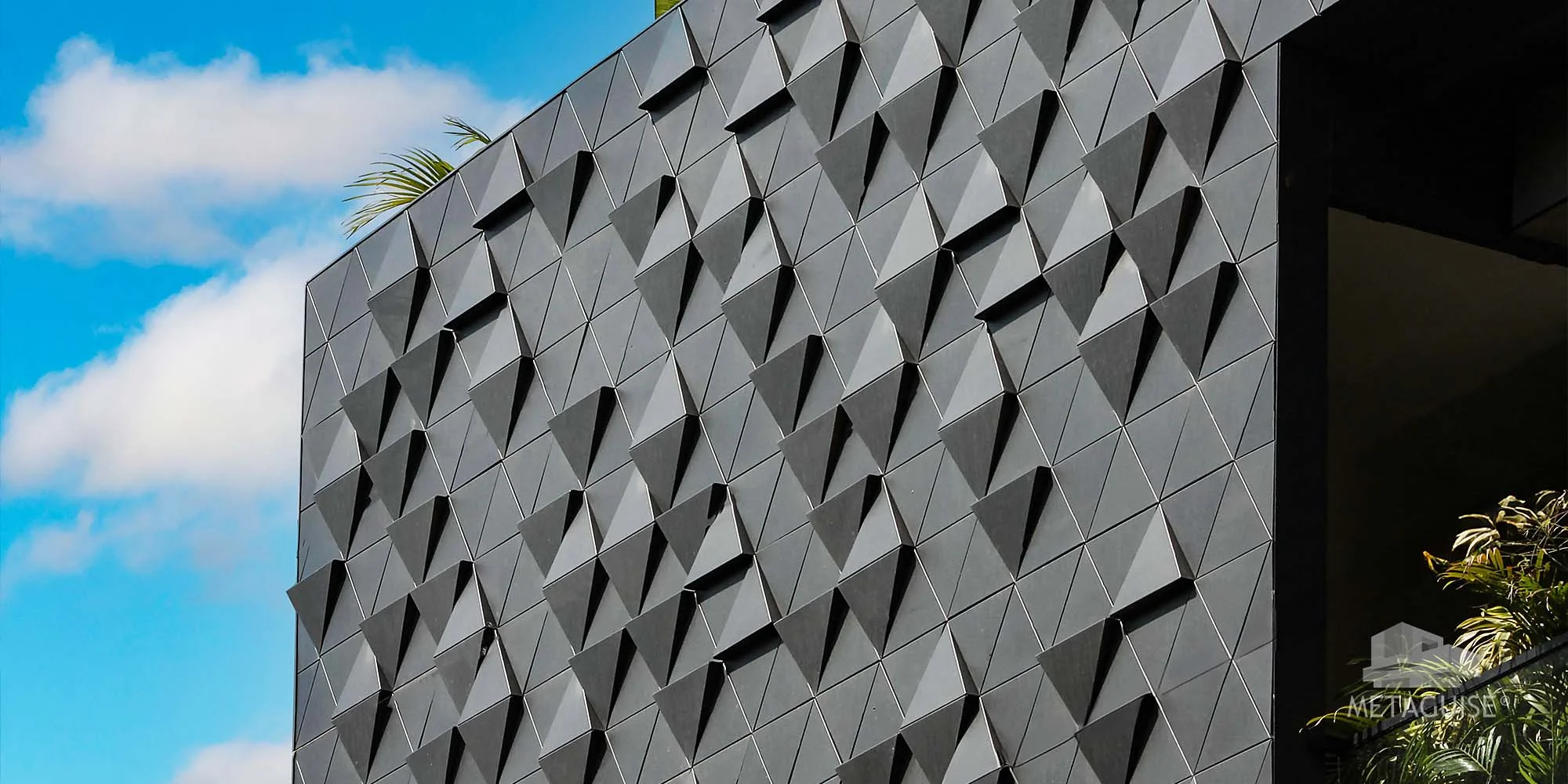
Panels with raised pyramids or facets have many surfaces facing different directions. As the sun moves, different faces light up and others fall into shadow, so the pattern appears to shift through the day. Deeper relief gives stronger effect. Explore the MetaPyramid panel and our guide to 3D elevation design ideas.3. Folded and Origami Panels
Folded metal creates sharp planes that catch light at different angles. When you walk along the facade, the fold lines seem to open and close. The effect works best with a strong, simple fold repeated across a large area. Read about MetaFold and origami architecture.4. Fluted Panels and Fins
Vertical flutes and fins create a rhythm of light and shadow lines. As you move past, the lines seem to ripple. Varying spacing, depth or angle along the facade turns a simple pattern into a wave. See the MetaFlute range, the MetaFin system and our guide to architectural fins design.5. Staggered Louvers and Gradient Perforation
Louvers set at changing angles, or perforated panels where hole size grows gradually, create a flowing pattern that reads as movement. A gradient from open to closed looks like wind passing over the surface. See the MetaLouver range, our project story on a staggered louver facade in Dhanbad and our guide to perforated metal panel design.How to Make the Effect Stronger
- Add depth. Deeper relief creates longer, more dramatic shadows.
- Use metallic or semi gloss finishes. They catch more light than flat matte surfaces.
- Vary the module. Small changes in angle, size or tone across the facade create gradients and waves.
- Think about the sun path. Orientation decides when the effect peaks. See our guide on light and shadow in metal facade design.
- Light it at night. Careful lighting brings out relief and keeps the effect alive after dark.
- View from distance. Test the pattern at street distance, not only up close.
Where a Kinetic Look Works Best
- Retail and showrooms that need street presence. See retail facade design in India
- Hotels, restaurants and hospitality
- Corporate offices and experience centres
- Premium residences and villas
- Stadiums, institutions and public buildings
For a look at a larger scale example, see how Miraj Stadium uses thousands of coins to turn a cricket stadium into art.
When You Should Choose Real Movement
A static look is not always the answer. Real kinetic systems make sense when:- The building gets very strong, direct sun and you want real shading control
- Movement itself is part of the brand story
- You have a strong budget for design, testing and long term servicing
See Kinetic Grid for a Metaguise project in this space, and how kinetic facades improve building performance.
Common Mistakes
- Choosing very shallow relief, so the effect disappears in flat light
- Using only matte finishes that do not catch light
- Ignoring orientation, so the effect is lost on a shaded wall
- Making modules too small to read from the street
- Skipping a mock-up, then finding the effect weaker than the render
Frequently Asked Questions
Can a facade look kinetic without motors?
Yes. Depth, reflective finishes and repeated modules create the feeling of movement as light and viewer position change.Is a static kinetic look cheaper than a real kinetic facade?
Usually, because there are no motors, controls or servicing, though cost depends on design and area.Which system gives the strongest effect?
Deep 3D panels and reflective coin or sequin modules usually give the strongest visual movement.Does it need maintenance?
Only washing and normal finish checks. See our metal facade maintenance guide.Can I see samples?
Yes, at Metaland, our experience centre in Gurugram.Get the Kinetic Look With Metaguise
See how light moves across real panels at Metaland, our experience centre in Gurugram, or share your elevation and we will suggest a system that suits it.Related reads: Wind-Driven Kinetic Facade; Kinetic, Dynamic, Responsive or Motorised; Geometric Facade Patterns.
29-10-26 | Facade Innovations
Everyone loves a facade that seems to move. Light ripples across it, shadows slide, the surface changes as you walk past. But a truly moving facade means motors, sensors, cables and a maintenance contract that never ends. In dust, heat and monsoon, every moving part is a part that can fail. There is another way. Some cladding systems have no moving parts at all, yet create the feeling of motion. The movement comes from you, the sun and the sky, not from a motor. This guide explains how it works and presents five systems that deliver a kinetic look with no mechanism to maintain.
Real Kinetic vs Kinetic Look
A real kinetic facade has parts that physically move, driven by wind, motors or manual adjustment. Our guide to what a kinetic facade is and how movable facade technology works cover that. A kinetic look is different. The panels are fixed. The motion is an optical effect created by:- Changing sun angle through the day
- The viewer moving past the facade
- Depth and relief, so shadows shift as light changes
- Reflective surfaces that catch and release light
- Repeating modules with small variations that create a ripple or wave
The result feels alive, but there is nothing to oil, recalibrate or replace.
Why Choose a Static Kinetic Look?
| Factor | Moving kinetic facade | Kinetic look with fixed panels |
|---|---|---|
| Motors and controls | Required | None |
| Running cost | Power and servicing | None |
| Upkeep | Regular mechanical checks | Washing and finish checks |
| Failure points | Many | Very few |
| Wind and storm risk | Needs special design | Handled like normal cladding |
| Visual effect | Real movement | Optical movement from light and viewer |
| Best for | Landmarks with a large budget | Most commercial and residential projects |
For many buildings, especially in India's dusty and monsoon heavy conditions, a static system gives 80 percent of the drama with a fraction of the risk. See also our guide on kinetic facade price in India to compare costs.
5 Cladding Systems That Create Motion With Light
1. Coin and Sequin Modules
Small circular metal modules arranged across a surface catch light individually. As you move or as the sun shifts, each module flashes, so the whole wall shimmers like water or fabric. Variations in tilt, size or colour create waves and gradients. See the MetaCoin system and the MetaSequin panel, and read about MetaCoin facades and MetaSequin metal panels.2. 3D Pyramid and Faceted Panels
Panels with raised pyramids or facets have many surfaces facing different directions. As the sun moves, different faces light up and others fall into shadow, so the pattern appears to shift through the day. Deeper relief gives stronger effect. Explore the MetaPyramid panel and our guide to 3D elevation design ideas.3. Folded and Origami Panels
Folded metal creates sharp planes that catch light at different angles. When you walk along the facade, the fold lines seem to open and close. The effect works best with a strong, simple fold repeated across a large area. Read about MetaFold and origami architecture.4. Fluted Panels and Fins
Vertical flutes and fins create a rhythm of light and shadow lines. As you move past, the lines seem to ripple. Varying spacing, depth or angle along the facade turns a simple pattern into a wave. See the MetaFlute range, the MetaFin system and our guide to architectural fins design.5. Staggered Louvers and Gradient Perforation
Louvers set at changing angles, or perforated panels where hole size grows gradually, create a flowing pattern that reads as movement. A gradient from open to closed looks like wind passing over the surface. See the MetaLouver range, our project story on a staggered louver facade in Dhanbad and our guide to perforated metal panel design.How to Make the Effect Stronger
- Add depth. Deeper relief creates longer, more dramatic shadows.
- Use metallic or semi gloss finishes. They catch more light than flat matte surfaces.
- Vary the module. Small changes in angle, size or tone across the facade create gradients and waves.
- Think about the sun path. Orientation decides when the effect peaks. See our guide on light and shadow in metal facade design.
- Light it at night. Careful lighting brings out relief and keeps the effect alive after dark.
- View from distance. Test the pattern at street distance, not only up close.
Where a Kinetic Look Works Best
- Retail and showrooms that need street presence. See retail facade design in India
- Hotels, restaurants and hospitality
- Corporate offices and experience centres
- Premium residences and villas
- Stadiums, institutions and public buildings
For a look at a larger scale example, see how Miraj Stadium uses thousands of coins to turn a cricket stadium into art.
When You Should Choose Real Movement
A static look is not always the answer. Real kinetic systems make sense when:- The building gets very strong, direct sun and you want real shading control
- Movement itself is part of the brand story
- You have a strong budget for design, testing and long term servicing
See Kinetic Grid for a Metaguise project in this space, and how kinetic facades improve building performance.
Common Mistakes
- Choosing very shallow relief, so the effect disappears in flat light
- Using only matte finishes that do not catch light
- Ignoring orientation, so the effect is lost on a shaded wall
- Making modules too small to read from the street
- Skipping a mock-up, then finding the effect weaker than the render
Frequently Asked Questions
Can a facade look kinetic without motors?
Yes. Depth, reflective finishes and repeated modules create the feeling of movement as light and viewer position change.Is a static kinetic look cheaper than a real kinetic facade?
Usually, because there are no motors, controls or servicing, though cost depends on design and area.Which system gives the strongest effect?
Deep 3D panels and reflective coin or sequin modules usually give the strongest visual movement.Does it need maintenance?
Only washing and normal finish checks. See our metal facade maintenance guide.Can I see samples?
Yes, at Metaland, our experience centre in Gurugram.Get the Kinetic Look With Metaguise
See how light moves across real panels at Metaland, our experience centre in Gurugram, or share your elevation and we will suggest a system that suits it.Related reads: Wind-Driven Kinetic Facade; Kinetic, Dynamic, Responsive or Motorised; Geometric Facade Patterns.
Related Articles
The Rise of Parametric facades: Designing with Algorithmic Elegance
A revolutionary parametric facade system designed to elevate architectural aesthetics. Crafted with premium metals and enhanced with MetaSurface finishes, MetaCoin offers unparalleled customizability, from the shape and size of each element to its color and arrangement. Its dynamic design reacts to light and perspective, creating ever-changing visual effects. Ideal for contemporary and iconic structures, MetaCoin transforms facades into captivating works of art that are sustainable, durable, and visually stunning.
01-04-25 | Facade Innovations
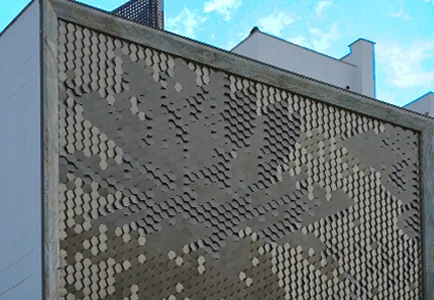
METABLOX™ by Metaguise: A Breakthrough in Parametric Facade Design
At the intersection of culture, craftsmanship, and cutting-edge geometry, METABLOX™ emerges as a bold new direction in architectural innovation. Introduced by Metaguise, this first-of-its-kind parametric facade technology makes its striking debut at the RJ Jewellers flagship store in Jaipur - setting a new benchmark in the world of metal design and modern Indian architecture.
09-04-25 | Facade Innovations
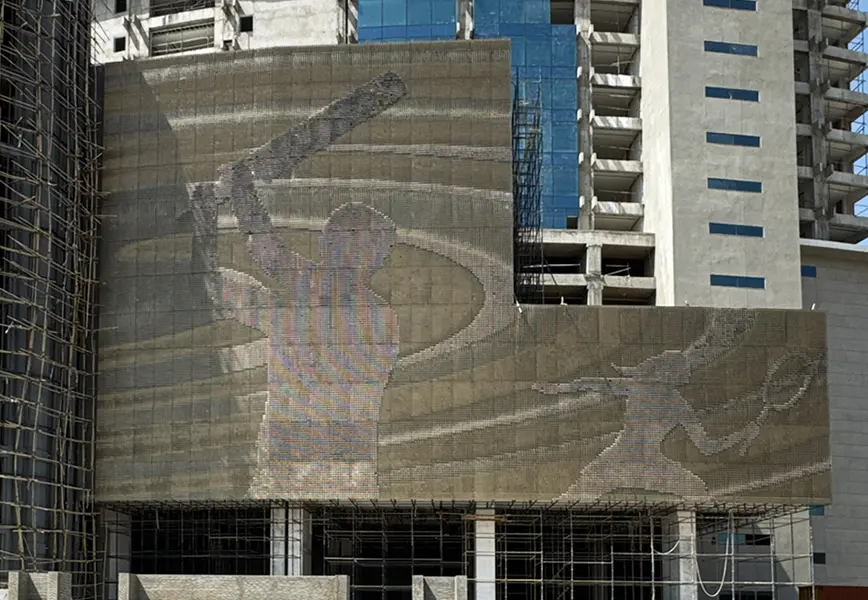
5 Landmark Projects That Used MetaCoin to Transform Facades
When it comes to parametric architecture, MetaCoin stands out as a revolutionary metal coin facade system. Crafted with precision, it offers dynamic aesthetics, adaptability, and a unique identity to structures. Let's delve into five notable projects where MetaCoin has redefined architectural facades.
13-05-25 | Facade Innovations
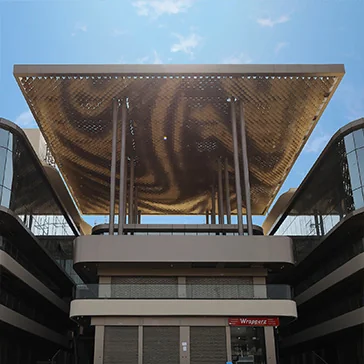
From Code to Construction: How Parametric Facades Are Built
Some buildings just make you look twice. Maybe it’s the way the facade curves. Or how the surface catches the light at different times of day. Often, what you’re seeing is more than just a design, it’s a parametric facade.
10-06-25 | Facade Innovations
Social
Legal
Privacy Policy|Terms & Conditions