



Geometric Facade Patterns: 7 Designs That Work in Indian Light
02-11-26 | Facade Innovations
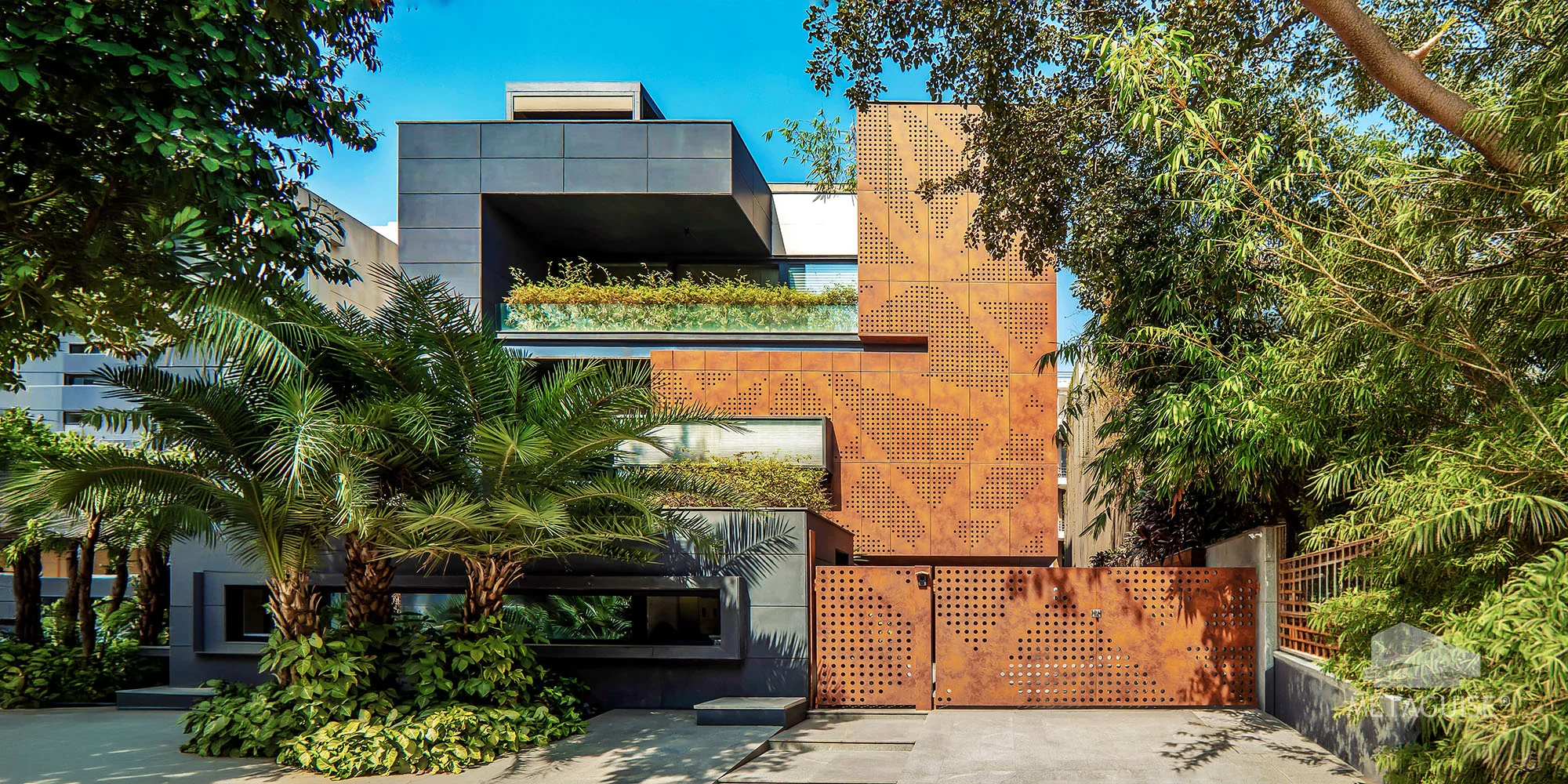
A good geometric facade does something a flat wall cannot: it changes through the day. In the morning it is soft and quiet. At noon, shadows sharpen. By evening, the pattern glows. In a country with strong, direct sunlight, geometry is not only decoration. It is a way to work with light. This guide covers 7 geometric facade patterns, how each behaves in Indian light, where to use them and what to check before you choose one.
Why Geometry Works So Well in India
Indian sun is high, bright and direct for much of the year. Flat surfaces look washed out in that light. Geometric patterns give the sun something to play with: edges catch light, recesses fall into shadow and the facade gains depth without adding colour. Good geometric design can also do real work:- Shade. Depth and projections cut direct sun on the wall behind.
- Airflow. Open patterns let breeze pass.
- Privacy. Pattern density controls what can be seen from outside.
- Identity. A recognisable pattern makes a building memorable.
7 Geometric Facade Patterns
1. Hexagons
Hexagons tile without gaps and feel organic, like honeycomb. They work well as perforated screens, 3D panels and feature walls. A six sided form also reads well from far and near. See the MetaHive system for a hexagon inspired approach.2. Triangles and Pyramids
Triangular and pyramid shaped panels create strong shadow lines that move across the day. Depth is the key: shallow forms give subtle texture, deep forms give dramatic contrast. Explore the MetaPyramid panel.3. Grids and Squares
A clean grid is calm, modern and easy to scale. Varying the depth or opening size of each cell adds rhythm. Grids suit offices, institutions and minimalist homes.4. Folds and Origami Patterns
Folded panels create planes that catch light at different angles. The result is a facade that appears to shift as you walk past. Read about MetaFold and origami in architecture.5. Circles and Coins
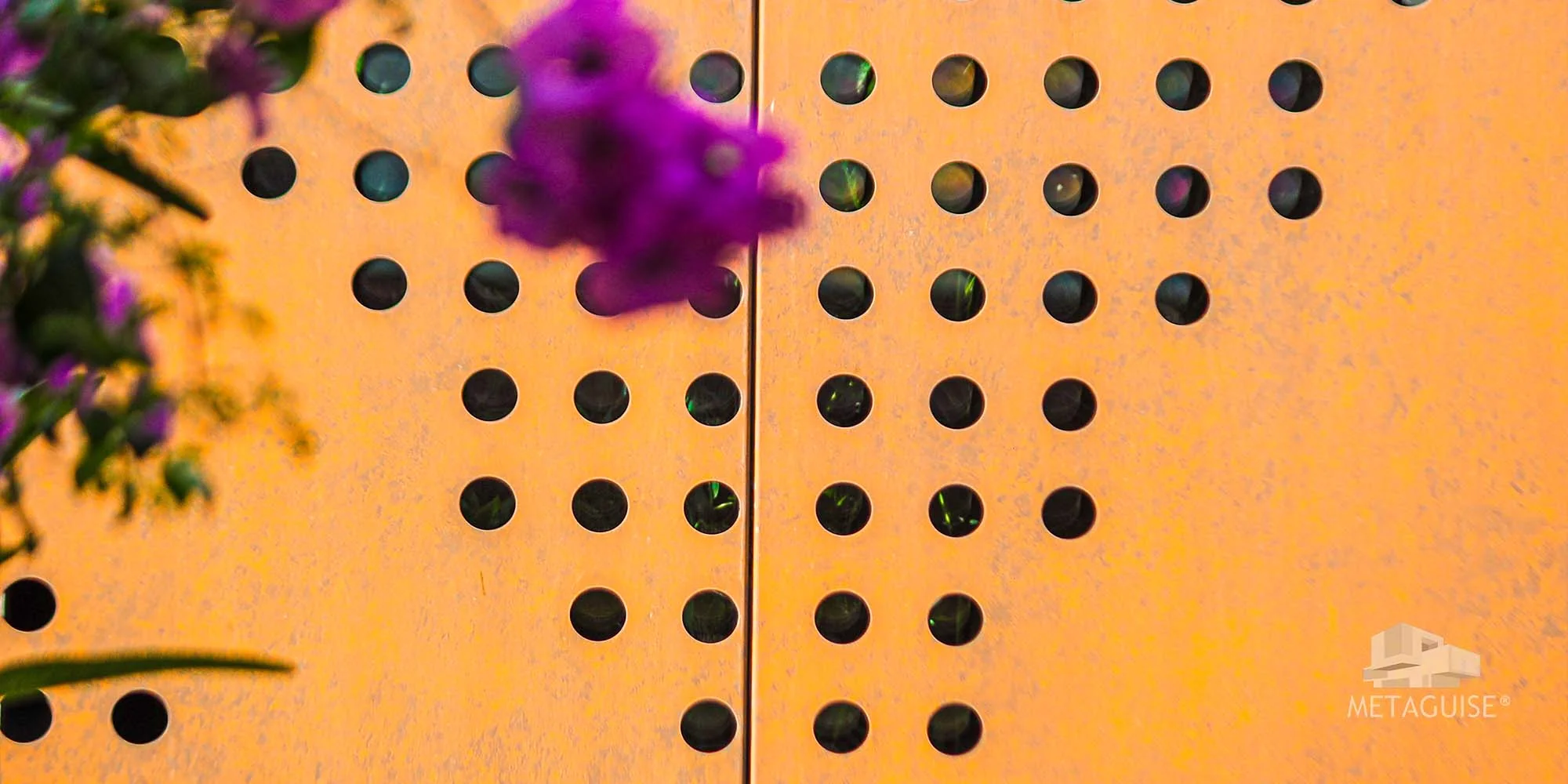
Circular modules create a soft, shimmering surface, especially in metallic finishes. They can be arranged in grids, waves or gradients. See our guides on the MetaCoin facade system and coin facade vs perforated panels.6. Sacred Geometry and Jaali Inspired Patterns
Indian architecture has a long tradition of geometric screens, from jaali work to mandalas. Modern laser cut metal brings these patterns back with precision, giving cultural depth to contemporary buildings. See our guide to laser cut metal facades.7. Gradient and Parametric Patterns
Parametric design uses algorithms to vary a shape across the facade: holes grow bigger, panels tilt gradually, density shifts from open to closed. The result is a flowing, organic pattern. Read our parametric facade design guide and how parametric facades are built.How Sun Angle Changes a Pattern
The same panel looks different on each side of a building.| Orientation | Light behaviour | Pattern tip |
|---|---|---|
| East | Soft, low morning light | Delicate patterns and shallow depth show well |
| South | High, strong sun | Deep horizontal projections and shading patterns |
| West | Low, hot, golden light | Vertical or dense patterns that block low sun |
| North | Even, soft light | Subtle texture, colour and finish do more of the work |
Test your pattern on a sun path study or a physical sample before you commit. Our guide on light and shadow in metal facade design explains how to read this.
Scale: Near and Far
A pattern must work from two distances. From the street, you read the overall form. From the entrance, you see detail and material. Too small a pattern disappears from far away. Too large a pattern looks crude up close. Try mixing a bold large pattern with fine texture inside it.Choosing the Panel Type
| Panel type | Best for | Note |
|---|---|---|
| Perforated or laser cut panels | Screens, feature walls, shading | Pattern controls light, privacy and airflow |
| 3D formed panels | Depth and shadow | Heavier forming, higher fabrication detail |
| Cassette panels with pattern | Clean rainscreen look | See cassette panel systems |
| Fins and louvers in a pattern | Shading and rhythm | See architectural fins design |
For perforation basics, read the power of perforation.
Material and Finish
Aluminium is the most common material for geometric facades because it is light, easy to form and corrosion resistant. The finish shapes the mood: matte for calm, metallic for shimmer, wood effect for warmth. Ask for finish and warranty details. See facade materials compared.Design Tips That Make Patterns Work
- Repeat a motif, then break it once or twice for interest
- Keep structure and joints in mind from the start, since patterns must fit panel sizes
- Plan lighting early. Patterns look stunning at night when lit well
- Do not overload the facade. Use pattern on one or two key surfaces
- Check cost early. Complex custom patterns raise fabrication effort
Common Mistakes
- Choosing a pattern from a render without testing in real sun
- Making holes or details too small to read from the street
- Ignoring cleaning access for deep patterns that collect dust
- Forgetting how joints cut across the pattern
- Using the same pattern on every orientation
Frequently Asked Questions
Which geometric pattern is best for an Indian home?
Hexagons, grids and jaali inspired patterns are popular because they handle strong sun and feel culturally familiar.Can geometric facades reduce heat?
Yes, when depth or perforation provides shade. The effect depends on orientation and design.Are geometric patterns expensive?
Cost depends on pattern complexity, panel type and quantity. Repeating modules are usually more economical than fully custom patterns.Can I create a custom pattern?
Yes. Laser cutting and parametric design allow custom patterns, including brand motifs.Do patterned facades need more cleaning?
Deep or very fine patterns can hold dust. Plan for periodic washing.Create Your Pattern With Metaguise
See patterns and finishes in person at Metaland, our experience centre in Gurugram, or share your elevation and we will help you explore options.Related reads: Backlit Metal Facades; Compound Wall Design With Metal Screens; Solar Shading Facades in India.
02-11-26 | Facade Innovations
A good geometric facade does something a flat wall cannot: it changes through the day. In the morning it is soft and quiet. At noon, shadows sharpen. By evening, the pattern glows. In a country with strong, direct sunlight, geometry is not only decoration. It is a way to work with light. This guide covers 7 geometric facade patterns, how each behaves in Indian light, where to use them and what to check before you choose one.
Why Geometry Works So Well in India
Indian sun is high, bright and direct for much of the year. Flat surfaces look washed out in that light. Geometric patterns give the sun something to play with: edges catch light, recesses fall into shadow and the facade gains depth without adding colour. Good geometric design can also do real work:- Shade. Depth and projections cut direct sun on the wall behind.
- Airflow. Open patterns let breeze pass.
- Privacy. Pattern density controls what can be seen from outside.
- Identity. A recognisable pattern makes a building memorable.
7 Geometric Facade Patterns
1. Hexagons
Hexagons tile without gaps and feel organic, like honeycomb. They work well as perforated screens, 3D panels and feature walls. A six sided form also reads well from far and near. See the MetaHive system for a hexagon inspired approach.2. Triangles and Pyramids
Triangular and pyramid shaped panels create strong shadow lines that move across the day. Depth is the key: shallow forms give subtle texture, deep forms give dramatic contrast. Explore the MetaPyramid panel.3. Grids and Squares
A clean grid is calm, modern and easy to scale. Varying the depth or opening size of each cell adds rhythm. Grids suit offices, institutions and minimalist homes.4. Folds and Origami Patterns
Folded panels create planes that catch light at different angles. The result is a facade that appears to shift as you walk past. Read about MetaFold and origami in architecture.5. Circles and Coins
Circular modules create a soft, shimmering surface, especially in metallic finishes. They can be arranged in grids, waves or gradients. See our guides on the MetaCoin facade system and coin facade vs perforated panels.6. Sacred Geometry and Jaali Inspired Patterns
Indian architecture has a long tradition of geometric screens, from jaali work to mandalas. Modern laser cut metal brings these patterns back with precision, giving cultural depth to contemporary buildings. See our guide to laser cut metal facades.7. Gradient and Parametric Patterns
Parametric design uses algorithms to vary a shape across the facade: holes grow bigger, panels tilt gradually, density shifts from open to closed. The result is a flowing, organic pattern. Read our parametric facade design guide and how parametric facades are built.How Sun Angle Changes a Pattern
The same panel looks different on each side of a building.| Orientation | Light behaviour | Pattern tip |
|---|---|---|
| East | Soft, low morning light | Delicate patterns and shallow depth show well |
| South | High, strong sun | Deep horizontal projections and shading patterns |
| West | Low, hot, golden light | Vertical or dense patterns that block low sun |
| North | Even, soft light | Subtle texture, colour and finish do more of the work |
Test your pattern on a sun path study or a physical sample before you commit. Our guide on light and shadow in metal facade design explains how to read this.
Scale: Near and Far
A pattern must work from two distances. From the street, you read the overall form. From the entrance, you see detail and material. Too small a pattern disappears from far away. Too large a pattern looks crude up close. Try mixing a bold large pattern with fine texture inside it.Choosing the Panel Type
| Panel type | Best for | Note |
|---|---|---|
| Perforated or laser cut panels | Screens, feature walls, shading | Pattern controls light, privacy and airflow |
| 3D formed panels | Depth and shadow | Heavier forming, higher fabrication detail |
| Cassette panels with pattern | Clean rainscreen look | See cassette panel systems |
| Fins and louvers in a pattern | Shading and rhythm | See architectural fins design |
For perforation basics, read the power of perforation.
Material and Finish
Aluminium is the most common material for geometric facades because it is light, easy to form and corrosion resistant. The finish shapes the mood: matte for calm, metallic for shimmer, wood effect for warmth. Ask for finish and warranty details. See facade materials compared.Design Tips That Make Patterns Work
- Repeat a motif, then break it once or twice for interest
- Keep structure and joints in mind from the start, since patterns must fit panel sizes
- Plan lighting early. Patterns look stunning at night when lit well
- Do not overload the facade. Use pattern on one or two key surfaces
- Check cost early. Complex custom patterns raise fabrication effort
Common Mistakes
- Choosing a pattern from a render without testing in real sun
- Making holes or details too small to read from the street
- Ignoring cleaning access for deep patterns that collect dust
- Forgetting how joints cut across the pattern
- Using the same pattern on every orientation
Frequently Asked Questions
Which geometric pattern is best for an Indian home?
Hexagons, grids and jaali inspired patterns are popular because they handle strong sun and feel culturally familiar.Can geometric facades reduce heat?
Yes, when depth or perforation provides shade. The effect depends on orientation and design.Are geometric patterns expensive?
Cost depends on pattern complexity, panel type and quantity. Repeating modules are usually more economical than fully custom patterns.Can I create a custom pattern?
Yes. Laser cutting and parametric design allow custom patterns, including brand motifs.Do patterned facades need more cleaning?
Deep or very fine patterns can hold dust. Plan for periodic washing.Create Your Pattern With Metaguise
See patterns and finishes in person at Metaland, our experience centre in Gurugram, or share your elevation and we will help you explore options.Related reads: Backlit Metal Facades; Compound Wall Design With Metal Screens; Solar Shading Facades in India.
Related Articles
The Rise of Parametric facades: Designing with Algorithmic Elegance
A revolutionary parametric facade system designed to elevate architectural aesthetics. Crafted with premium metals and enhanced with MetaSurface finishes, MetaCoin offers unparalleled customizability, from the shape and size of each element to its color and arrangement. Its dynamic design reacts to light and perspective, creating ever-changing visual effects. Ideal for contemporary and iconic structures, MetaCoin transforms facades into captivating works of art that are sustainable, durable, and visually stunning.
01-04-25 | Facade Innovations
METABLOX™ by Metaguise: A Breakthrough in Parametric Facade Design
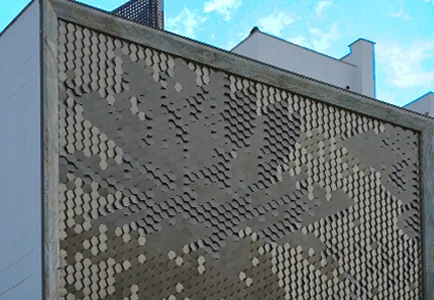
At the intersection of culture, craftsmanship, and cutting-edge geometry, METABLOX™ emerges as a bold new direction in architectural innovation. Introduced by Metaguise, this first-of-its-kind parametric facade technology makes its striking debut at the RJ Jewellers flagship store in Jaipur - setting a new benchmark in the world of metal design and modern Indian architecture.
09-04-25 | Facade Innovations
5 Landmark Projects That Used MetaCoin to Transform Facades
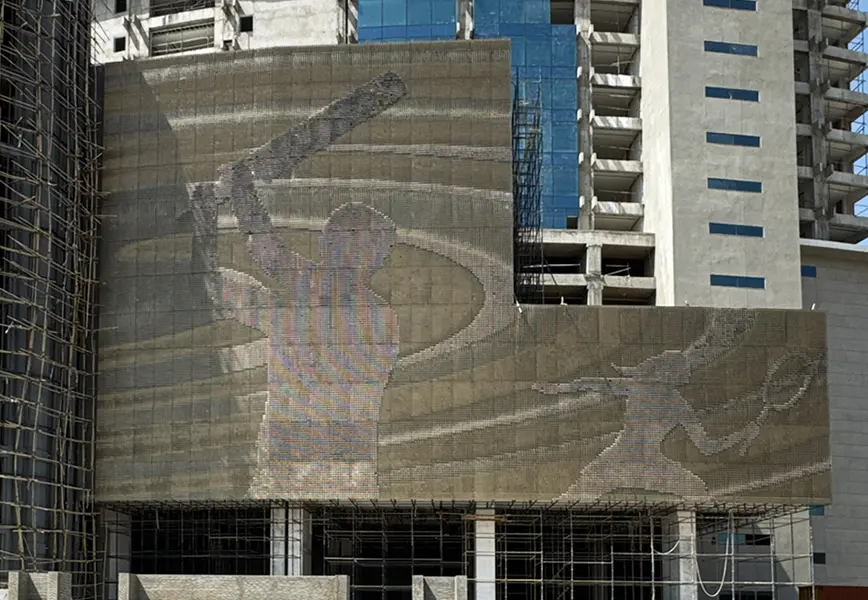
When it comes to parametric architecture, MetaCoin stands out as a revolutionary metal coin facade system. Crafted with precision, it offers dynamic aesthetics, adaptability, and a unique identity to structures. Let's delve into five notable projects where MetaCoin has redefined architectural facades.
13-05-25 | Facade Innovations
From Code to Construction: How Parametric Facades Are Built
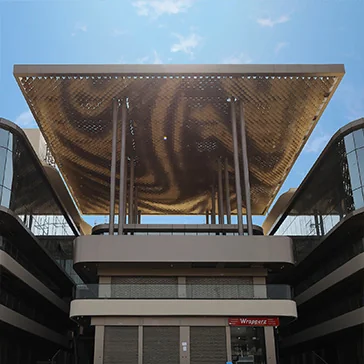
Some buildings just make you look twice. Maybe it’s the way the facade curves. Or how the surface catches the light at different times of day. Often, what you’re seeing is more than just a design, it’s a parametric facade.
10-06-25 | Facade Innovations
Social
Legal
Privacy Policy|Terms & Conditions