



Miraj Stadium Rajasthan Facade: How Thousands of Gold Coins Turned a Cricket Stadium Into Art
07-10-26 | Project Highlights
Most stadiums announce themselves with size. A few announce themselves with an idea.
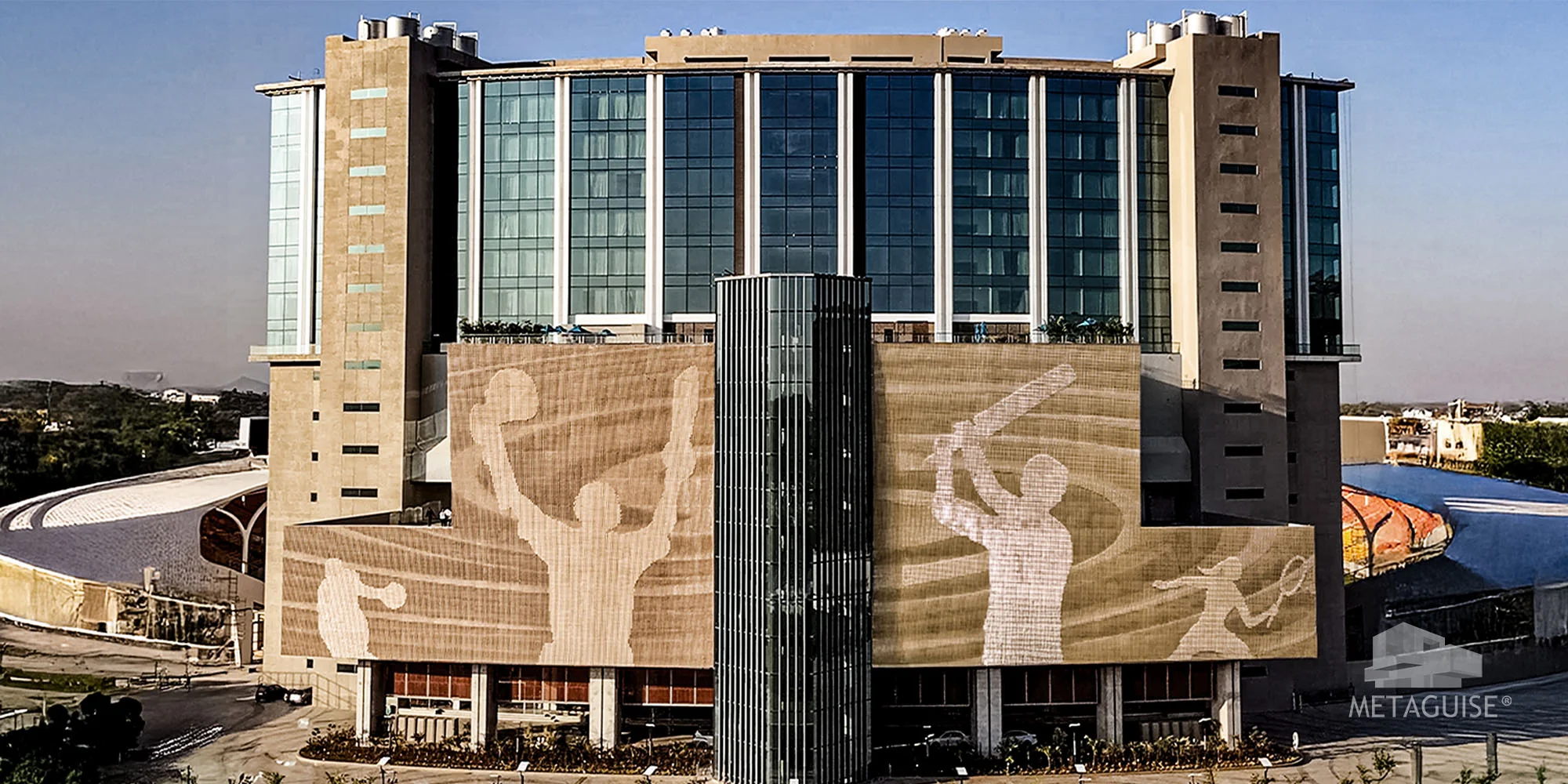
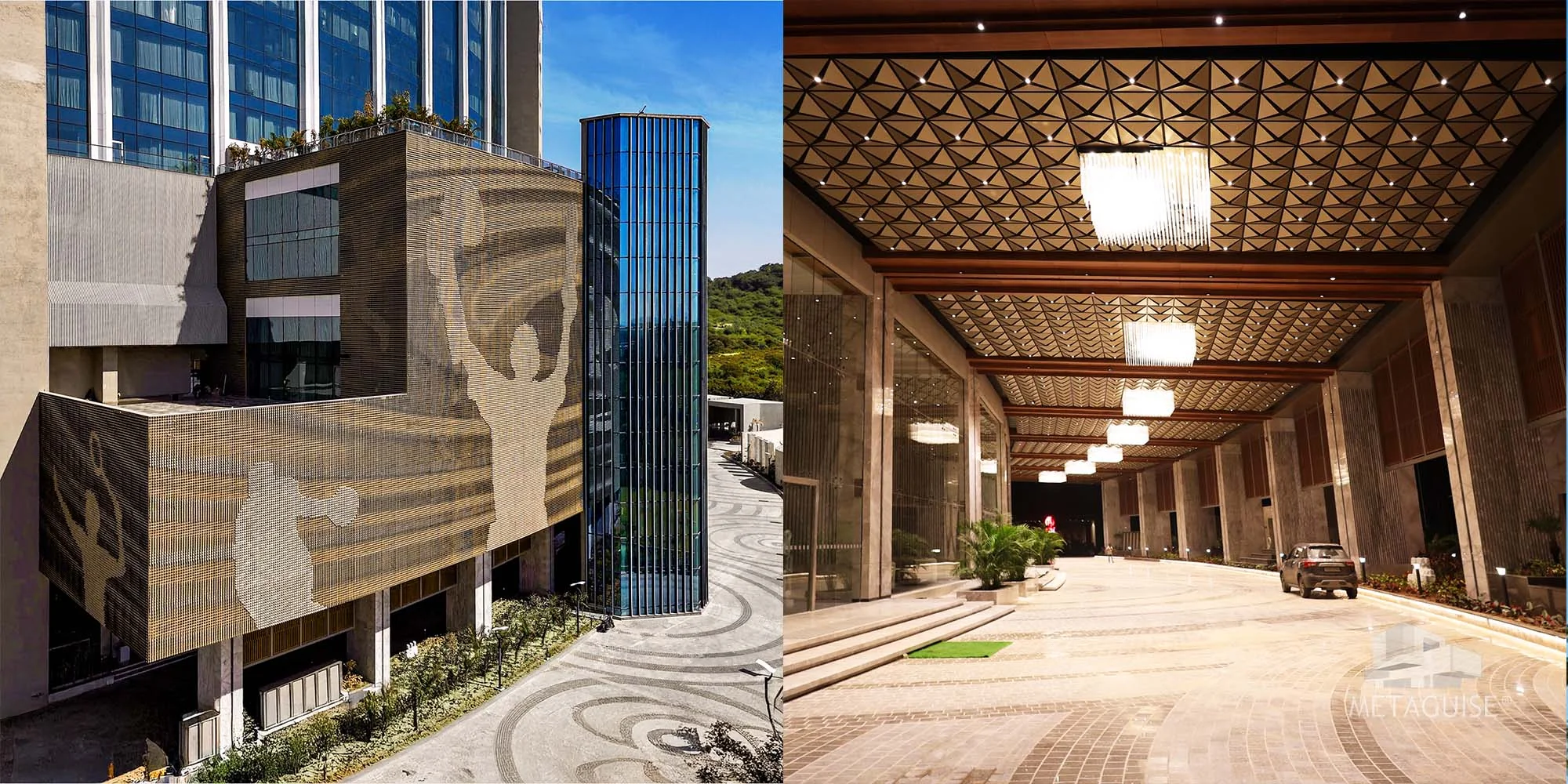
The Miraj Stadium in Rajasthan belongs in the second group. Instead of a plain concrete bowl or a generic sheet of cladding, its facade is built from gold toned coin motifs that reference cricketing moments. From a distance, the building shimmers. Up close, every coin catches the light on its own.
This article looks at the Miraj Stadium facade in Rajasthan: the systems behind it, the design thinking, and what the project teaches anyone planning a stadium facade design or any other large venue.
Quick Answer: What Is the Miraj Stadium Facade?
The Miraj Cricket Stadium in Rajasthan, located in Udaipur, is clad in MetaCoin and MetaCryst systems. Its facade uses gold toned coin motifs that reference cricketing moments. Metaguise designed, fabricated and installed the facade.
- Location: Udaipur, Rajasthan
- Systems: MetaCoin and MetaCryst
- Look: gold toned coin motifs referencing cricketing moments
- Delivered by: Metaguise, from design through fabrication to installation
- Project type: large scale sports and institutional facade
You can see the full gallery on the Miraj Stadium project page.
Why a Stadium Facade Is a Different Kind of Problem
Designing a facade for an office tower and designing one for a stadium may look like the same job. They are not.
Scale. A stadium facade is wide and continuous. Any inconsistency in colour or alignment is visible from far away, and there is nowhere to hide it.
Viewing distance. People see the building from a kilometre away on the approach road, from fifty metres at the gate, and from arm's length at the ticket counter. The facade has to work at all three distances.
Crowds and events. Tens of thousands of people arrive in a short window. The facade is the backdrop for photographs, broadcasts and social media posts. It has to look good in a phone camera as much as in a drawing.
Exposure. A stadium is often an open site with strong wind, heavy sun and little shelter. The facade carries those conditions every day, not just on match days.
Identity. A stadium is a civic landmark. People associate a city with it. The facade is not decoration, it is the brand of the place.
Our wider work on landmark buildings is collected in 5 landmark projects that used MetaCoin to transform facades.
The Idea: Gold Coins and Cricketing Moments
Every strong facade starts with a story that fits the building. At Miraj, the story is told in gold toned coins.
A coin is simple geometry, a circle, and that simplicity is its strength. A circle reads clearly from far away. It repeats well. It catches light from almost any angle. And in the context of cricket, it carries meaning. The toss is the first ritual of any match, and gold itself stands for achievement, trophies and milestones.
The motifs on the Miraj facade reference cricketing moments rather than simply repeating a pattern. That is what turns a clad wall into a narrative surface. A viewer does not need to decode every detail to feel that the building has something to say.
This is the principle behind narrative facades generally. If the idea behind a building can be felt in five seconds, people remember it. We explore the broader trend in narrative facades and how brands turn buildings into stories.
The Systems: MetaCoin and MetaCryst
MetaCoin: The Circular Module
MetaCoin is a circular module system from Metaguise. Each coin can be arranged in rows, clusters or flowing patterns, and the surface responds to light as the viewer moves. In motion, the wall appears to shimmer.
If you want the full technical story of the system, see our complete guide to the MetaCoin coin cladding system.
MetaCryst: The Faceted Counterpart
MetaCryst is a modular, custom-engineered 3D faceted metal panel system. Each panel's faceted geometry catches light and shifts with perspective, which turns flat surfaces and under-ceilings into sculpted, dimensional compositions.
Used alongside MetaCoin, it adds a second texture. Where coins give a soft, rounded shimmer, facets give sharper highlights and shadow. Together, they let a large facade avoid monotony without losing coherence.
Designing for Distance: Three Viewing Zones
One of the biggest lessons from a stadium project is that scale of detail must match distance.
Far view, from the road or the city. Here, only large patterns and overall colour register. Individual coins merge into a shimmering field. The overall silhouette, the rhythm of light and dark, and the colour temperature matter most.
Mid view, near the gates and plaza. Now the module size becomes visible. The coin pattern, the spacing and the transitions between sections read clearly. This is where most photographs are taken.
Near view, at the concourse. At arm's length people see edges, finish quality and fixing details. A scratched coating or sloppy joint is impossible to miss here.
A good designer tests the facade in all three zones, using renders, then physical samples, then a mock-up. Skipping any of them means you only know how the wall looks in one view.
Engineering Challenges on Large Venues
Beauty gets the attention. Engineering decides whether the facade lasts.
Wind
Stadiums are tall, wide and often exposed. Wind loads on cladding can be significant, especially at edges and corners where pressure is highest. Panels, sub-frames and fixings all need to be designed for local wind speed and building height, with calculations that can be reviewed. Our explainer on how metal facade engineering works shows how loads travel from panel to structure.
Heat and Thermal Movement
Rajasthan summers are severe. Metal expands and contracts as it heats and cools, and long runs of cladding need properly designed joints so movement does not cause buckling or noise. Good detailing allows each panel to move slightly without losing its alignment.
Colour Consistency Across Thousands of Modules
When a facade uses thousands of repeated modules, the eye notices differences quickly. A slight shift in gold tone between batches shows as a stripe across the wall. This is why a controlled coating process, batch tracking and quality checks matter. Read about how we think about finishes on our MetaSurface page.
Dust and Maintenance
Dust is routine in Rajasthan. The facade has to be easy to wash and its design should avoid pockets where dust and water collect. Access for cleaning crews should be planned at the start, not discovered later.
Manufacturing and Installation at Scale
A project with thousands of repeated modules is as much a logistics exercise as a design one.
Fabrication. Each module is cut, formed and finished to tight tolerances. Consistent output depends on proper tooling, process control and quality inspection.
Numbering and packing. Panels are labelled and packed in installation sequence, so the crew finds what it needs without searching. Damaged finish in transit is expensive and slow to fix.
Installation sequencing. Work at height needs careful planning of access, safety and weather windows. A large facade is installed in sections so that each completed zone can be inspected and signed off.
Site supervision. On large projects the person who understands the design should be on site to solve problems fast.
Because Metaguise designs, fabricates and installs, these steps stay under one roof. That cuts handover gaps, which are the most common cause of delay on big projects. We describe our full process in why the Metaguise facade process is the benchmark.
Lighting and the Match Night Experience
A stadium comes alive after dark. A well-designed facade has to work with light, not against it.
Gold toned metal reflects warm light beautifully, which is why warm white and amber lighting suits it. Grazing light along the surface exposes the coin texture and creates movement. Floodlighting that washes directly across the face flattens the pattern.
Think too about cameras. Broadcasts, drone shots and phone photos all capture the facade in different ways. Lighting that looks right to the eye can overexpose on camera, so test with real devices.
8 Lessons for Any Large Venue Facade
The Miraj Stadium offers lessons that apply to arenas, convention centres, airports, malls and any large civic building.
- Start with an idea people can feel in five seconds. Story beats decoration.
- Use simple geometry at scale. Circles, hexagons and clean facets read clearly from far away.
- Design for three viewing distances. Far, mid and near each need attention.
- Engineer for wind and heat early. These are not afterthoughts.
- Control colour across batches. At scale, consistency is the design.
- Plan maintenance access from day one. A facade you cannot clean will not stay beautiful.
- Build a mock-up. Judge the design in daylight at full size.
- Choose a team that can deliver the whole chain. Design, fabrication and installation work best when they speak to each other.
Other Stadium Work by Metaguise
Miraj is not our only stadium facade. Metaguise has also worked on the Barabti Stadium for the Odisha Cricket Association and the Himachal Stadium for the Government of Himachal Pradesh, among other institutional and commercial projects.
Large venues are a natural fit for custom systems, because the scale allows an idea to repeat and build, which is where facades like MetaCoin are strongest. If you are weighing a perforated screen against a modular coin system for a big building, read our comparison of coin facade versus perforated panels.
How Much Does a Stadium Facade Cost?
There is no single number for a stadium, because cost depends on area, system, finish, height, access and engineering requirements. As a reference point, Metaguise installed systems typically fall between INR 800 and INR 2,500 per sq ft, depending on the system and complexity.
Large projects benefit from repetition, because tooling and set-up costs are spread across thousands of identical modules. But they also add costs such as scaffolding or cradles, logistics, site storage and extended supervision. Our metal facade cost guide goes through each cost driver.
Checklist: Briefing a Facade Company for a Stadium or Arena
Before you approach a facade company for a large venue, prepare answers to these questions.
- What story or identity should the building express?
- What are the main viewing distances and angles?
- What are the local wind, heat, dust and rain conditions?
- What fire, safety and structural requirements apply?
- What is the expected life of the facade and finish?
- How will the facade be cleaned and maintained?
- What is the construction programme and handover date?
- What is the budget range, including access and lighting?
Frequently Asked Questions
Where is the Miraj Stadium located?
The Miraj Cricket Stadium is in Rajasthan, in Udaipur. Its facade was designed, fabricated and installed by Metaguise using MetaCoin and MetaCryst systems.
What materials and systems are used on the Miraj Stadium facade?
The facade uses MetaCoin, a circular modular system, and MetaCryst, a modular 3D faceted metal panel system. The look is gold toned coin motifs that reference cricketing moments.
Who designed the Miraj Stadium facade?
Metaguise handled design, fabrication and installation of the facade, which means the same team managed the concept, engineering and delivery of the cladding.
Why use coins on a cricket stadium facade?
Circles read clearly from far away, repeat well and catch light from many angles. A coin also connects to the ritual of the toss, and gold toned finishes suggest achievement and milestones.
How do facades handle wind on large stadiums?
Panels, sub-frames and fixings are engineered for local wind speed and building height, with extra attention at corners and edges. Calculations should be available for review before approval.
Can similar facades be used on other buildings?
Yes. MetaCoin and MetaCryst suit stadiums, hospitality, retail, experience centres and homes. Scale, module size and finish are adjusted to the building.
How do I start a stadium or large venue facade project?
Share your drawings, location, budget range and design goals with a facade company that can design, fabricate and install. Request a mock-up before full production.
Planning a Landmark Facade?
A great facade begins with a clear idea and ends with careful engineering. If you are planning a stadium, a campus or any large public building, talk to our team about concept, systems and delivery.
Reach out through the Metaguise contact page or browse more of our completed facade projects.
07-10-26 | Project Highlights
Most stadiums announce themselves with size. A few announce themselves with an idea.
The Miraj Stadium in Rajasthan belongs in the second group. Instead of a plain concrete bowl or a generic sheet of cladding, its facade is built from gold toned coin motifs that reference cricketing moments. From a distance, the building shimmers. Up close, every coin catches the light on its own.
This article looks at the Miraj Stadium facade in Rajasthan: the systems behind it, the design thinking, and what the project teaches anyone planning a stadium facade design or any other large venue.
Quick Answer: What Is the Miraj Stadium Facade?
The Miraj Cricket Stadium in Rajasthan, located in Udaipur, is clad in MetaCoin and MetaCryst systems. Its facade uses gold toned coin motifs that reference cricketing moments. Metaguise designed, fabricated and installed the facade.
- Location: Udaipur, Rajasthan
- Systems: MetaCoin and MetaCryst
- Look: gold toned coin motifs referencing cricketing moments
- Delivered by: Metaguise, from design through fabrication to installation
- Project type: large scale sports and institutional facade
You can see the full gallery on the Miraj Stadium project page.
Why a Stadium Facade Is a Different Kind of Problem
Designing a facade for an office tower and designing one for a stadium may look like the same job. They are not.
Scale. A stadium facade is wide and continuous. Any inconsistency in colour or alignment is visible from far away, and there is nowhere to hide it.
Viewing distance. People see the building from a kilometre away on the approach road, from fifty metres at the gate, and from arm's length at the ticket counter. The facade has to work at all three distances.
Crowds and events. Tens of thousands of people arrive in a short window. The facade is the backdrop for photographs, broadcasts and social media posts. It has to look good in a phone camera as much as in a drawing.
Exposure. A stadium is often an open site with strong wind, heavy sun and little shelter. The facade carries those conditions every day, not just on match days.
Identity. A stadium is a civic landmark. People associate a city with it. The facade is not decoration, it is the brand of the place.
Our wider work on landmark buildings is collected in 5 landmark projects that used MetaCoin to transform facades.
The Idea: Gold Coins and Cricketing Moments
Every strong facade starts with a story that fits the building. At Miraj, the story is told in gold toned coins.
A coin is simple geometry, a circle, and that simplicity is its strength. A circle reads clearly from far away. It repeats well. It catches light from almost any angle. And in the context of cricket, it carries meaning. The toss is the first ritual of any match, and gold itself stands for achievement, trophies and milestones.
The motifs on the Miraj facade reference cricketing moments rather than simply repeating a pattern. That is what turns a clad wall into a narrative surface. A viewer does not need to decode every detail to feel that the building has something to say.
This is the principle behind narrative facades generally. If the idea behind a building can be felt in five seconds, people remember it. We explore the broader trend in narrative facades and how brands turn buildings into stories.
The Systems: MetaCoin and MetaCryst
MetaCoin: The Circular Module
MetaCoin is a circular module system from Metaguise. Each coin can be arranged in rows, clusters or flowing patterns, and the surface responds to light as the viewer moves. In motion, the wall appears to shimmer.
If you want the full technical story of the system, see our complete guide to the MetaCoin coin cladding system.
MetaCryst: The Faceted Counterpart
MetaCryst is a modular, custom-engineered 3D faceted metal panel system. Each panel's faceted geometry catches light and shifts with perspective, which turns flat surfaces and under-ceilings into sculpted, dimensional compositions.
Used alongside MetaCoin, it adds a second texture. Where coins give a soft, rounded shimmer, facets give sharper highlights and shadow. Together, they let a large facade avoid monotony without losing coherence.
Designing for Distance: Three Viewing Zones
One of the biggest lessons from a stadium project is that scale of detail must match distance.
Far view, from the road or the city. Here, only large patterns and overall colour register. Individual coins merge into a shimmering field. The overall silhouette, the rhythm of light and dark, and the colour temperature matter most.
Mid view, near the gates and plaza. Now the module size becomes visible. The coin pattern, the spacing and the transitions between sections read clearly. This is where most photographs are taken.
Near view, at the concourse. At arm's length people see edges, finish quality and fixing details. A scratched coating or sloppy joint is impossible to miss here.
A good designer tests the facade in all three zones, using renders, then physical samples, then a mock-up. Skipping any of them means you only know how the wall looks in one view.
Engineering Challenges on Large Venues
Beauty gets the attention. Engineering decides whether the facade lasts.
Wind
Stadiums are tall, wide and often exposed. Wind loads on cladding can be significant, especially at edges and corners where pressure is highest. Panels, sub-frames and fixings all need to be designed for local wind speed and building height, with calculations that can be reviewed. Our explainer on how metal facade engineering works shows how loads travel from panel to structure.
Heat and Thermal Movement
Rajasthan summers are severe. Metal expands and contracts as it heats and cools, and long runs of cladding need properly designed joints so movement does not cause buckling or noise. Good detailing allows each panel to move slightly without losing its alignment.
Colour Consistency Across Thousands of Modules
When a facade uses thousands of repeated modules, the eye notices differences quickly. A slight shift in gold tone between batches shows as a stripe across the wall. This is why a controlled coating process, batch tracking and quality checks matter. Read about how we think about finishes on our MetaSurface page.
Dust and Maintenance
Dust is routine in Rajasthan. The facade has to be easy to wash and its design should avoid pockets where dust and water collect. Access for cleaning crews should be planned at the start, not discovered later.
Manufacturing and Installation at Scale
A project with thousands of repeated modules is as much a logistics exercise as a design one.
Fabrication. Each module is cut, formed and finished to tight tolerances. Consistent output depends on proper tooling, process control and quality inspection.
Numbering and packing. Panels are labelled and packed in installation sequence, so the crew finds what it needs without searching. Damaged finish in transit is expensive and slow to fix.
Installation sequencing. Work at height needs careful planning of access, safety and weather windows. A large facade is installed in sections so that each completed zone can be inspected and signed off.
Site supervision. On large projects the person who understands the design should be on site to solve problems fast.
Because Metaguise designs, fabricates and installs, these steps stay under one roof. That cuts handover gaps, which are the most common cause of delay on big projects. We describe our full process in why the Metaguise facade process is the benchmark.
Lighting and the Match Night Experience
A stadium comes alive after dark. A well-designed facade has to work with light, not against it.
Gold toned metal reflects warm light beautifully, which is why warm white and amber lighting suits it. Grazing light along the surface exposes the coin texture and creates movement. Floodlighting that washes directly across the face flattens the pattern.
Think too about cameras. Broadcasts, drone shots and phone photos all capture the facade in different ways. Lighting that looks right to the eye can overexpose on camera, so test with real devices.
8 Lessons for Any Large Venue Facade
The Miraj Stadium offers lessons that apply to arenas, convention centres, airports, malls and any large civic building.
- Start with an idea people can feel in five seconds. Story beats decoration.
- Use simple geometry at scale. Circles, hexagons and clean facets read clearly from far away.
- Design for three viewing distances. Far, mid and near each need attention.
- Engineer for wind and heat early. These are not afterthoughts.
- Control colour across batches. At scale, consistency is the design.
- Plan maintenance access from day one. A facade you cannot clean will not stay beautiful.
- Build a mock-up. Judge the design in daylight at full size.
- Choose a team that can deliver the whole chain. Design, fabrication and installation work best when they speak to each other.
Other Stadium Work by Metaguise
Miraj is not our only stadium facade. Metaguise has also worked on the Barabti Stadium for the Odisha Cricket Association and the Himachal Stadium for the Government of Himachal Pradesh, among other institutional and commercial projects.
Large venues are a natural fit for custom systems, because the scale allows an idea to repeat and build, which is where facades like MetaCoin are strongest. If you are weighing a perforated screen against a modular coin system for a big building, read our comparison of coin facade versus perforated panels.
How Much Does a Stadium Facade Cost?
There is no single number for a stadium, because cost depends on area, system, finish, height, access and engineering requirements. As a reference point, Metaguise installed systems typically fall between INR 800 and INR 2,500 per sq ft, depending on the system and complexity.
Large projects benefit from repetition, because tooling and set-up costs are spread across thousands of identical modules. But they also add costs such as scaffolding or cradles, logistics, site storage and extended supervision. Our metal facade cost guide goes through each cost driver.
Checklist: Briefing a Facade Company for a Stadium or Arena
Before you approach a facade company for a large venue, prepare answers to these questions.
- What story or identity should the building express?
- What are the main viewing distances and angles?
- What are the local wind, heat, dust and rain conditions?
- What fire, safety and structural requirements apply?
- What is the expected life of the facade and finish?
- How will the facade be cleaned and maintained?
- What is the construction programme and handover date?
- What is the budget range, including access and lighting?
Frequently Asked Questions
Where is the Miraj Stadium located?
The Miraj Cricket Stadium is in Rajasthan, in Udaipur. Its facade was designed, fabricated and installed by Metaguise using MetaCoin and MetaCryst systems.
What materials and systems are used on the Miraj Stadium facade?
The facade uses MetaCoin, a circular modular system, and MetaCryst, a modular 3D faceted metal panel system. The look is gold toned coin motifs that reference cricketing moments.
Who designed the Miraj Stadium facade?
Metaguise handled design, fabrication and installation of the facade, which means the same team managed the concept, engineering and delivery of the cladding.
Why use coins on a cricket stadium facade?
Circles read clearly from far away, repeat well and catch light from many angles. A coin also connects to the ritual of the toss, and gold toned finishes suggest achievement and milestones.
How do facades handle wind on large stadiums?
Panels, sub-frames and fixings are engineered for local wind speed and building height, with extra attention at corners and edges. Calculations should be available for review before approval.
Can similar facades be used on other buildings?
Yes. MetaCoin and MetaCryst suit stadiums, hospitality, retail, experience centres and homes. Scale, module size and finish are adjusted to the building.
How do I start a stadium or large venue facade project?
Share your drawings, location, budget range and design goals with a facade company that can design, fabricate and install. Request a mock-up before full production.
Planning a Landmark Facade?
A great facade begins with a clear idea and ends with careful engineering. If you are planning a stadium, a campus or any large public building, talk to our team about concept, systems and delivery.
Reach out through the Metaguise contact page or browse more of our completed facade projects.
Related Articles
How Kinetic Facades Improve Building Performance and User Experience
Kinetic facades are changing the way buildings behave. Instead of being fixed and static, these facades respond. To sunlight. To wind. Even to how people use the space. They’re not just eye-catching, they’re smart. And when done right, they make buildings more comfortable, more energy-efficient, and honestly, a lot more interesting to be around.
25-05-25 | Project Highlights
Before There Were Copies, There Was Metaguise: The Story of India’s Facade Pioneer
In the world of facade design, trends may come and go, but trailblazers are remembered forever. Metaguise stands as the original pioneer in India’s facade architecture landscape - long before metal facades became a mainstream aesthetic. With over 1800+ projects delivered, Metaguise has set the benchmark for what excellence in metal design truly means.
29-09-25 | Project Highlights
.webp)
Why Metaguise’s Facade Process Is the Benchmark for Architectural Excellence
In a world of shortcuts and surface-level solutions, Metaguise stands alone with a commitment to excellence so precise, it’s been engineered into a 47-step process. This isn’t just project management - it’s a performance ritual that transforms buildings into timeless expressions of facade architecture.
06-10-25 | Project Highlights
Then and Now: How Metaguise Facades from Years Ago Still Stand Flawless Today
At Metaguise, we believe the facade of a building isn’t just its outer layer - it’s its identity. And in today’s design landscape
14-11-25 | Project Highlights
Social
Legal
Privacy Policy|Terms & Conditions