






The Science of Light and Shadow in Metal Facade Design
24-04-26 | Architectural Insights
The Science of Light and Shadow in Metal Facade Design
Stand in front of a truly exceptional building at seven in the morning, then return at noon, and again at golden hour. If the facade looks identical across all three visits, something fundamental has been lost. Architecture's most compelling facades don't present a single fixed image - they perform across time, responding to the sun's arc with the subtlety of a sundial and the drama of theatre lighting. This is where the anatomy of depth in metal facade systems becomes not just technical specification but the very language through which buildings communicate. We're talking about the difference between a surface that reflects light uniformly, like a mirror held flat to the sky, and one that fragments, filters, and choreographs illumination into gradients of brightness and shadow that tell you something new every time you look. For architects designing a flagship retail space, a luxury residential tower, or an institutional campus, understanding how metal panels create depth determines whether your building will photograph well but feel lifeless in person, or whether it will stop people mid-stride, compelling them to pause and trace the play of light across its skin. For real estate developers, it's the difference between a facade that adds asset value through sheer visual magnetism versus one that simply checks the "modern cladding" box on a specification sheet. The mechanics are rooted in geometry and material science, but the outcomes are emotional. A facade with properly engineered depth doesn't just look expensive - it feels considered, intentional, alive. It signals that someone cared enough to think not just about how the building would appear in an architect's rendering, but how it would exist in actual sunlight, actual shadow, actual urban context.
The Science Behind Shadow and Light Modulation
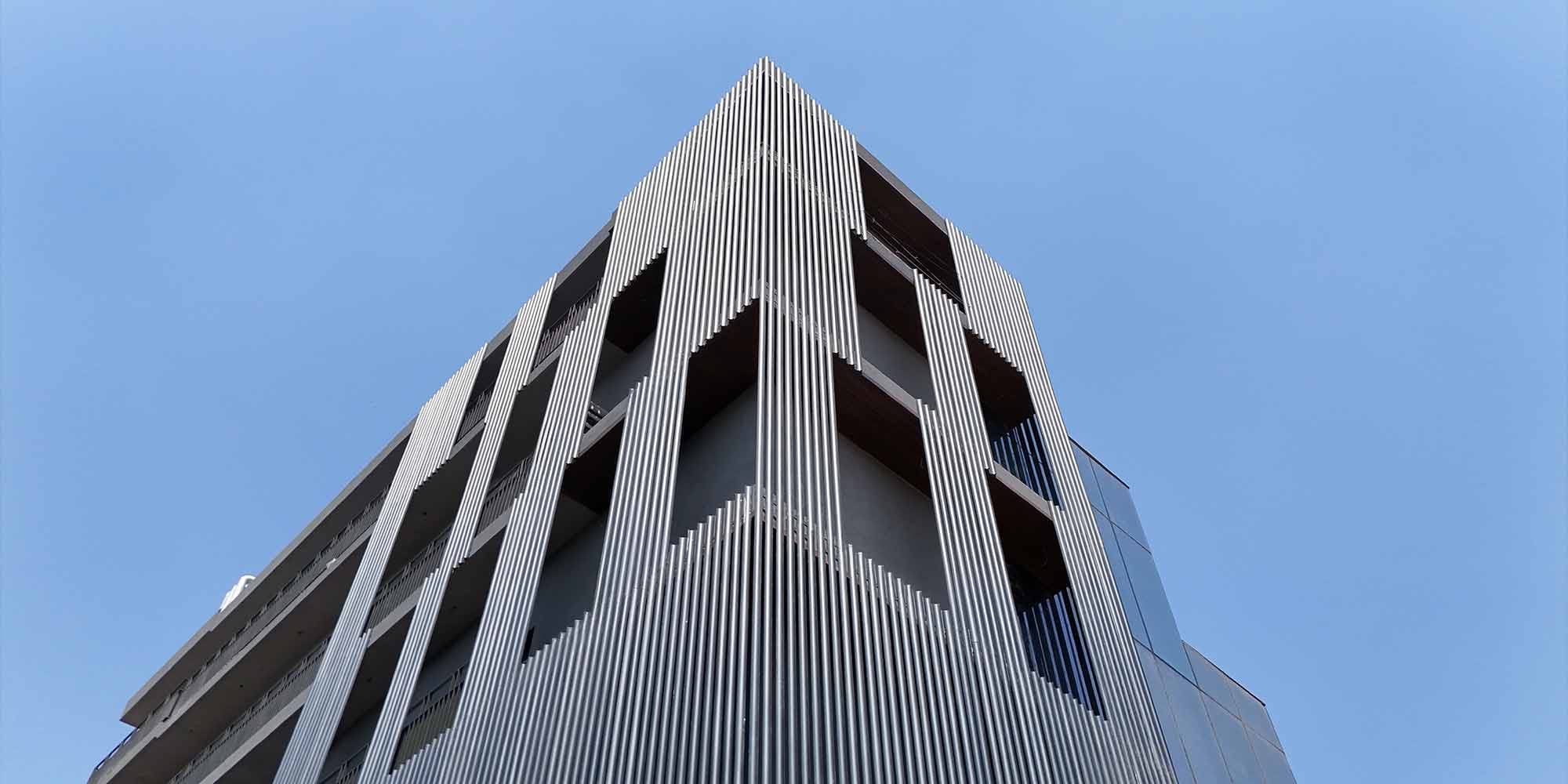
Depth in metal facade systems emerges from the precise manipulation of three core elements: panel geometry, surface treatment, and spatial arrangement. Each plays a distinct role in how light behaves when it encounters the building envelope. Panel Geometry: The Foundation of Three-Dimensionality Flat metal panels mounted flush to a substrate do one thing with light - they reflect it predictably, creating a monolithic surface that reads as a single plane. But introduce even a fifteen-degree angle to that panel, and suddenly you've created two distinct zones: a face that catches direct light and an underside that falls into shadow. Multiply this across hundreds of panels, each angled slightly differently through parametric logic, and you generate a field of micro-environments where light and shadow dance in organized complexity. Systems that allow for dimensional variation - whether through folded profiles, coin-like circular elements, or fin structures projecting perpendicular to the wall - create shadow depth that changes based on solar angle. A façade composed of vertically-oriented fins, for instance, will cast the longest shadows at sunrise and sunset when the sun is low on the horizon, creating dramatic striations across the elevation. At midday, those same fins may appear to flatten visually as the sun strikes from directly overhead, only to regain dimensionality as afternoon progresses. "The three-dimensional configuration of building facades significantly influences both thermal performance and visual perception, with angular variations of 10-30 degrees from the base plane creating optimal conditions for self-shading while maintaining architectural expression." - Building and Environment Journal, Impact of Facade Configuration on Energy Performance and Aesthetics Surface Treatment: Controlling Reflectivity and Diffusion Not all metal surfaces interact with light identically. The choice between a mirror-polished finish, a brushed texture, a matte powder coat, or a perforated screen fundamentally alters how depth is perceived: High-gloss finishes create sharp highlights and dramatic contrast, amplifying the sense of three-dimensionality through specular reflection - but they can also read as harsh in direct tropical sunlight, producing glare that obscures rather than reveals form Brushed or textured surfaces diffuse light more evenly, softening shadow transitions and creating a more muted, sophisticated depth that reveals itself gradually rather than announcing itself immediately Matte finishes with low reflectivity allow the physical geometry of the panels to do the visual work, relying purely on shadow gradients rather than surface shine - this approach often reads as more timeless and less susceptible to trending tastes Perforated panels introduce an additional layer of complexity, where light doesn't just reflect off the surface but passes through it, creating dual depth - the shadow cast by the panel itself, plus the dappled pattern created by light filtering through the perforations onto the substrate behind Premium metal facade systems engineer these surface treatments not as aesthetic afterthoughts but as integral components of the depth strategy. When you see a building where the facade appears to shimmer with subtle tonal shifts as you move past it - that's not accident, that's surface science calibrated to amplify the geometric depth already built into the panel configuration. Spatial Arrangement: Layering and Offset Strategies The most sophisticated depth effects come from layering multiple planes at varying distances from the building's structural envelope. Imagine a primary layer of larger panels set at one depth, with a secondary layer of smaller elements projecting beyond them, and perhaps a third layer of perforated screens recessed behind. Each layer casts shadows onto the others, creating a visual complexity that cannot be achieved through single-plane design. This is where parametric design tools become essential. Manually coordinating hundreds of panels at varying offsets, ensuring structural stability, waterproofing integrity, and visual rhythm, would be prohibitively complex. Computational algorithms can generate offset patterns based on desired shadow density, structural constraints, and aesthetic intent - producing fabrication-ready specifications where every panel's exact position is calculated to contribute to the overall depth narrative.
How India's Light Conditions Amplify Metal Facade Depth
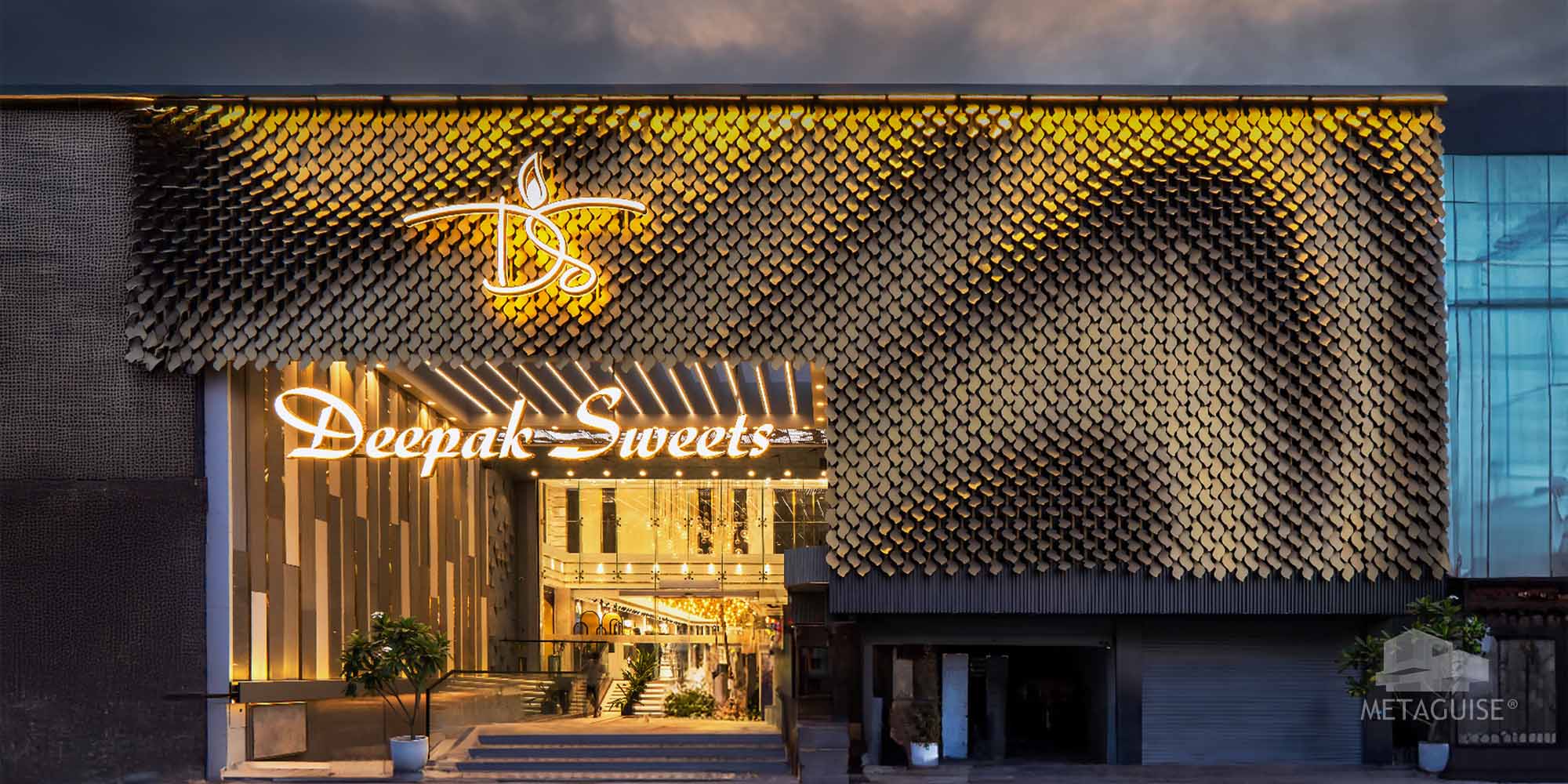
India's geography creates unique opportunities for metal facade depth expression that differ markedly from temperate climates. The intensity of subcontinental sunlight - particularly in northern and western regions - means that even modest geometric variations in panel arrangement can produce dramatic shadow contrasts. In Delhi's summer, when the sun reaches near-vertical angles at midday, facades with horizontal layering or coin-like elements create pools of deep shadow beneath each projecting element, reading almost as voids cut into the elevation. During monsoon season, diffuse cloud cover softens these contrasts, allowing the metallic surface treatments to take visual precedence, revealing subtle tone variations that harsh direct light might wash out. Coastal cities like Mumbai introduce another variable: reflected light from humid atmospheric conditions. Metal facades here can appear to glow from within during late afternoon, as indirect light bounces off moisture particles in the air and illuminates panel undersides that would remain in shadow under drier conditions. Designing for these regional variations requires understanding not just geometry and material, but local climate patterns and how they modulate light throughout the year. The Cultural Dimension of Shadow in Indian Architecture Traditional Indian architecture has always understood the value of shadow as relief - from the deep overhangs of Kerala's Nalukettu homes to the jaali screens of Rajasthani havelis that filter harsh desert sun into dappled interior illumination. Contemporary metal facade systems that create depth through shadow aren't importing foreign design languages but rather translating centuries-old climate-responsive wisdom into modern materials and computational precision. When a stadium in Rajasthan employs thousands of metal coins arranged in gradated density to create shadow patterns that shift across the day, it's not merely decorative - it's a parametric interpretation of jaali logic, where perforation and projection work together to moderate heat while creating visual poetry. The depth created serves both functional and aesthetic purposes, exactly as the best traditional architecture always has.
Technical Specifications That Determine Depth Quality
Not all metal facade systems are created equal when it comes to depth creation. If you're evaluating systems for a project where dimensional richness matters, here are the technical specifications that separate basic cladding from architecturally significant envelope solutions: Panel projection depth range: Look for systems that allow variations from 25mm to 300mm or more from the base plane - insufficient projection range limits shadow-casting potential Angle adjustment capability: The system should permit individual panel angles to be specified independently, not locked into preset orientations - this is what enables parametric non-repetitive patterns Layering compatibility: Can the system support multiple depth layers within a single assembly, with independent weather barriers for each? Single-plane systems cannot achieve true layered depth Panel size modularity: Depth effects are amplified when panel sizes vary across the elevation - systems locked to single module dimensions produce more monotonous shadow patterns Structural capacity for cantilever: Projecting elements need robust fixing systems that can handle wind loads without visible structural bracing that would interrupt the visual clean Perforation customization: If the system includes perforated options, can hole size, pattern density, and distribution be customized, or are you limited to catalog patterns? Finish durability under UV exposure: India's intense sunlight degrades inferior coatings rapidly - depth effects are lost if panels fade unevenly or surface treatments deteriorate These aren't specifications you'll find in generic architectural catalogs. They emerge from working with facade partners who understand that depth is a design outcome requiring systematic engineering support, not a happy accident of clever detailing.
The Parametric Advantage in Depth Orchestration
Here's where we need to talk about the revolution happening at the intersection of computational design and metal fabrication. Traditional facade design worked from repetition - choose a panel type, establish a module, repeat across the elevation. This approach could create texture through repetition, but it couldn't create true depth variation because every panel behaved identically with light. Parametric metal facade systems break this limitation. Using algorithmic design tools, each panel's size, angle, position, and orientation can be calculated as part of a larger pattern where variation is the organizing principle, not uniformity. The result is facades where shadow patterns never repeat exactly, where light creates gradients and transitions rather than hard boundaries, where the elevation reads as a continuous three-dimensional field rather than an assembly of discrete parts. For a luxury residential project, this might mean a facade where panel density and projection depth gradually increase toward the penthouse levels, creating a visual crescendo that reinforces the building's hierarchy. For a retail flagship, it could mean organizing panels to create a "spotlight" effect around the entrance, where maximum depth and shadow contrast draw the eye to the threshold. For an institutional building, parametric depth variation might encode the institution's logo or symbolic geometry into the shadow patterns cast at a specific time of day - say, noon on the winter solstice. From Digital Model to Physical Reality The gap between designing parametric depth and building it comes down to fabrication precision. If your computational model specifies that Panel A-247 should be mounted 187mm from the base plane at a 23-degree angle, but your fabricator can only work to ±10mm tolerances, the intended depth choreography collapses into randomness. This is why integrated design-fabrication workflows matter immensely for depth-critical facades. When the same team generating the parametric model also controls the CNC fabrication and installation sequencing, the digital design intent survives translation into physical reality. Panel positions match the model within millimeter tolerance. Shadow patterns behave as predicted. The building performs as designed, not as approximated.
Learning to See Depth: A Framework for Evaluation
When you're standing in front of a completed building or reviewing facade options for your project, how do you assess whether the depth strategy is truly working? Here's what to look for: Shadow gradient quality: Do shadows transition smoothly from deep to light, or are there harsh boundaries that read as accidental rather than intentional? Consistency of visual rhythm: Does the pattern of depth variation feel organized even when non-repetitive, or does it read as chaotic? Performance across viewing distances: Does the facade reward both distant views (where overall patterns dominate) and close inspection (where individual panel logic becomes clear)? Time-of-day variation: If possible, observe the facade at different times - depth-rich systems will look markedly different at morning, noon, and evening light angles Material aging grace: Are the finishes engineered to age uniformly, maintaining depth clarity over time, or will differential weathering destroy the effect within a few years? Integration with fenestration: How does the facade depth strategy handle the transition to windows and openings - does it feel resolved or awkward? Buildings with genuinely sophisticated depth strategies hold your attention without revealing all their secrets immediately. You notice new details on second and third viewings. You find yourself walking around the building to understand how the facade transforms from different vantage points. That sustained visual interest is the signature of depth done right.
The Brand Philosophy Behind Dimensional Facades
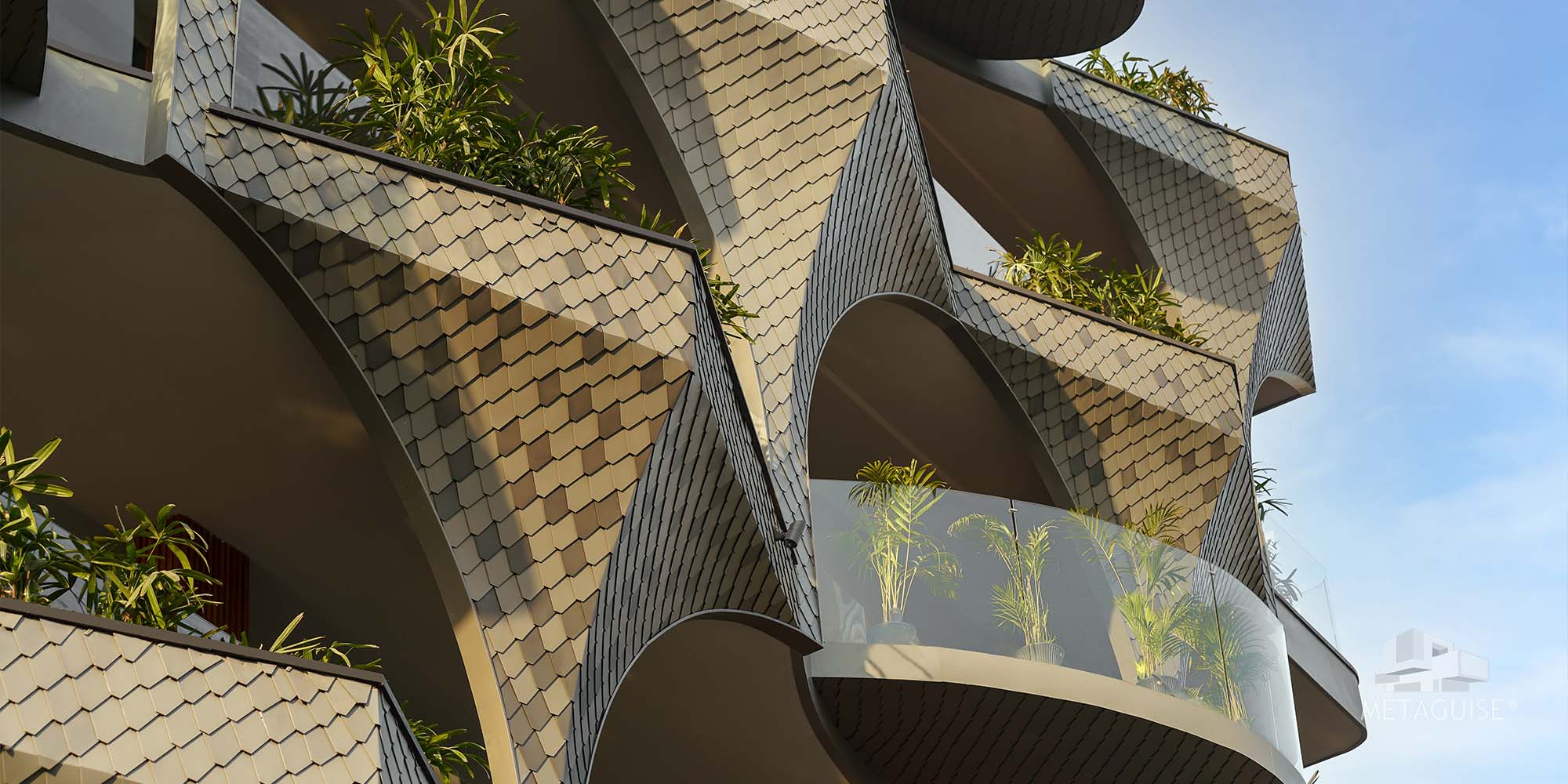
At Metaguise, we've spent over a decade obsessing over this exact anatomy of depth - not as abstract theory but as daily practice across 1800+ projects where architects trusted us to translate their ambitions into built reality. Our approach begins with a fundamental belief: metal facades should perform as three-dimensional installations, not two-dimensional graphics applied to buildings. This philosophy manifests in every system we've developed. MetaSequin, with its overlapping scale-like panels, creates depth through layering where each element casts shadow onto the ones below, generating a continuous shimmer effect as viewing angle shifts. MetaFin uses vertical blade elements at parametrically-varied angles to create shadow striations that compress and expand based on solar position, turning the building envelope into a kind of architectural clock that marks time through light. MetaCoin arranges circular metal elements in gradated density patterns where depth is controlled not through projection but through spacing - tight clusters read as solid shadow zones while dispersed areas allow light to reach the substrate, creating tonal variation across the elevation. What unites these systems is complete integration of design, engineering, and fabrication. When an architect engages us at concept stage with a vision for how their building should interact with light, we don't just provide catalog options - we script parametric models that test thousands of panel configurations,
The Science of Light and Shadow in Metal Facade Design
24-04-26 | Architectural Insights
The Science of Light and Shadow in Metal Facade Design
Stand in front of a truly exceptional building at seven in the morning, then return at noon, and again at golden hour. If the facade looks identical across all three visits, something fundamental has been lost. Architecture's most compelling facades don't present a single fixed image - they perform across time, responding to the sun's arc with the subtlety of a sundial and the drama of theatre lighting. This is where the anatomy of depth in metal facade systems becomes not just technical specification but the very language through which buildings communicate. We're talking about the difference between a surface that reflects light uniformly, like a mirror held flat to the sky, and one that fragments, filters, and choreographs illumination into gradients of brightness and shadow that tell you something new every time you look. For architects designing a flagship retail space, a luxury residential tower, or an institutional campus, understanding how metal panels create depth determines whether your building will photograph well but feel lifeless in person, or whether it will stop people mid-stride, compelling them to pause and trace the play of light across its skin. For real estate developers, it's the difference between a facade that adds asset value through sheer visual magnetism versus one that simply checks the "modern cladding" box on a specification sheet. The mechanics are rooted in geometry and material science, but the outcomes are emotional. A facade with properly engineered depth doesn't just look expensive - it feels considered, intentional, alive. It signals that someone cared enough to think not just about how the building would appear in an architect's rendering, but how it would exist in actual sunlight, actual shadow, actual urban context.
The Science Behind Shadow and Light Modulation
Depth in metal facade systems emerges from the precise manipulation of three core elements: panel geometry, surface treatment, and spatial arrangement. Each plays a distinct role in how light behaves when it encounters the building envelope. Panel Geometry: The Foundation of Three-Dimensionality Flat metal panels mounted flush to a substrate do one thing with light - they reflect it predictably, creating a monolithic surface that reads as a single plane. But introduce even a fifteen-degree angle to that panel, and suddenly you've created two distinct zones: a face that catches direct light and an underside that falls into shadow. Multiply this across hundreds of panels, each angled slightly differently through parametric logic, and you generate a field of micro-environments where light and shadow dance in organized complexity. Systems that allow for dimensional variation - whether through folded profiles, coin-like circular elements, or fin structures projecting perpendicular to the wall - create shadow depth that changes based on solar angle. A façade composed of vertically-oriented fins, for instance, will cast the longest shadows at sunrise and sunset when the sun is low on the horizon, creating dramatic striations across the elevation. At midday, those same fins may appear to flatten visually as the sun strikes from directly overhead, only to regain dimensionality as afternoon progresses. "The three-dimensional configuration of building facades significantly influences both thermal performance and visual perception, with angular variations of 10-30 degrees from the base plane creating optimal conditions for self-shading while maintaining architectural expression." - Building and Environment Journal, Impact of Facade Configuration on Energy Performance and Aesthetics Surface Treatment: Controlling Reflectivity and Diffusion Not all metal surfaces interact with light identically. The choice between a mirror-polished finish, a brushed texture, a matte powder coat, or a perforated screen fundamentally alters how depth is perceived: High-gloss finishes create sharp highlights and dramatic contrast, amplifying the sense of three-dimensionality through specular reflection - but they can also read as harsh in direct tropical sunlight, producing glare that obscures rather than reveals form Brushed or textured surfaces diffuse light more evenly, softening shadow transitions and creating a more muted, sophisticated depth that reveals itself gradually rather than announcing itself immediately Matte finishes with low reflectivity allow the physical geometry of the panels to do the visual work, relying purely on shadow gradients rather than surface shine - this approach often reads as more timeless and less susceptible to trending tastes Perforated panels introduce an additional layer of complexity, where light doesn't just reflect off the surface but passes through it, creating dual depth - the shadow cast by the panel itself, plus the dappled pattern created by light filtering through the perforations onto the substrate behind Premium metal facade systems engineer these surface treatments not as aesthetic afterthoughts but as integral components of the depth strategy. When you see a building where the facade appears to shimmer with subtle tonal shifts as you move past it - that's not accident, that's surface science calibrated to amplify the geometric depth already built into the panel configuration. Spatial Arrangement: Layering and Offset Strategies The most sophisticated depth effects come from layering multiple planes at varying distances from the building's structural envelope. Imagine a primary layer of larger panels set at one depth, with a secondary layer of smaller elements projecting beyond them, and perhaps a third layer of perforated screens recessed behind. Each layer casts shadows onto the others, creating a visual complexity that cannot be achieved through single-plane design. This is where parametric design tools become essential. Manually coordinating hundreds of panels at varying offsets, ensuring structural stability, waterproofing integrity, and visual rhythm, would be prohibitively complex. Computational algorithms can generate offset patterns based on desired shadow density, structural constraints, and aesthetic intent - producing fabrication-ready specifications where every panel's exact position is calculated to contribute to the overall depth narrative.
How India's Light Conditions Amplify Metal Facade Depth
India's geography creates unique opportunities for metal facade depth expression that differ markedly from temperate climates. The intensity of subcontinental sunlight - particularly in northern and western regions - means that even modest geometric variations in panel arrangement can produce dramatic shadow contrasts. In Delhi's summer, when the sun reaches near-vertical angles at midday, facades with horizontal layering or coin-like elements create pools of deep shadow beneath each projecting element, reading almost as voids cut into the elevation. During monsoon season, diffuse cloud cover softens these contrasts, allowing the metallic surface treatments to take visual precedence, revealing subtle tone variations that harsh direct light might wash out. Coastal cities like Mumbai introduce another variable: reflected light from humid atmospheric conditions. Metal facades here can appear to glow from within during late afternoon, as indirect light bounces off moisture particles in the air and illuminates panel undersides that would remain in shadow under drier conditions. Designing for these regional variations requires understanding not just geometry and material, but local climate patterns and how they modulate light throughout the year. The Cultural Dimension of Shadow in Indian Architecture Traditional Indian architecture has always understood the value of shadow as relief - from the deep overhangs of Kerala's Nalukettu homes to the jaali screens of Rajasthani havelis that filter harsh desert sun into dappled interior illumination. Contemporary metal facade systems that create depth through shadow aren't importing foreign design languages but rather translating centuries-old climate-responsive wisdom into modern materials and computational precision. When a stadium in Rajasthan employs thousands of metal coins arranged in gradated density to create shadow patterns that shift across the day, it's not merely decorative - it's a parametric interpretation of jaali logic, where perforation and projection work together to moderate heat while creating visual poetry. The depth created serves both functional and aesthetic purposes, exactly as the best traditional architecture always has.
Technical Specifications That Determine Depth Quality
Not all metal facade systems are created equal when it comes to depth creation. If you're evaluating systems for a project where dimensional richness matters, here are the technical specifications that separate basic cladding from architecturally significant envelope solutions: Panel projection depth range: Look for systems that allow variations from 25mm to 300mm or more from the base plane - insufficient projection range limits shadow-casting potential Angle adjustment capability: The system should permit individual panel angles to be specified independently, not locked into preset orientations - this is what enables parametric non-repetitive patterns Layering compatibility: Can the system support multiple depth layers within a single assembly, with independent weather barriers for each? Single-plane systems cannot achieve true layered depth Panel size modularity: Depth effects are amplified when panel sizes vary across the elevation - systems locked to single module dimensions produce more monotonous shadow patterns Structural capacity for cantilever: Projecting elements need robust fixing systems that can handle wind loads without visible structural bracing that would interrupt the visual clean Perforation customization: If the system includes perforated options, can hole size, pattern density, and distribution be customized, or are you limited to catalog patterns? Finish durability under UV exposure: India's intense sunlight degrades inferior coatings rapidly - depth effects are lost if panels fade unevenly or surface treatments deteriorate These aren't specifications you'll find in generic architectural catalogs. They emerge from working with facade partners who understand that depth is a design outcome requiring systematic engineering support, not a happy accident of clever detailing.
The Parametric Advantage in Depth Orchestration
Here's where we need to talk about the revolution happening at the intersection of computational design and metal fabrication. Traditional facade design worked from repetition - choose a panel type, establish a module, repeat across the elevation. This approach could create texture through repetition, but it couldn't create true depth variation because every panel behaved identically with light. Parametric metal facade systems break this limitation. Using algorithmic design tools, each panel's size, angle, position, and orientation can be calculated as part of a larger pattern where variation is the organizing principle, not uniformity. The result is facades where shadow patterns never repeat exactly, where light creates gradients and transitions rather than hard boundaries, where the elevation reads as a continuous three-dimensional field rather than an assembly of discrete parts. For a luxury residential project, this might mean a facade where panel density and projection depth gradually increase toward the penthouse levels, creating a visual crescendo that reinforces the building's hierarchy. For a retail flagship, it could mean organizing panels to create a "spotlight" effect around the entrance, where maximum depth and shadow contrast draw the eye to the threshold. For an institutional building, parametric depth variation might encode the institution's logo or symbolic geometry into the shadow patterns cast at a specific time of day - say, noon on the winter solstice. From Digital Model to Physical Reality The gap between designing parametric depth and building it comes down to fabrication precision. If your computational model specifies that Panel A-247 should be mounted 187mm from the base plane at a 23-degree angle, but your fabricator can only work to ±10mm tolerances, the intended depth choreography collapses into randomness. This is why integrated design-fabrication workflows matter immensely for depth-critical facades. When the same team generating the parametric model also controls the CNC fabrication and installation sequencing, the digital design intent survives translation into physical reality. Panel positions match the model within millimeter tolerance. Shadow patterns behave as predicted. The building performs as designed, not as approximated.
Learning to See Depth: A Framework for Evaluation
When you're standing in front of a completed building or reviewing facade options for your project, how do you assess whether the depth strategy is truly working? Here's what to look for: Shadow gradient quality: Do shadows transition smoothly from deep to light, or are there harsh boundaries that read as accidental rather than intentional? Consistency of visual rhythm: Does the pattern of depth variation feel organized even when non-repetitive, or does it read as chaotic? Performance across viewing distances: Does the facade reward both distant views (where overall patterns dominate) and close inspection (where individual panel logic becomes clear)? Time-of-day variation: If possible, observe the facade at different times - depth-rich systems will look markedly different at morning, noon, and evening light angles Material aging grace: Are the finishes engineered to age uniformly, maintaining depth clarity over time, or will differential weathering destroy the effect within a few years? Integration with fenestration: How does the facade depth strategy handle the transition to windows and openings - does it feel resolved or awkward? Buildings with genuinely sophisticated depth strategies hold your attention without revealing all their secrets immediately. You notice new details on second and third viewings. You find yourself walking around the building to understand how the facade transforms from different vantage points. That sustained visual interest is the signature of depth done right.
The Brand Philosophy Behind Dimensional Facades
At Metaguise, we've spent over a decade obsessing over this exact anatomy of depth - not as abstract theory but as daily practice across 1800+ projects where architects trusted us to translate their ambitions into built reality. Our approach begins with a fundamental belief: metal facades should perform as three-dimensional installations, not two-dimensional graphics applied to buildings. This philosophy manifests in every system we've developed. MetaSequin, with its overlapping scale-like panels, creates depth through layering where each element casts shadow onto the ones below, generating a continuous shimmer effect as viewing angle shifts. MetaFin uses vertical blade elements at parametrically-varied angles to create shadow striations that compress and expand based on solar position, turning the building envelope into a kind of architectural clock that marks time through light. MetaCoin arranges circular metal elements in gradated density patterns where depth is controlled not through projection but through spacing - tight clusters read as solid shadow zones while dispersed areas allow light to reach the substrate, creating tonal variation across the elevation. What unites these systems is complete integration of design, engineering, and fabrication. When an architect engages us at concept stage with a vision for how their building should interact with light, we don't just provide catalog options - we script parametric models that test thousands of panel configurations,
Related Articles
Related Articles
Architectural Luxury, Within Reach: Why MetaFlutes and MetaLouvers Are the Smartest Investment in Metal Facades
In today’s built environment, luxury is no longer defined by extravagance - it’s defined by intention. It’s about refined details, enduring finishes, and design that performs as beautifully as it looks. At Metaguise, our metal facade systems - MetaFlutes, MetaLouvers, and MetaCassette Perforated - are crafted to bring that standard of architectural luxury within reach...
07-04-25 | Architectural Insights
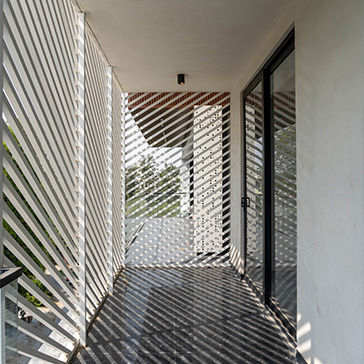
Why Architects Are Turning to Custom Metal Louvers in 2025
There’s something quietly brilliant happening in architecture right now. As buildings become more responsive and designers look for ways to merge aesthetics with performance, one feature is making a serious comeback, custom metal louvers.
03-06-25 | Architectural Insights
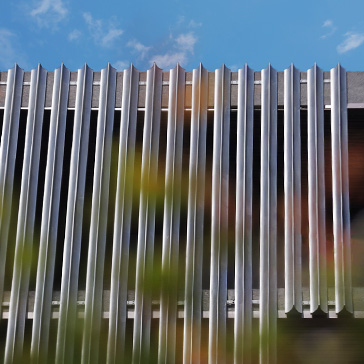
The Science of Shadows: How Facade Design Shapes Light and Mood
Architecture has always been about more than structure - it’s about rhythm, reflection, and the way light interacts with space.At Metaguise, we see every innovative facade as a living canvas, one that transforms not just how a building looks, but how it feels. Light becomes our material, and shadow becomes our tool.This is the art and the science behind MetaLouvers, MetaCassette, and the entire Metaguise facade family.
13-10-25 | Architectural Insights
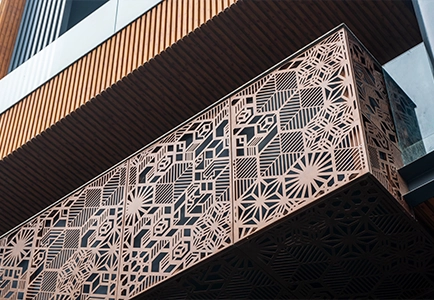
Custom Metal Facade Cladding in 2026: Design, Cost, Materials & Architect Guide
Explore how commercial spaces are using Metaguise facades to express identity and elevate perception.
24-11-25 | Architectural Insights
Social
Legal
Privacy Policy|Terms & Conditions