






PVDF vs Powder Coat for Metal Facades: What Indian Architects Need to Know
22-06-26 | Facade Innovations
Key Takeaways
• PVDF and powder coat are the two primary coating systems for architectural aluminium facades in India — and the difference between them is not subtle. On south and west-facing facades in India's UV conditions, powder coat shows visible colour shift within 5–8 years. PVDF maintains colour for 25+ years on the same surfaces. • PVDF (polyvinylidene fluoride) meets AAMA 2605 — the highest performance standard for architectural aluminium coatings. Its fluorine-carbon bond chemistry is inherently resistant to UV photodegradation in India's intense solar conditions. Powder coat meets AAMA 2604 — a lower standard — and its organic resin is susceptible to the UV levels that Indian facades experience year-round. • This guide gives Indian architects and project consultants the complete technical comparison — chemistry, UV resistance, monsoon performance, colour retention, maintenance, and climate-zone recommendations — in structured tables and plain-language analysis.
Why the PVDF vs Powder Coat Decision Matters for Indian Architecture
Nobody talks about facade coatings at a project review meeting until something goes wrong. By the time a powder-coated facade is chalking on the south elevation and the client is asking who specified it, the architect has moved on to other projects, the contractor has been paid, and the building owner is left with a remediation cost that nobody budgeted for. The coating decision gets made quietly, often by price, often by whatever the fabricator uses as their default. And in most Indian climates — high UV, heavy monsoon, particulate-laden winter air in the NCR — the wrong coating shows its limitations within a decade and becomes a problem within two. PVDF and powder coat are not interchangeable finishes at different price points. They are chemically different systems with genuinely different performance trajectories in India's climate. This guide explains what those differences are, where they matter, and what the correct specification is for every major Indian facade context.
PVDF vs Powder Coat: The Complete Head-to-Head Comparison
| Criterion | PVDF Coating | Powder Coat |
|---|---|---|
| Chemistry | Polyvinylidene fluoride (fluoropolymer) with fluorine-carbon bond chemistry; architectural grade contains 70%+ PVDF resin. | Thermosetting polyester, epoxy, or hybrid polymer cured by heat; contains no fluoropolymer component. |
| Industry Standard | AAMA 2605 — the highest-performance architectural coating standard, requiring 10+ years of colour and gloss retention in accelerated weathering tests. | AAMA 2604 (standard polyester) or AAMA 2605 (premium powder, rarely achieved). Most commercial powder coatings comply with AAMA 2604. |
| UV Resistance | Excellent — fluorine-carbon bonds resist UV degradation, with minimal colour shift over 25+ years in Indian climates. | Good to moderate — organic resins gradually degrade under UV exposure, causing chalking and colour fading within 5–8 years on highly exposed façades. |
| Colour Retention | 25+ year warranty is standard, with documented long-term performance showing significantly better stability than powder coating. | Typically backed by a 10–15 year warranty; noticeable colour fading often begins after 5–7 years on exposed façades. |
| Monsoon / Moisture Resistance | Excellent — chemically inert to water with no moisture absorption. Edge sealing is recommended for coastal environments. | Good — resists moisture well, but chips, scratches, and poorly sealed edges can become vulnerable. |
| Salt Air / Coastal Performance | Very good when panel edges are properly sealed. The PVDF film itself is highly resistant to salt-air exposure. | Moderate — exposed edges and damaged coating can initiate corrosion in coastal environments. Not recommended within 3 km of the sea without premium specifications. |
| Surface Hardness / Abrasion | Moderate — softer than powder coating and more susceptible to scratches, though its self-cleaning properties reduce surface soiling. | High — hard, abrasion-resistant surface suitable for high-traffic interior areas and ground-level exterior applications. |
| Colour Range | Full RAL and NCS range, including metallic, pearlescent, and special-effect finishes with excellent batch consistency. | Full RAL and NCS range with more limited metallic effects; larger production runs may show slight batch variation. |
| Application Method | Factory-applied liquid coating by coil coating or spray before fabrication, followed by high-temperature curing for an integral bond. | Electrostatically applied powder, oven-cured after fabrication; panel edges are more susceptible to contamination. |
| Maintenance | Requires only annual cleaning with no repainting expected for 25+ years. Self-cleaning characteristics reduce dirt accumulation. | Requires annual cleaning, with repainting typically needed every 8–15 years on exposed exterior surfaces. |
| Fire Rating | Non-combustible aluminium substrate with negligible fuel contribution from the PVDF coating; maintains an A1 fire rating. | Non-combustible aluminium substrate with negligible fuel contribution from the powder coating; maintains an A1 fire rating. |
| Best-Fit Application | Ideal for exterior façades, especially south- and west-facing elevations, coastal projects, and long-term premium developments. | Best suited to interior metalwork, sheltered exterior locations, and projects where budget is the primary consideration. |
UV Resistance in Indian Sun: Why the Fluorine-Carbon Bond Wins
India's UV environment is one of the most demanding in the world for architectural coatings. The UV index across India's peninsular states (Tamil Nadu, Andhra Pradesh, Telangana, Karnataka, Kerala, Maharashtra) averages 8–12 throughout the year; in Rajasthan, Gujarat, and the NCR belt, peak summer UV indices reach 10–14 — figures comparable to the most UV-intense regions on earth. The Florida exposure tests that are the basis for most international coating performance data were conducted in a UV environment with a UV index of 4–7 — significantly less intense than India's conditions. The consequence of this UV intensity gap is that Indian facades experience coating degradation at a rate that international test data underestimates. Powder coat systems that maintain AAMA 2604 performance for 10–15 years in Florida field tests may show equivalent degradation within five to eight years on south and west-facing Indian facades. PVDF systems rated to AAMA 2605, by contrast, demonstrate only marginal additional degradation in India relative to Florida — because the fluorine-carbon bond's UV resistance is not a relative performance that scales with UV intensity: it is a chemical stability that holds across the full terrestrial UV spectrum. Metaguise specifies PVDF as the standard exterior coating for all systems across the full MetaSurface range — not as a premium option but as the baseline specification for any project where the facade is expected to look as designed in 2045 as at handover. For Indian architects preparing facade specifications, this is the key technical argument: in India's UV conditions, PVDF is not a luxury upgrade. It is the correct specification.
Monsoon and Salt Air Performance: How Each Coating Responds to India's Wettest Challenges
Monsoon Performance: The Wetting and Drying Cycle India's monsoon creates a specific challenge for facade coatings that is different from both the sustained rainfall of temperate European climates and the year-round humidity of equatorial climates. The Indian monsoon pattern — intense rainfall concentrated over three to four months, followed by rapid drying in the post-monsoon season — creates repeated wetting-and-drying cycles that stress coating adhesion, expose any edge or joint vulnerability, and create conditions in which biological growth (algae, lichen, mould) can establish on surfaces that retain moisture even briefly. PVDF's chemical inertness to water, combined with its self-cleaning surface properties (the fluoropolymer surface has a very low surface energy that prevents dust and biological material from adhering effectively), makes it the coating most resistant to both the direct effects of monsoon exposure and the biological growth that follows. Powder coat, with a higher surface energy, shows measurably greater soiling and biological growth in monsoon-exposed applications — leading to the characteristic grey-green discolouration that is the most common visible maintenance indicator on powder-coated facades in India's monsoon zone after five to ten years of service. Salt Air Performance: The Critical Difference for Coastal India For coastal Indian projects, the PVDF vs powder coat decision is unambiguous: PVDF with sealed panel edges is the only appropriate exterior coating specification for buildings within three to five kilometres of the sea. Salt-laden coastal air carries chloride ions that attack the bond interface between coating and substrate at any coating vulnerability — chip, scratch, cut edge, or inadequately sealed joint. In powder coat systems, this attack initiates under-film corrosion that propagates laterally beneath the coating, lifting the film and eventually blistering the surface in a pattern that is irreversible without stripping and recoating. PVDF's chemical inertness extends to chloride ion attack — the fluorine-carbon bond has no susceptibility to the electrochemical processes that drive coastal corrosion. With properly sealed panel edges (sealing the cut aluminium edge where the factory PVDF coating ends), PVDF-coated aluminium has no accessible vulnerability to coastal salt-air attack. This is why Metaguise's Mumbai, Goa, Chennai, and Kerala coastal specifications use PVDF with sealed edges as a baseline requirement — not an optional upgrade.
Climate-Specific Recommendations: PVDF or Powder Coat for Your Indian Project Location
| Location / Exposure | PVDF Recommendation | Powder Coat Assessment |
|---|---|---|
| South-facing Facade (Delhi NCR / Ahmedabad) | Strongly recommended — maximum UV exposure requires PVDF's fluoropolymer chemistry, providing 25-year colour stability. | Acceptable with premium polyester, but noticeable colour shift within 5–7 years on south-facing elevations is well documented, leading to an earlier repainting cycle. |
| West-facing Facade (Any Major Indian City) | Strongly recommended — intense afternoon heat and UV exposure make PVDF the preferred long-term specification. | Not recommended for long-term investment properties, as predictable maintenance and repainting are often required within the first decade. |
| Coastal Location (Mumbai, Goa, Chennai, Kochi) | Essential — specify PVDF with sealed panel edges and stainless steel fixings for maximum coastal durability. | Not recommended within 3 km of the sea, where chips and exposed panel edges can accelerate salt-air corrosion. |
| North-facing Interior Courtyard Facade | Appropriate — PVDF remains the premium option, although its performance advantage over powder coating is less significant in low-UV conditions. | Acceptable — reduced UV exposure minimizes powder coating's primary weakness, making it a suitable budget-conscious choice. |
| Interior Feature Wall / Lobby | Appropriate — excellent colour consistency and self-cleaning properties make PVDF a premium interior finish. | Good — with no UV or weather exposure, powder coating offers excellent scratch resistance and surface hardness for interior applications. |
| Industrial / Pollution-heavy Zone (NCR, Pune Industrial Areas) | Strongly recommended — PVDF's chemical inertness provides superior resistance to acid rain and industrial pollutants. | Moderate — standard polyester powder coatings are more susceptible to acid rain; premium polyurethane powders perform better but remain less durable than PVDF. |
Long-Term Colour Retention: What Your Facade Looks Like in 2040
The most practical way to understand the PVDF vs powder coat difference for a building owner is to model what the facade looks like at the point of comparison — ten, fifteen, and twenty-five years after installation. The following describes the documented performance trajectory of each coating system on a representative south-facing Indian exterior facade in a composite climate. PVDF: Consistent Across the Design Life A PVDF-coated MetaFlute facade in warm grey PVDF at the time of installation in 2025 will, in 2040, look essentially identical to its handover appearance. The colour will not have shifted measurably in hue or saturation on any elevation, including the south and west-facing surfaces. The gloss level will remain within the AAMA 2605 tolerance band. Annual cleaning will remove whatever surface soiling has accumulated. The facade at fifteen years looks like a building that was installed recently — not because it has been maintained intensively, but because the coating chemistry is inherently stable. This is the performance that Metaguise's PVDF warranty documents. Powder Coat: The Degradation Trajectory A powder-coated facade in the same warm grey installed in 2025 will, by 2030, show the first visible signs of colour shift on the most exposed south and west-facing elevations — a slight chalking or lightening that is most visible at grazing viewing angles. By 2035, the colour shift is visible in standard viewing conditions and the chalking is apparent on direct inspection. By 2040, the facade requires repainting — at which point the scaffolding, preparation, and recoating work represents a maintenance cost that, spread across the building's life, makes the economics of the initial powder coat specification less favourable than they appeared at the time of installation. This is the trajectory that the 30–80% better stability documented in 12-year field tests reflects.
Frequently Asked Questions
1.Is PVDF significantly more expensive than powder coat — and does the difference justify the specification?
PVDF-coated aluminium carries a material premium over powder-coated aluminium — typically in the range of 10–20% of the panel material cost alone, though this translates to a smaller percentage of the total installed facade cost (which includes sub-frame, fabrication, and installation). The justification for this premium is the maintenance and repainting cycle that powder coat requires on exposed Indian exterior facades and PVDF does not. A powder-coated facade that requires repainting at year eight, year sixteen, and year twenty-four represents three repainting cycles within a 25-year period — each involving scaffolding, surface preparation, coating removal, recoating, and finishing. Evaluated on a 25-year total cost of ownership basis, PVDF is consistently the more economical specification for Indian exterior facades. Metaguise provides cost-of-ownership analysis on request.2.Are there situations where powder coat is acceptable for an exterior Indian facade?
Yes. Powder coat is an acceptable exterior specification for: north-facing facades on buildings at higher latitudes where UV exposure is limited; covered or overhung exterior surfaces that receive minimal direct solar radiation; and applications where the building has a defined short functional life and long-term colour retention is not a specification priority. For standard Indian residential and commercial exterior facades — particularly south, west, or east-facing elevations in the country's full range of climate zones — powder coat is not the correct specification for long-term investment properties.3. What is AAMA 2605 and why does it matter for Indian facade specification?
AAMA 2605 is the American Architectural Manufacturers Association's highest performance classification for liquid coatings on architectural aluminium — specifically formulated to address fluoropolymer (PVDF) coatings. The standard requires that a compliant coating demonstrate: minimum 10 years of colour and gloss retention within defined tolerances under accelerated weathering test; zero chalking above a defined rating; specified adhesion performance; specified humidity resistance; and specified salt spray resistance. AAMA 2604, by contrast, sets lower performance thresholds that standard polyester powder coat typically meets. Specifying AAMA 2605 in the coating specification clause of a project's facade documentation is the correct way to ensure that a PVDF coating — not a premium powder coat claiming similar performance — is supplied. Metaguise's MetaSurface PVDF coatings are specified to AAMA 2605 standards on all Metaguise projects.4.Can a powder-coated facade be converted to PVDF at a later stage?
Technically, a powder-coated facade can be stripped and recoated with PVDF — but this is not a standard or cost-effective remediation process. Field application of PVDF cannot replicate the factory coil-coating or spray-and-bake process that produces PVDF's molecular bond with the substrate; field-applied PVDF is significantly less durable than factory-applied. The practical answer, when a powder-coated facade has degraded beyond acceptable appearance, is to strip the panels and replace them with new PVDF-coated panels, or to remove the cladding system entirely and reinstall with PVDF from the outset. This is why the initial coating specification decision is the one that matters — not the remediation options available after the wrong specification has played out.PVDF vs Powder Coat for Metal Facades: What Indian Architects Need to Know
22-06-26 | Facade Innovations
Key Takeaways
• PVDF and powder coat are the two primary coating systems for architectural aluminium facades in India — and the difference between them is not subtle. On south and west-facing facades in India's UV conditions, powder coat shows visible colour shift within 5–8 years. PVDF maintains colour for 25+ years on the same surfaces. • PVDF (polyvinylidene fluoride) meets AAMA 2605 — the highest performance standard for architectural aluminium coatings. Its fluorine-carbon bond chemistry is inherently resistant to UV photodegradation in India's intense solar conditions. Powder coat meets AAMA 2604 — a lower standard — and its organic resin is susceptible to the UV levels that Indian facades experience year-round. • This guide gives Indian architects and project consultants the complete technical comparison — chemistry, UV resistance, monsoon performance, colour retention, maintenance, and climate-zone recommendations — in structured tables and plain-language analysis.
Why the PVDF vs Powder Coat Decision Matters for Indian Architecture
Nobody talks about facade coatings at a project review meeting until something goes wrong. By the time a powder-coated facade is chalking on the south elevation and the client is asking who specified it, the architect has moved on to other projects, the contractor has been paid, and the building owner is left with a remediation cost that nobody budgeted for. The coating decision gets made quietly, often by price, often by whatever the fabricator uses as their default. And in most Indian climates — high UV, heavy monsoon, particulate-laden winter air in the NCR — the wrong coating shows its limitations within a decade and becomes a problem within two. PVDF and powder coat are not interchangeable finishes at different price points. They are chemically different systems with genuinely different performance trajectories in India's climate. This guide explains what those differences are, where they matter, and what the correct specification is for every major Indian facade context.
PVDF vs Powder Coat: The Complete Head-to-Head Comparison
| Criterion | PVDF Coating | Powder Coat |
|---|---|---|
| Chemistry | Polyvinylidene fluoride (fluoropolymer) with fluorine-carbon bond chemistry; architectural grade contains 70%+ PVDF resin. | Thermosetting polyester, epoxy, or hybrid polymer cured by heat; contains no fluoropolymer component. |
| Industry Standard | AAMA 2605 — the highest-performance architectural coating standard, requiring 10+ years of colour and gloss retention in accelerated weathering tests. | AAMA 2604 (standard polyester) or AAMA 2605 (premium powder, rarely achieved). Most commercial powder coatings comply with AAMA 2604. |
| UV Resistance | Excellent — fluorine-carbon bonds resist UV degradation, with minimal colour shift over 25+ years in Indian climates. | Good to moderate — organic resins gradually degrade under UV exposure, causing chalking and colour fading within 5–8 years on highly exposed façades. |
| Colour Retention | 25+ year warranty is standard, with documented long-term performance showing significantly better stability than powder coating. | Typically backed by a 10–15 year warranty; noticeable colour fading often begins after 5–7 years on exposed façades. |
| Monsoon / Moisture Resistance | Excellent — chemically inert to water with no moisture absorption. Edge sealing is recommended for coastal environments. | Good — resists moisture well, but chips, scratches, and poorly sealed edges can become vulnerable. |
| Salt Air / Coastal Performance | Very good when panel edges are properly sealed. The PVDF film itself is highly resistant to salt-air exposure. | Moderate — exposed edges and damaged coating can initiate corrosion in coastal environments. Not recommended within 3 km of the sea without premium specifications. |
| Surface Hardness / Abrasion | Moderate — softer than powder coating and more susceptible to scratches, though its self-cleaning properties reduce surface soiling. | High — hard, abrasion-resistant surface suitable for high-traffic interior areas and ground-level exterior applications. |
| Colour Range | Full RAL and NCS range, including metallic, pearlescent, and special-effect finishes with excellent batch consistency. | Full RAL and NCS range with more limited metallic effects; larger production runs may show slight batch variation. |
| Application Method | Factory-applied liquid coating by coil coating or spray before fabrication, followed by high-temperature curing for an integral bond. | Electrostatically applied powder, oven-cured after fabrication; panel edges are more susceptible to contamination. |
| Maintenance | Requires only annual cleaning with no repainting expected for 25+ years. Self-cleaning characteristics reduce dirt accumulation. | Requires annual cleaning, with repainting typically needed every 8–15 years on exposed exterior surfaces. |
| Fire Rating | Non-combustible aluminium substrate with negligible fuel contribution from the PVDF coating; maintains an A1 fire rating. | Non-combustible aluminium substrate with negligible fuel contribution from the powder coating; maintains an A1 fire rating. |
| Best-Fit Application | Ideal for exterior façades, especially south- and west-facing elevations, coastal projects, and long-term premium developments. | Best suited to interior metalwork, sheltered exterior locations, and projects where budget is the primary consideration. |
UV Resistance in Indian Sun: Why the Fluorine-Carbon Bond Wins
India's UV environment is one of the most demanding in the world for architectural coatings. The UV index across India's peninsular states (Tamil Nadu, Andhra Pradesh, Telangana, Karnataka, Kerala, Maharashtra) averages 8–12 throughout the year; in Rajasthan, Gujarat, and the NCR belt, peak summer UV indices reach 10–14 — figures comparable to the most UV-intense regions on earth. The Florida exposure tests that are the basis for most international coating performance data were conducted in a UV environment with a UV index of 4–7 — significantly less intense than India's conditions. The consequence of this UV intensity gap is that Indian facades experience coating degradation at a rate that international test data underestimates. Powder coat systems that maintain AAMA 2604 performance for 10–15 years in Florida field tests may show equivalent degradation within five to eight years on south and west-facing Indian facades. PVDF systems rated to AAMA 2605, by contrast, demonstrate only marginal additional degradation in India relative to Florida — because the fluorine-carbon bond's UV resistance is not a relative performance that scales with UV intensity: it is a chemical stability that holds across the full terrestrial UV spectrum. Metaguise specifies PVDF as the standard exterior coating for all systems across the full MetaSurface range — not as a premium option but as the baseline specification for any project where the facade is expected to look as designed in 2045 as at handover. For Indian architects preparing facade specifications, this is the key technical argument: in India's UV conditions, PVDF is not a luxury upgrade. It is the correct specification.
Monsoon and Salt Air Performance: How Each Coating Responds to India's Wettest Challenges
Monsoon Performance: The Wetting and Drying Cycle India's monsoon creates a specific challenge for facade coatings that is different from both the sustained rainfall of temperate European climates and the year-round humidity of equatorial climates. The Indian monsoon pattern — intense rainfall concentrated over three to four months, followed by rapid drying in the post-monsoon season — creates repeated wetting-and-drying cycles that stress coating adhesion, expose any edge or joint vulnerability, and create conditions in which biological growth (algae, lichen, mould) can establish on surfaces that retain moisture even briefly. PVDF's chemical inertness to water, combined with its self-cleaning surface properties (the fluoropolymer surface has a very low surface energy that prevents dust and biological material from adhering effectively), makes it the coating most resistant to both the direct effects of monsoon exposure and the biological growth that follows. Powder coat, with a higher surface energy, shows measurably greater soiling and biological growth in monsoon-exposed applications — leading to the characteristic grey-green discolouration that is the most common visible maintenance indicator on powder-coated facades in India's monsoon zone after five to ten years of service. Salt Air Performance: The Critical Difference for Coastal India For coastal Indian projects, the PVDF vs powder coat decision is unambiguous: PVDF with sealed panel edges is the only appropriate exterior coating specification for buildings within three to five kilometres of the sea. Salt-laden coastal air carries chloride ions that attack the bond interface between coating and substrate at any coating vulnerability — chip, scratch, cut edge, or inadequately sealed joint. In powder coat systems, this attack initiates under-film corrosion that propagates laterally beneath the coating, lifting the film and eventually blistering the surface in a pattern that is irreversible without stripping and recoating. PVDF's chemical inertness extends to chloride ion attack — the fluorine-carbon bond has no susceptibility to the electrochemical processes that drive coastal corrosion. With properly sealed panel edges (sealing the cut aluminium edge where the factory PVDF coating ends), PVDF-coated aluminium has no accessible vulnerability to coastal salt-air attack. This is why Metaguise's Mumbai, Goa, Chennai, and Kerala coastal specifications use PVDF with sealed edges as a baseline requirement — not an optional upgrade.
Climate-Specific Recommendations: PVDF or Powder Coat for Your Indian Project Location
| Location / Exposure | PVDF Recommendation | Powder Coat Assessment |
|---|---|---|
| South-facing Facade (Delhi NCR / Ahmedabad) | Strongly recommended — maximum UV exposure requires PVDF's fluoropolymer chemistry, providing 25-year colour stability. | Acceptable with premium polyester, but noticeable colour shift within 5–7 years on south-facing elevations is well documented, leading to an earlier repainting cycle. |
| West-facing Facade (Any Major Indian City) | Strongly recommended — intense afternoon heat and UV exposure make PVDF the preferred long-term specification. | Not recommended for long-term investment properties, as predictable maintenance and repainting are often required within the first decade. |
| Coastal Location (Mumbai, Goa, Chennai, Kochi) | Essential — specify PVDF with sealed panel edges and stainless steel fixings for maximum coastal durability. | Not recommended within 3 km of the sea, where chips and exposed panel edges can accelerate salt-air corrosion. |
| North-facing Interior Courtyard Facade | Appropriate — PVDF remains the premium option, although its performance advantage over powder coating is less significant in low-UV conditions. | Acceptable — reduced UV exposure minimizes powder coating's primary weakness, making it a suitable budget-conscious choice. |
| Interior Feature Wall / Lobby | Appropriate — excellent colour consistency and self-cleaning properties make PVDF a premium interior finish. | Good — with no UV or weather exposure, powder coating offers excellent scratch resistance and surface hardness for interior applications. |
| Industrial / Pollution-heavy Zone (NCR, Pune Industrial Areas) | Strongly recommended — PVDF's chemical inertness provides superior resistance to acid rain and industrial pollutants. | Moderate — standard polyester powder coatings are more susceptible to acid rain; premium polyurethane powders perform better but remain less durable than PVDF. |
Long-Term Colour Retention: What Your Facade Looks Like in 2040
The most practical way to understand the PVDF vs powder coat difference for a building owner is to model what the facade looks like at the point of comparison — ten, fifteen, and twenty-five years after installation. The following describes the documented performance trajectory of each coating system on a representative south-facing Indian exterior facade in a composite climate. PVDF: Consistent Across the Design Life A PVDF-coated MetaFlute facade in warm grey PVDF at the time of installation in 2025 will, in 2040, look essentially identical to its handover appearance. The colour will not have shifted measurably in hue or saturation on any elevation, including the south and west-facing surfaces. The gloss level will remain within the AAMA 2605 tolerance band. Annual cleaning will remove whatever surface soiling has accumulated. The facade at fifteen years looks like a building that was installed recently — not because it has been maintained intensively, but because the coating chemistry is inherently stable. This is the performance that Metaguise's PVDF warranty documents. Powder Coat: The Degradation Trajectory A powder-coated facade in the same warm grey installed in 2025 will, by 2030, show the first visible signs of colour shift on the most exposed south and west-facing elevations — a slight chalking or lightening that is most visible at grazing viewing angles. By 2035, the colour shift is visible in standard viewing conditions and the chalking is apparent on direct inspection. By 2040, the facade requires repainting — at which point the scaffolding, preparation, and recoating work represents a maintenance cost that, spread across the building's life, makes the economics of the initial powder coat specification less favourable than they appeared at the time of installation. This is the trajectory that the 30–80% better stability documented in 12-year field tests reflects.
Frequently Asked Questions
1.Is PVDF significantly more expensive than powder coat — and does the difference justify the specification?
PVDF-coated aluminium carries a material premium over powder-coated aluminium — typically in the range of 10–20% of the panel material cost alone, though this translates to a smaller percentage of the total installed facade cost (which includes sub-frame, fabrication, and installation). The justification for this premium is the maintenance and repainting cycle that powder coat requires on exposed Indian exterior facades and PVDF does not. A powder-coated facade that requires repainting at year eight, year sixteen, and year twenty-four represents three repainting cycles within a 25-year period — each involving scaffolding, surface preparation, coating removal, recoating, and finishing. Evaluated on a 25-year total cost of ownership basis, PVDF is consistently the more economical specification for Indian exterior facades. Metaguise provides cost-of-ownership analysis on request.2.Are there situations where powder coat is acceptable for an exterior Indian facade?
Yes. Powder coat is an acceptable exterior specification for: north-facing facades on buildings at higher latitudes where UV exposure is limited; covered or overhung exterior surfaces that receive minimal direct solar radiation; and applications where the building has a defined short functional life and long-term colour retention is not a specification priority. For standard Indian residential and commercial exterior facades — particularly south, west, or east-facing elevations in the country's full range of climate zones — powder coat is not the correct specification for long-term investment properties.3. What is AAMA 2605 and why does it matter for Indian facade specification?
AAMA 2605 is the American Architectural Manufacturers Association's highest performance classification for liquid coatings on architectural aluminium — specifically formulated to address fluoropolymer (PVDF) coatings. The standard requires that a compliant coating demonstrate: minimum 10 years of colour and gloss retention within defined tolerances under accelerated weathering test; zero chalking above a defined rating; specified adhesion performance; specified humidity resistance; and specified salt spray resistance. AAMA 2604, by contrast, sets lower performance thresholds that standard polyester powder coat typically meets. Specifying AAMA 2605 in the coating specification clause of a project's facade documentation is the correct way to ensure that a PVDF coating — not a premium powder coat claiming similar performance — is supplied. Metaguise's MetaSurface PVDF coatings are specified to AAMA 2605 standards on all Metaguise projects.4.Can a powder-coated facade be converted to PVDF at a later stage?
Technically, a powder-coated facade can be stripped and recoated with PVDF — but this is not a standard or cost-effective remediation process. Field application of PVDF cannot replicate the factory coil-coating or spray-and-bake process that produces PVDF's molecular bond with the substrate; field-applied PVDF is significantly less durable than factory-applied. The practical answer, when a powder-coated facade has degraded beyond acceptable appearance, is to strip the panels and replace them with new PVDF-coated panels, or to remove the cladding system entirely and reinstall with PVDF from the outset. This is why the initial coating specification decision is the one that matters — not the remediation options available after the wrong specification has played out.Related Articles
Related Articles
The Rise of Parametric facades: Designing with Algorithmic Elegance
A revolutionary parametric facade system designed to elevate architectural aesthetics. Crafted with premium metals and enhanced with MetaSurface finishes, MetaCoin offers unparalleled customizability, from the shape and size of each element to its color and arrangement. Its dynamic design reacts to light and perspective, creating ever-changing visual effects. Ideal for contemporary and iconic structures, MetaCoin transforms facades into captivating works of art that are sustainable, durable, and visually stunning.
01-04-25 | Facade Innovations
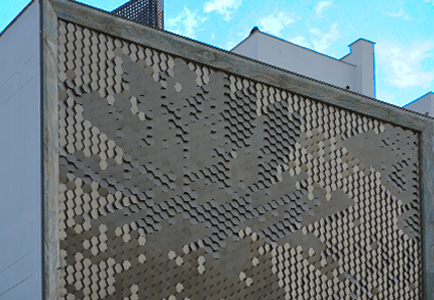
METABLOX™ by Metaguise: A Breakthrough in Parametric Facade Design
At the intersection of culture, craftsmanship, and cutting-edge geometry, METABLOX™ emerges as a bold new direction in architectural innovation. Introduced by Metaguise, this first-of-its-kind parametric facade technology makes its striking debut at the RJ Jewellers flagship store in Jaipur - setting a new benchmark in the world of metal design and modern Indian architecture.
09-04-25 | Facade Innovations
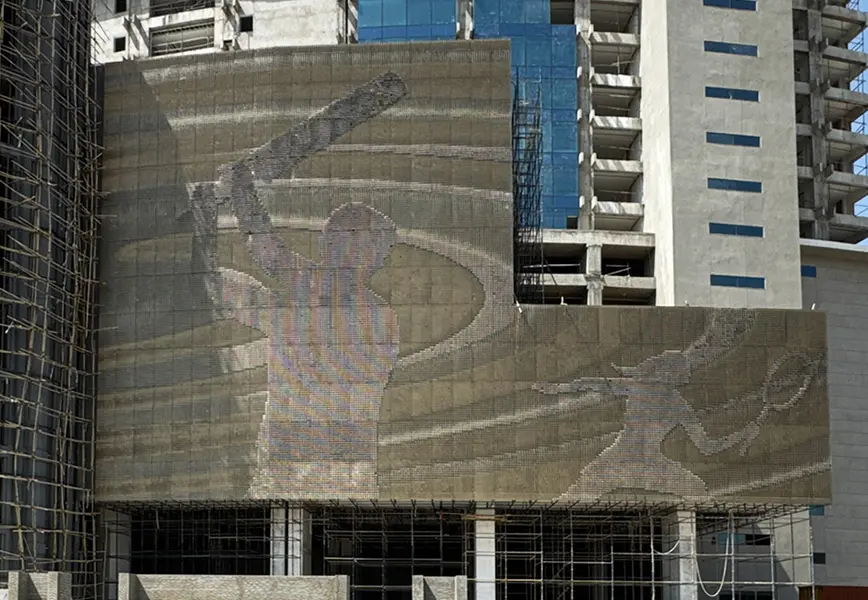
5 Landmark Projects That Used MetaCoin to Transform Facades
When it comes to parametric architecture, MetaCoin stands out as a revolutionary metal coin facade system. Crafted with precision, it offers dynamic aesthetics, adaptability, and a unique identity to structures. Let's delve into five notable projects where MetaCoin has redefined architectural facades.
13-05-25 | Facade Innovations
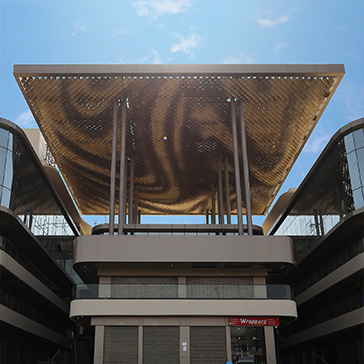
From Code to Construction: How Parametric Facades Are Built
Some buildings just make you look twice. Maybe it’s the way the facade curves. Or how the surface catches the light at different times of day. Often, what you’re seeing is more than just a design, it’s a parametric facade.
10-06-25 | Facade Innovations
Social
Legal
Privacy Policy|Terms & Conditions