





MetaFold Panel: Where Origami Meets Architecture — Functional Metal Cladding for Iconic Facades
05-06-26 | Facade Innovations
Key Takeaways
• MetaFold is Metaguise's origami-inspired folded metal panel system — precision-CNC-formed aluminium surfaces that create three-dimensional angular geometry, deep shadow relief, and a facade presence that reads as sculptural rather than clad. • MetaFold is simultaneously an aesthetic system and a performance system: the folded geometry creates passive solar shading through self-shadowing, structural stiffness through the engineered fold, and a facade that changes visual character at every viewing angle. • Applications span high-end residential elevations, commercial landmark buildings, hospitality feature facades, retail flagships, and institutional commissions where the brief demands a facade that is genuinely one-of-a-kind. • This guide covers the art and engineering of folded architecture, MetaFold's fabrication process, residential and commercial applications, a project gallery, the collaboration process with Metaguise, and FAQs.
The Art of Folded Architecture: Why the Fold Is the Most Powerful Gesture in Metal Design
In mathematics, a fold transforms a two-dimensional surface into a three-dimensional object. In architecture, it does the same — and does something more. It makes the building look as though it has been shaped by intention, not assembled from components. The fold announces that this surface was thought about: that someone decided exactly where each plane should change direction, at precisely what angle, to create precisely what shadow at precisely what hour. According to the Research and Markets Facade Market Outlook 2026–2034, the global facade market was valued at USD 136.16 billion in 2025 and is growing at an 8.4% CAGR toward USD 299.9 billion by 2034 — with growing architectural design complexity and the demand for iconic building identity explicitly cited as primary growth drivers. In this context, MetaFold occupies a specific and irreplaceable position: it is the system for projects where the brief is not just premium but singular — where the homeowner, architect, or developer wants a facade that is definitively unlike anything else in the neighbourhood, the city, or the country. The reference to origami in MetaFold's identity is deliberate and precise. Origami — the Japanese art of paper folding — achieves complex three-dimensional form through a single material, shaped entirely by the geometry of its folds. No cutting, no joining, no addition of other materials. The complexity of the resulting form is a direct consequence of the intelligence of the fold sequence. MetaFold applies this principle to aluminium: a flat sheet of metal, formed by CNC press-brake or roll-forming into a specified fold geometry, becomes a three-dimensional panel whose surface relief, shadow pattern, and viewing-angle dependency are all consequences of the fold. The material is aluminium throughout; the architecture is entirely in the geometry. This economy of means — maximum visual complexity from a single material formed by a single process — is what makes MetaFold particularly coherent as an architectural system. Unlike systems that achieve visual richness by adding materials (stone cladding on a metal frame, timber screens in front of a glass wall), MetaFold achieves it by shaping a single material with intelligence. The result is a facade of absolute material integrity — every surface you see is the same aluminium, shaped differently, telling the same story from different angles.
MetaFold: Engineering Meets Art — How the System Is Made
MetaFold is fabricated entirely in Metaguise's in-house CNC facility — the same manufacturing environment that produces MetaSequin, MetaCoin, MetaCassette, and the full MetaForm range. The fabrication process is what makes MetaFold possible at the quality level that the system demands. The CNC Press-Brake Process Each MetaFold panel begins as a flat sheet of solid aluminium — typically 2mm or 2.5mm gauge — cut to the net shape of the developed panel geometry. The 'developed' geometry is the flat form that, when folded along specified fold lines, produces the three-dimensional panel shape. Calculating the developed geometry for a complex folded panel requires understanding how the aluminium will spring back after bending — a material behaviour that varies with gauge, alloy, and bend radius — and compensating for it in the flat pattern. Metaguise's fabrication team has developed a library of springback compensation factors for every aluminium grade and gauge it uses, allowing the press-brake program to produce panels that fold to their designed geometry with submillimetre accuracy. The press-brake forms each fold line by applying a precisely controlled force through a shaped die — the same principle as bending sheet metal in any fabrication shop, but executed with the CNC precision that allows fold angles to be controlled to ±0.5°. For complex MetaFold panels with multiple fold lines, each fold is executed in sequence — the order of folding is part of the engineering, because some fold sequences would make subsequent folds geometrically impossible without distorting the panel. Metaguise's fabrication engineers plan the fold sequence for every MetaFold panel design as part of the design development process. Surface Geometry Types • Faceted fold (planar faces meeting at sharp fold lines): The most common MetaFold geometry — each panel face is flat, with crisp angular transitions at the fold lines; maximum shadow contrast between adjacent faces; the origami reference is most explicit in this form • Curved fold (smooth curved transition between adjacent faces): A more refined, sculptural MetaFold variant — the transition between panel faces is a curved surface rather than a sharp edge; creates a more sensuous, less angular composition suited for hospitality and residential applications where drama is the intent but sharpness is not • Compound fold (multiple fold directions in a single panel): The most complex MetaFold form — panels folded along lines in multiple directions, creating surfaces that change plane in both the horizontal and vertical axes simultaneously; produces a facade that reads differently from every viewing angle; requires the most careful fabrication sequencing and is typically specified for landmark one-of-a-kind commissions • Parametric fold array (fold geometry generated by computational script): MetaFold panels where the fold geometry — angle, depth, direction — varies progressively across the facade according to a parametric rule; creates a facade where the shadow pattern evolves continuously from one end to the other; the most architecturally ambitious MetaFold specification, combining parametric design intelligence with CNC fabrication precision Self-Shadowing: The Performance Dimension of the Fold A MetaFold facade has a performance characteristic that flat panel systems do not: self-shadowing. When a folded panel surface is angled away from the incident solar radiation, it is in its own shade — the fold geometry creates shadow zones that reduce the solar heat gain of the panel without any additional shading system. For west and south-facing MetaFold facades in NCR and Ahmedabad, the fold geometry can be oriented to maximise self-shadowing during peak summer hours — angling the panel faces so that the critical solar exposure angles strike surfaces that are already partially self-shaded by adjacent folds. This is passive solar control embedded in the facade geometry itself — not added as an external element but integrated into the fundamental form of the cladding. Structural Stiffness Through Geometry The fold is also an engineering tool. A flat sheet of 2mm aluminium deflects significantly under wind load at large formats — this is the oil-canning problem that afflicts flat panel systems. A folded sheet of the same thickness and gauge has dramatically higher structural stiffness: the fold converts the flat sheet into a structural section — the same principle by which a sheet of paper, flat and flimsy, becomes rigid when folded into a Z-section. MetaFold panels achieve structural stiffness through geometry rather than material mass, allowing large-format folded panels to maintain their shape under wind load and thermal cycling without the need for additional stiffening ribs or increased gauge.
Applications in High-End Residential Architecture: The Statement Facade That Cannot Be Copied/h2>
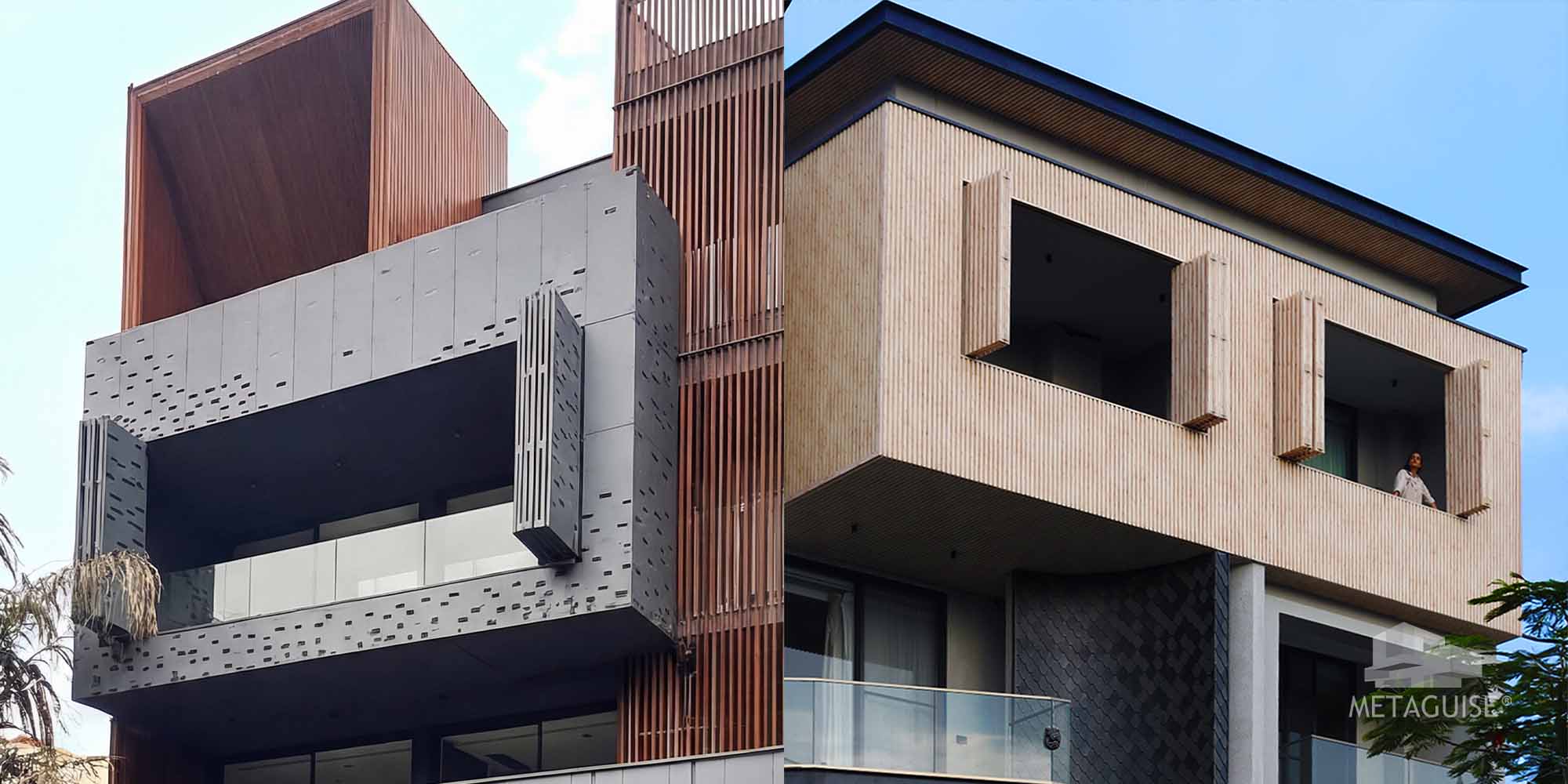
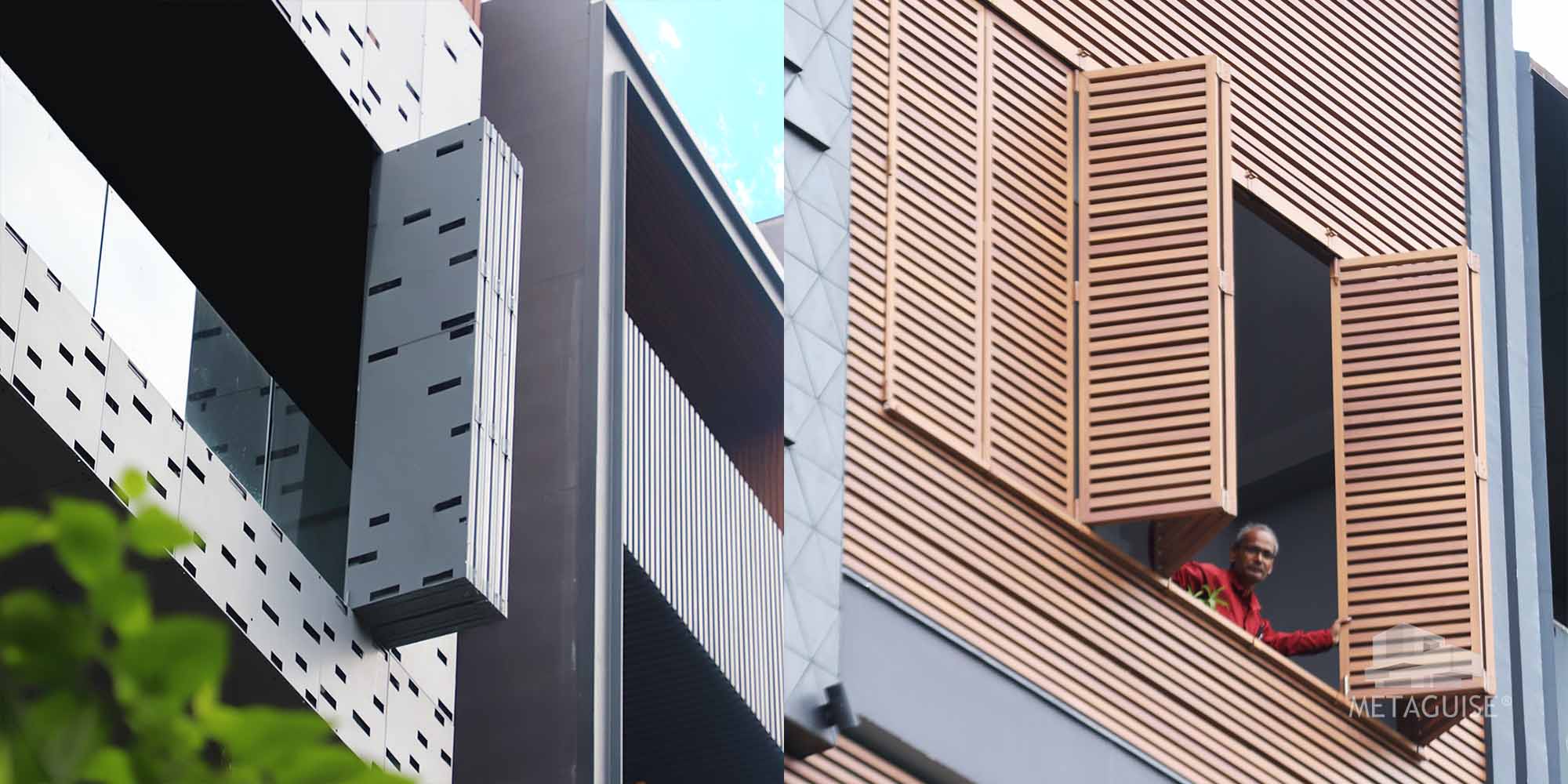
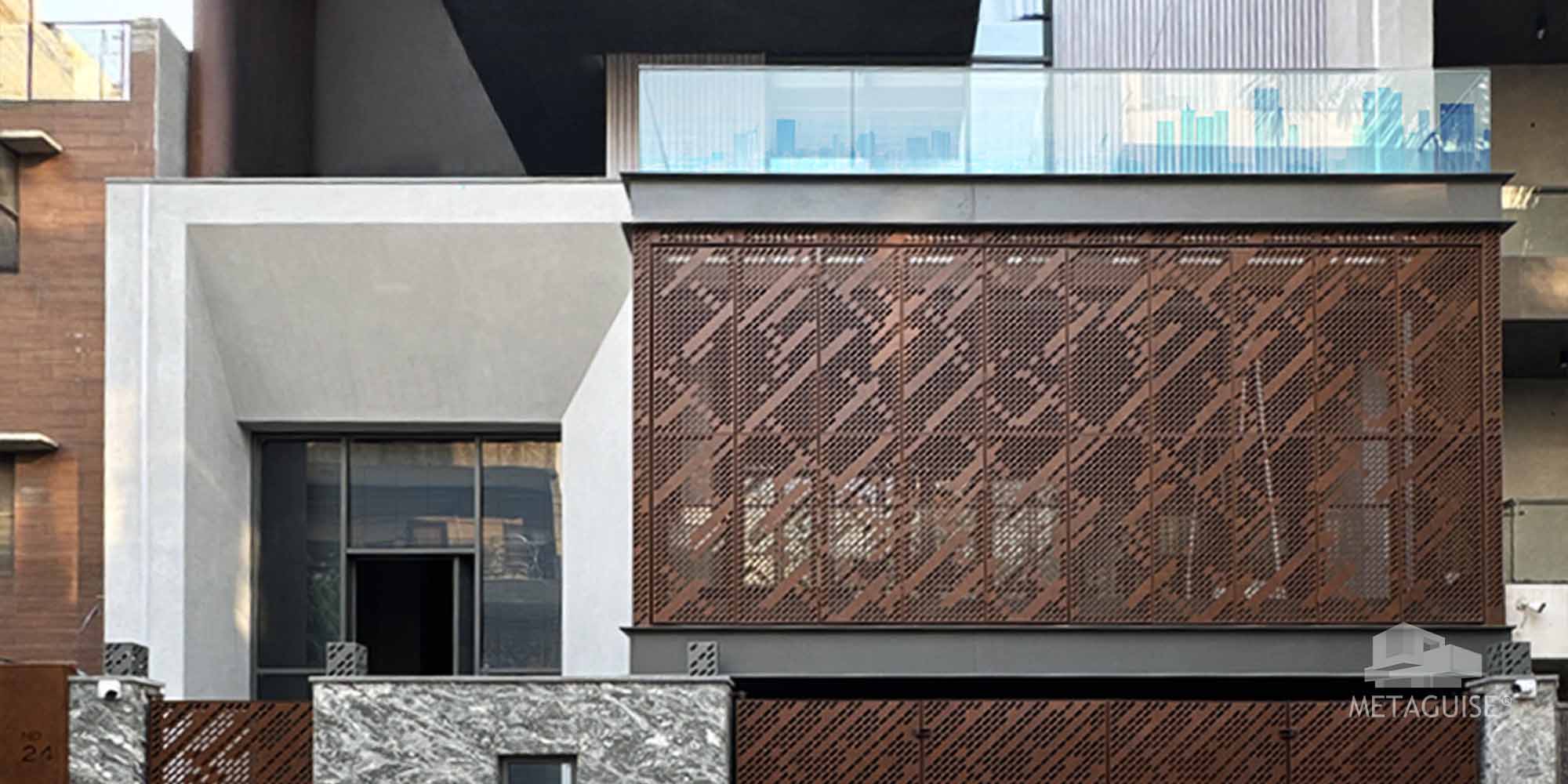
MetaFold's residential application context is specific: it is the specification for homeowners and architects who have exhausted the vocabulary of conventional premium cladding — who have seen MetaFlute, MetaCassette, and MetaCoin on neighbouring buildings, and want something that is demonstrably different from anything that can be ordered from a product catalogue. The residential brief that MetaFold answers most directly is: 'I want a facade that looks like it was designed specifically for this building — not adapted from a system.' MetaFold achieves this because the fold geometry of every panel installation is developed specifically for the project's building geometry, orientation, and design intent. A MetaFold entrance tower in South Delhi is not the same as a MetaFold entrance tower in Ahmedabad or Bangalore — the fold geometry, panel dimensions, and shadow angles are all calculated for the specific site. No two MetaFold installations are the same, which means no homeowner can walk past a neighbour's house and have their facade reproduced. Entrance Towers and Gates: Maximum Impact at the Threshold The most common residential MetaFold application is the entrance tower or feature gate — the architectural element at the boundary between the street and the property. This is the threshold that every visitor crosses; it is the image that is remembered; it is the face of the home at the scale of the street. A MetaFold entrance tower — faceted planes of aluminium meeting at sharp fold lines, finished in matte warm white or deep charcoal PVDF — creates an entrance experience that is immediately, unmistakably architectural. The fold geometry catches light differently from every approach angle: from the left, one set of faces is illuminated and another in shadow; from the right, the reading reverses. The building appears to change composition as you approach it — a quality that no flat or simply textured facade can deliver. Primary Street-Facing Elevations: Sculptural Architecture at Residential Scale For luxury bungalows and villas where the homeowner's brief is unambiguously sculptural — 'make my building look like a piece of architecture, not a house' — MetaFold on the full primary elevation delivers the most powerful residential facade statement available in Metaguise's range. Combined with SolidPanel on the flanking walls (the flat, quiet context against which the folded surface reads as dynamic), dark-frame glazing, and a considered planting strategy, a MetaFold primary elevation creates a residential building that holds its own against any international architectural reference. Metaguise has delivered MetaFold residential elevations across South Delhi, Gurgaon, Ahmedabad, and Bengaluru — in each case producing a building that is immediately photographable and architecturally distinct from every neighbour. Boundary Walls and Landscape Features At the landscape scale, MetaFold boundary walls and compound wall feature panels create a site identity that signals the architectural ambition of the residence within before the building itself is visible. A MetaFold-clad boundary wall section on a Gurgaon villa — folded planes of matte aluminium catching the morning sun from multiple angles simultaneously — creates a street presence that is articulate and intentional without being decorative. It says: the building behind this wall was designed with the same intelligence as this wall.
Commercial and Institutional Uses: When the Building Must Be the Brand
In commercial and institutional architecture, MetaFold serves a specific brief: the building as an expression of organisational identity. For companies, institutions, and public bodies whose building is their most visible physical asset, a MetaFold facade communicates precision, ambition, and originality at a scale that no signage, no branding programme, and no interior design initiative can replicate. Corporate Headquarters: Architecture as Brand Identity For corporate headquarters where the building must communicate the organisation's values — precision engineering companies, technology groups, financial institutions, research organisations — MetaFold creates a facade that embodies the qualities that the brand claims: rigour, intelligence, and the willingness to commit to something that is difficult to execute because it is worth executing perfectly. A corporate headquarters in an industrial or technology corridor with a MetaFold primary elevation reads as an institution that takes quality seriously — a message that is received by employees, clients, and competitors every time they approach the building. Luxury Retail Brands: Architecture as a Statement of Craftsmanship For luxury retail brands, a MetaFold facade is an architectural manifesto — it says that the brand's commitment to craftsmanship and precision extends to its built environment. A jewellery or fashion flagship with a MetaFold primary elevation in gold-anodised or MetaCopper finish creates a retail facade that is itself a luxury object — a surface of such precision and visual complexity that it draws customers closer to investigate, replicating in architecture the same mechanism of attraction and discovery that governs the best luxury product design. Institutional Buildings: Universities, Civic Centres, Cultural Facilities For institutional buildings — university research centres, civic government offices, cultural facilities — MetaFold creates a facade that communicates permanence, seriousness, and architectural aspiration without ostentation. The folded geometry in a restrained, matte finish reads as intellectually rigorous rather than expressive or decorative — a quality that suits institutional briefs where the architecture must communicate credibility and permanence to a range of audiences simultaneously. Several of Metaguise's most celebrated institutional commissions have featured MetaFold as the defining facade element — creating buildings that have become architectural landmarks in their campuses and cities.
MetaFold Project Gallery: Completed Installations Across India
Luxury Bungalow Entrance, South Delhi — Matte White PVDF A private residence in South Delhi's Vasant Vihar commissioned MetaFold for the entrance tower — a compound-fold panel composition in matte white PVDF, approximately 80 sq ft of folded aluminium at 2.5mm gauge, with fold angles calculated to create maximum shadow contrast in Delhi's morning light. The installation transformed the property's entrance from a standard masonry gatepier to an architectural threshold that the homeowner's architect described as 'the single best design decision we made on the entire project.' The installation took six weeks from design approval to completion. Corporate Technology Campus, Bangalore — Charcoal PVDF A technology company's Bangalore campus used MetaFold in faceted fold geometry, deep charcoal matte PVDF, on the primary elevation of the campus reception building — approximately 2,800 sq ft of folded panels creating an elevation that reads as a single sculptural composition from the approach road. The fold geometry was developed in Metaguise's parametric design environment, with panel faces angled to create self-shadowing during Bangalore's afternoon peak solar period. The building received a design publication feature within three months of completion. Luxury Hotel Feature Facade, Rajasthan — MetaCorten Tone PVDF A boutique heritage hotel in Rajasthan's Aravalli region used MetaFold in a curved-fold variant — smooth curved transitions between panel faces rather than sharp angular fold lines — in MetaCorten tone PVDF. The curved MetaFold composition referenced the rounded rock formations of the Aravalli landscape, creating a hotel facade that read as simultaneously architectural and geological. The hotel's marketing team reported that the facade was consistently mentioned by guests as the primary visual memory of their stay. Jewellery Retail Flagship — Gold Anodised A luxury jewellery brand's flagship store used MetaFold in a parametric fold array — fold depth and angle graduating progressively across the facade from a shallow fold at the periphery to a deep, dramatic fold at the entrance centre — in gold anodised finish. The gold MetaFold surface created a retail facade of extraordinary visual richness: from across the mall atrium, the progressive fold array read as a single composition of dimensional depth and precious-metal sheen; from close range, the individual panel precision was apparent as a mark of craft.
The MetaFold Collaboration Process: From Brief to Installed Panel
MetaFold is the most collaborative system in Metaguise's range — because the fold geometry is always developed specifically for the project, the design process involves more creative exchange between the Metaguise team and the client or architect than any modular system requires. The following describes how that collaboration typically unfolds. Phase 1: Design Brief and Intent Conversation Every MetaFold commission begins with a conversation about intent, not specification. What should the building feel like? What references inspire the brief? What does the homeowner or client want someone to think when they see the building for the first time? Is the desired quality sculptural drama, or restrained complexity? Warm and material, or cool and precise? Angular and sharp, or curved and sensuous? The answers to these questions — developed through conversation, reference images, and site visits — shape the fold geometry direction before any CNC programming begins. Phase 2: Parametric Design Development Metaguise's design team develops the MetaFold composition in its parametric design environment — generating fold geometries in 3D, evaluating shadow studies at the critical solar angles for the building's orientation, and producing photorealistic visualisations that show the proposed installation in morning, midday, and evening light. Physical prototype panels in the proposed fold geometry and finish are fabricated at this stage and sent to the client — because MetaFold's visual quality is three-dimensional and cannot be fully appreciated on screen. The physical prototype is often the moment when the brief crystallises: holding a folded aluminium panel at different angles in real light is the most direct way to understand what the installed facade will deliver. Phase 3: Engineering, Approval, and Full Fabrication The approved design geometry is passed to Metaguise's engineering team for structural validation, fixing specification, and fabrication programming. Every panel's fold sequence is programmed into the CNC press-brake. The sub-frame geometry is engineered to accept the folded panels at their specified angles without distortion. A full-scale mockup section — typically one complete bay of the facade — is fabricated and inspected before full production begins. Following mockup approval, full panel production proceeds in Metaguise's in-house facility. Phase 4: Installation and Handover MetaFold installation is executed by Metaguise's specialist team — the same team that fabricated the panels and developed the installation sequence. For MetaFold, installation precision is critical: the three-dimensional fold geometry must be installed at exactly the specified angles to produce the designed shadow pattern. Metaguise uses laser alignment tools and pre-positioned fixing jigs to maintain panel orientation accuracy throughout the installation. Post-installation, a full shadow study is conducted at the designed solar angle to confirm that the installation delivers the designed performance, before handover.
Frequently Asked Questions
1.What is the difference between MetaFold and MetaPyramid — aren't they both 3D metal panels?
The fundamental difference is in the geometry and the visual effect it produces. MetaPyramid is a modular system — each panel is an identical square with a pressed pyramid relief; the overall surface effect comes from the repetition of identical modules across the facade. MetaFold is a bespoke system — each panel's fold geometry is developed specifically for the project, and the overall composition is a designed whole rather than a field of repeated modules. MetaPyramid creates texture through repetition; MetaFold creates form through variation. MetaPyramid is the right choice when consistent surface texture across a large area is the design intent; MetaFold is the right choice when a sculptural, one-of-a-kind facade composition is the brief.2.Can MetaFold be combined with other Metaguise systems on the same building?
Yes — and this is one of the most effective ways to specify MetaFold on residential and commercial projects. MetaFold is most powerful as a focused composition element — on the entrance tower, a feature bay, or the primary street-facing panel — against a calm context of SolidPanel or MetaCassette on the flanking surfaces. The contrast between the dynamic fold geometry and the quiet flat context maximises the visual impact of the MetaFold element without overwhelming the overall composition. Metaguise's design team develops combination specifications as standard, ensuring that system transitions and finish relationships are architecturally coherent.3.How long does a MetaFold project take from brief to installation?
MetaFold projects follow a longer timeline than modular MetaForm systems, because the design development and fabrication programming are project-specific rather than catalogue-based. The typical MetaFold project timeline is 14–20 weeks from initial brief to completed installation: 4–6 weeks of design development, prototype fabrication, and client approval; 2–3 weeks of engineering validation and fabrication programming; 6–8 weeks of full panel fabrication and finishing; and 2–4 weeks of on-site installation depending on project scale. Metaguise provides a detailed programme at the outset of every MetaFold commission, with milestones for design approval, prototype sign-off, fabrication start, site delivery, and installation completion.4.What does a MetaFold installation cost, and how is it priced?
MetaFold is priced on a project-specific basis — because the fold geometry, panel sizes, and fabrication complexity vary significantly between commissions, a catalogue price per sq ft would not accurately reflect any particular project's cost. As a general reference, MetaFold installations on residential projects in India typically range from ₹1,800 to ₹3,500 per sq ft installed, depending on fold complexity (faceted simple fold vs compound parametric fold), panel size, gauge, and finish specification. For landmark commercial or institutional MetaFold commissions, the investment per sq ft can extend further for the most complex geometries. Metaguise provides a detailed fixed-price proposal for every MetaFold project following the design development and prototype approval phase.MetaFold Panel: Where Origami Meets Architecture — Functional Metal Cladding for Iconic Facades
05-06-26 | Facade Innovations
Key Takeaways
• MetaFold is Metaguise's origami-inspired folded metal panel system — precision-CNC-formed aluminium surfaces that create three-dimensional angular geometry, deep shadow relief, and a facade presence that reads as sculptural rather than clad. • MetaFold is simultaneously an aesthetic system and a performance system: the folded geometry creates passive solar shading through self-shadowing, structural stiffness through the engineered fold, and a facade that changes visual character at every viewing angle. • Applications span high-end residential elevations, commercial landmark buildings, hospitality feature facades, retail flagships, and institutional commissions where the brief demands a facade that is genuinely one-of-a-kind. • This guide covers the art and engineering of folded architecture, MetaFold's fabrication process, residential and commercial applications, a project gallery, the collaboration process with Metaguise, and FAQs.
The Art of Folded Architecture: Why the Fold Is the Most Powerful Gesture in Metal Design
In mathematics, a fold transforms a two-dimensional surface into a three-dimensional object. In architecture, it does the same — and does something more. It makes the building look as though it has been shaped by intention, not assembled from components. The fold announces that this surface was thought about: that someone decided exactly where each plane should change direction, at precisely what angle, to create precisely what shadow at precisely what hour. According to the Research and Markets Facade Market Outlook 2026–2034, the global facade market was valued at USD 136.16 billion in 2025 and is growing at an 8.4% CAGR toward USD 299.9 billion by 2034 — with growing architectural design complexity and the demand for iconic building identity explicitly cited as primary growth drivers. In this context, MetaFold occupies a specific and irreplaceable position: it is the system for projects where the brief is not just premium but singular — where the homeowner, architect, or developer wants a facade that is definitively unlike anything else in the neighbourhood, the city, or the country. The reference to origami in MetaFold's identity is deliberate and precise. Origami — the Japanese art of paper folding — achieves complex three-dimensional form through a single material, shaped entirely by the geometry of its folds. No cutting, no joining, no addition of other materials. The complexity of the resulting form is a direct consequence of the intelligence of the fold sequence. MetaFold applies this principle to aluminium: a flat sheet of metal, formed by CNC press-brake or roll-forming into a specified fold geometry, becomes a three-dimensional panel whose surface relief, shadow pattern, and viewing-angle dependency are all consequences of the fold. The material is aluminium throughout; the architecture is entirely in the geometry. This economy of means — maximum visual complexity from a single material formed by a single process — is what makes MetaFold particularly coherent as an architectural system. Unlike systems that achieve visual richness by adding materials (stone cladding on a metal frame, timber screens in front of a glass wall), MetaFold achieves it by shaping a single material with intelligence. The result is a facade of absolute material integrity — every surface you see is the same aluminium, shaped differently, telling the same story from different angles.
MetaFold: Engineering Meets Art — How the System Is Made
MetaFold is fabricated entirely in Metaguise's in-house CNC facility — the same manufacturing environment that produces MetaSequin, MetaCoin, MetaCassette, and the full MetaForm range. The fabrication process is what makes MetaFold possible at the quality level that the system demands. The CNC Press-Brake Process Each MetaFold panel begins as a flat sheet of solid aluminium — typically 2mm or 2.5mm gauge — cut to the net shape of the developed panel geometry. The 'developed' geometry is the flat form that, when folded along specified fold lines, produces the three-dimensional panel shape. Calculating the developed geometry for a complex folded panel requires understanding how the aluminium will spring back after bending — a material behaviour that varies with gauge, alloy, and bend radius — and compensating for it in the flat pattern. Metaguise's fabrication team has developed a library of springback compensation factors for every aluminium grade and gauge it uses, allowing the press-brake program to produce panels that fold to their designed geometry with submillimetre accuracy. The press-brake forms each fold line by applying a precisely controlled force through a shaped die — the same principle as bending sheet metal in any fabrication shop, but executed with the CNC precision that allows fold angles to be controlled to ±0.5°. For complex MetaFold panels with multiple fold lines, each fold is executed in sequence — the order of folding is part of the engineering, because some fold sequences would make subsequent folds geometrically impossible without distorting the panel. Metaguise's fabrication engineers plan the fold sequence for every MetaFold panel design as part of the design development process. Surface Geometry Types • Faceted fold (planar faces meeting at sharp fold lines): The most common MetaFold geometry — each panel face is flat, with crisp angular transitions at the fold lines; maximum shadow contrast between adjacent faces; the origami reference is most explicit in this form • Curved fold (smooth curved transition between adjacent faces): A more refined, sculptural MetaFold variant — the transition between panel faces is a curved surface rather than a sharp edge; creates a more sensuous, less angular composition suited for hospitality and residential applications where drama is the intent but sharpness is not • Compound fold (multiple fold directions in a single panel): The most complex MetaFold form — panels folded along lines in multiple directions, creating surfaces that change plane in both the horizontal and vertical axes simultaneously; produces a facade that reads differently from every viewing angle; requires the most careful fabrication sequencing and is typically specified for landmark one-of-a-kind commissions • Parametric fold array (fold geometry generated by computational script): MetaFold panels where the fold geometry — angle, depth, direction — varies progressively across the facade according to a parametric rule; creates a facade where the shadow pattern evolves continuously from one end to the other; the most architecturally ambitious MetaFold specification, combining parametric design intelligence with CNC fabrication precision Self-Shadowing: The Performance Dimension of the Fold A MetaFold facade has a performance characteristic that flat panel systems do not: self-shadowing. When a folded panel surface is angled away from the incident solar radiation, it is in its own shade — the fold geometry creates shadow zones that reduce the solar heat gain of the panel without any additional shading system. For west and south-facing MetaFold facades in NCR and Ahmedabad, the fold geometry can be oriented to maximise self-shadowing during peak summer hours — angling the panel faces so that the critical solar exposure angles strike surfaces that are already partially self-shaded by adjacent folds. This is passive solar control embedded in the facade geometry itself — not added as an external element but integrated into the fundamental form of the cladding. Structural Stiffness Through Geometry The fold is also an engineering tool. A flat sheet of 2mm aluminium deflects significantly under wind load at large formats — this is the oil-canning problem that afflicts flat panel systems. A folded sheet of the same thickness and gauge has dramatically higher structural stiffness: the fold converts the flat sheet into a structural section — the same principle by which a sheet of paper, flat and flimsy, becomes rigid when folded into a Z-section. MetaFold panels achieve structural stiffness through geometry rather than material mass, allowing large-format folded panels to maintain their shape under wind load and thermal cycling without the need for additional stiffening ribs or increased gauge.
Applications in High-End Residential Architecture: The Statement Facade That Cannot Be Copied/h2>
MetaFold's residential application context is specific: it is the specification for homeowners and architects who have exhausted the vocabulary of conventional premium cladding — who have seen MetaFlute, MetaCassette, and MetaCoin on neighbouring buildings, and want something that is demonstrably different from anything that can be ordered from a product catalogue. The residential brief that MetaFold answers most directly is: 'I want a facade that looks like it was designed specifically for this building — not adapted from a system.' MetaFold achieves this because the fold geometry of every panel installation is developed specifically for the project's building geometry, orientation, and design intent. A MetaFold entrance tower in South Delhi is not the same as a MetaFold entrance tower in Ahmedabad or Bangalore — the fold geometry, panel dimensions, and shadow angles are all calculated for the specific site. No two MetaFold installations are the same, which means no homeowner can walk past a neighbour's house and have their facade reproduced. Entrance Towers and Gates: Maximum Impact at the Threshold The most common residential MetaFold application is the entrance tower or feature gate — the architectural element at the boundary between the street and the property. This is the threshold that every visitor crosses; it is the image that is remembered; it is the face of the home at the scale of the street. A MetaFold entrance tower — faceted planes of aluminium meeting at sharp fold lines, finished in matte warm white or deep charcoal PVDF — creates an entrance experience that is immediately, unmistakably architectural. The fold geometry catches light differently from every approach angle: from the left, one set of faces is illuminated and another in shadow; from the right, the reading reverses. The building appears to change composition as you approach it — a quality that no flat or simply textured facade can deliver. Primary Street-Facing Elevations: Sculptural Architecture at Residential Scale For luxury bungalows and villas where the homeowner's brief is unambiguously sculptural — 'make my building look like a piece of architecture, not a house' — MetaFold on the full primary elevation delivers the most powerful residential facade statement available in Metaguise's range. Combined with SolidPanel on the flanking walls (the flat, quiet context against which the folded surface reads as dynamic), dark-frame glazing, and a considered planting strategy, a MetaFold primary elevation creates a residential building that holds its own against any international architectural reference. Metaguise has delivered MetaFold residential elevations across South Delhi, Gurgaon, Ahmedabad, and Bengaluru — in each case producing a building that is immediately photographable and architecturally distinct from every neighbour. Boundary Walls and Landscape Features At the landscape scale, MetaFold boundary walls and compound wall feature panels create a site identity that signals the architectural ambition of the residence within before the building itself is visible. A MetaFold-clad boundary wall section on a Gurgaon villa — folded planes of matte aluminium catching the morning sun from multiple angles simultaneously — creates a street presence that is articulate and intentional without being decorative. It says: the building behind this wall was designed with the same intelligence as this wall.
Commercial and Institutional Uses: When the Building Must Be the Brand
In commercial and institutional architecture, MetaFold serves a specific brief: the building as an expression of organisational identity. For companies, institutions, and public bodies whose building is their most visible physical asset, a MetaFold facade communicates precision, ambition, and originality at a scale that no signage, no branding programme, and no interior design initiative can replicate. Corporate Headquarters: Architecture as Brand Identity For corporate headquarters where the building must communicate the organisation's values — precision engineering companies, technology groups, financial institutions, research organisations — MetaFold creates a facade that embodies the qualities that the brand claims: rigour, intelligence, and the willingness to commit to something that is difficult to execute because it is worth executing perfectly. A corporate headquarters in an industrial or technology corridor with a MetaFold primary elevation reads as an institution that takes quality seriously — a message that is received by employees, clients, and competitors every time they approach the building. Luxury Retail Brands: Architecture as a Statement of Craftsmanship For luxury retail brands, a MetaFold facade is an architectural manifesto — it says that the brand's commitment to craftsmanship and precision extends to its built environment. A jewellery or fashion flagship with a MetaFold primary elevation in gold-anodised or MetaCopper finish creates a retail facade that is itself a luxury object — a surface of such precision and visual complexity that it draws customers closer to investigate, replicating in architecture the same mechanism of attraction and discovery that governs the best luxury product design. Institutional Buildings: Universities, Civic Centres, Cultural Facilities For institutional buildings — university research centres, civic government offices, cultural facilities — MetaFold creates a facade that communicates permanence, seriousness, and architectural aspiration without ostentation. The folded geometry in a restrained, matte finish reads as intellectually rigorous rather than expressive or decorative — a quality that suits institutional briefs where the architecture must communicate credibility and permanence to a range of audiences simultaneously. Several of Metaguise's most celebrated institutional commissions have featured MetaFold as the defining facade element — creating buildings that have become architectural landmarks in their campuses and cities.
MetaFold Project Gallery: Completed Installations Across India
Luxury Bungalow Entrance, South Delhi — Matte White PVDF A private residence in South Delhi's Vasant Vihar commissioned MetaFold for the entrance tower — a compound-fold panel composition in matte white PVDF, approximately 80 sq ft of folded aluminium at 2.5mm gauge, with fold angles calculated to create maximum shadow contrast in Delhi's morning light. The installation transformed the property's entrance from a standard masonry gatepier to an architectural threshold that the homeowner's architect described as 'the single best design decision we made on the entire project.' The installation took six weeks from design approval to completion. Corporate Technology Campus, Bangalore — Charcoal PVDF A technology company's Bangalore campus used MetaFold in faceted fold geometry, deep charcoal matte PVDF, on the primary elevation of the campus reception building — approximately 2,800 sq ft of folded panels creating an elevation that reads as a single sculptural composition from the approach road. The fold geometry was developed in Metaguise's parametric design environment, with panel faces angled to create self-shadowing during Bangalore's afternoon peak solar period. The building received a design publication feature within three months of completion. Luxury Hotel Feature Facade, Rajasthan — MetaCorten Tone PVDF A boutique heritage hotel in Rajasthan's Aravalli region used MetaFold in a curved-fold variant — smooth curved transitions between panel faces rather than sharp angular fold lines — in MetaCorten tone PVDF. The curved MetaFold composition referenced the rounded rock formations of the Aravalli landscape, creating a hotel facade that read as simultaneously architectural and geological. The hotel's marketing team reported that the facade was consistently mentioned by guests as the primary visual memory of their stay. Jewellery Retail Flagship — Gold Anodised A luxury jewellery brand's flagship store used MetaFold in a parametric fold array — fold depth and angle graduating progressively across the facade from a shallow fold at the periphery to a deep, dramatic fold at the entrance centre — in gold anodised finish. The gold MetaFold surface created a retail facade of extraordinary visual richness: from across the mall atrium, the progressive fold array read as a single composition of dimensional depth and precious-metal sheen; from close range, the individual panel precision was apparent as a mark of craft.
The MetaFold Collaboration Process: From Brief to Installed Panel
MetaFold is the most collaborative system in Metaguise's range — because the fold geometry is always developed specifically for the project, the design process involves more creative exchange between the Metaguise team and the client or architect than any modular system requires. The following describes how that collaboration typically unfolds. Phase 1: Design Brief and Intent Conversation Every MetaFold commission begins with a conversation about intent, not specification. What should the building feel like? What references inspire the brief? What does the homeowner or client want someone to think when they see the building for the first time? Is the desired quality sculptural drama, or restrained complexity? Warm and material, or cool and precise? Angular and sharp, or curved and sensuous? The answers to these questions — developed through conversation, reference images, and site visits — shape the fold geometry direction before any CNC programming begins. Phase 2: Parametric Design Development Metaguise's design team develops the MetaFold composition in its parametric design environment — generating fold geometries in 3D, evaluating shadow studies at the critical solar angles for the building's orientation, and producing photorealistic visualisations that show the proposed installation in morning, midday, and evening light. Physical prototype panels in the proposed fold geometry and finish are fabricated at this stage and sent to the client — because MetaFold's visual quality is three-dimensional and cannot be fully appreciated on screen. The physical prototype is often the moment when the brief crystallises: holding a folded aluminium panel at different angles in real light is the most direct way to understand what the installed facade will deliver. Phase 3: Engineering, Approval, and Full Fabrication The approved design geometry is passed to Metaguise's engineering team for structural validation, fixing specification, and fabrication programming. Every panel's fold sequence is programmed into the CNC press-brake. The sub-frame geometry is engineered to accept the folded panels at their specified angles without distortion. A full-scale mockup section — typically one complete bay of the facade — is fabricated and inspected before full production begins. Following mockup approval, full panel production proceeds in Metaguise's in-house facility. Phase 4: Installation and Handover MetaFold installation is executed by Metaguise's specialist team — the same team that fabricated the panels and developed the installation sequence. For MetaFold, installation precision is critical: the three-dimensional fold geometry must be installed at exactly the specified angles to produce the designed shadow pattern. Metaguise uses laser alignment tools and pre-positioned fixing jigs to maintain panel orientation accuracy throughout the installation. Post-installation, a full shadow study is conducted at the designed solar angle to confirm that the installation delivers the designed performance, before handover.
Frequently Asked Questions
1.What is the difference between MetaFold and MetaPyramid — aren't they both 3D metal panels?
The fundamental difference is in the geometry and the visual effect it produces. MetaPyramid is a modular system — each panel is an identical square with a pressed pyramid relief; the overall surface effect comes from the repetition of identical modules across the facade. MetaFold is a bespoke system — each panel's fold geometry is developed specifically for the project, and the overall composition is a designed whole rather than a field of repeated modules. MetaPyramid creates texture through repetition; MetaFold creates form through variation. MetaPyramid is the right choice when consistent surface texture across a large area is the design intent; MetaFold is the right choice when a sculptural, one-of-a-kind facade composition is the brief.2.Can MetaFold be combined with other Metaguise systems on the same building?
Yes — and this is one of the most effective ways to specify MetaFold on residential and commercial projects. MetaFold is most powerful as a focused composition element — on the entrance tower, a feature bay, or the primary street-facing panel — against a calm context of SolidPanel or MetaCassette on the flanking surfaces. The contrast between the dynamic fold geometry and the quiet flat context maximises the visual impact of the MetaFold element without overwhelming the overall composition. Metaguise's design team develops combination specifications as standard, ensuring that system transitions and finish relationships are architecturally coherent.3.How long does a MetaFold project take from brief to installation?
MetaFold projects follow a longer timeline than modular MetaForm systems, because the design development and fabrication programming are project-specific rather than catalogue-based. The typical MetaFold project timeline is 14–20 weeks from initial brief to completed installation: 4–6 weeks of design development, prototype fabrication, and client approval; 2–3 weeks of engineering validation and fabrication programming; 6–8 weeks of full panel fabrication and finishing; and 2–4 weeks of on-site installation depending on project scale. Metaguise provides a detailed programme at the outset of every MetaFold commission, with milestones for design approval, prototype sign-off, fabrication start, site delivery, and installation completion.4.What does a MetaFold installation cost, and how is it priced?
MetaFold is priced on a project-specific basis — because the fold geometry, panel sizes, and fabrication complexity vary significantly between commissions, a catalogue price per sq ft would not accurately reflect any particular project's cost. As a general reference, MetaFold installations on residential projects in India typically range from ₹1,800 to ₹3,500 per sq ft installed, depending on fold complexity (faceted simple fold vs compound parametric fold), panel size, gauge, and finish specification. For landmark commercial or institutional MetaFold commissions, the investment per sq ft can extend further for the most complex geometries. Metaguise provides a detailed fixed-price proposal for every MetaFold project following the design development and prototype approval phase.Related Articles
Related Articles
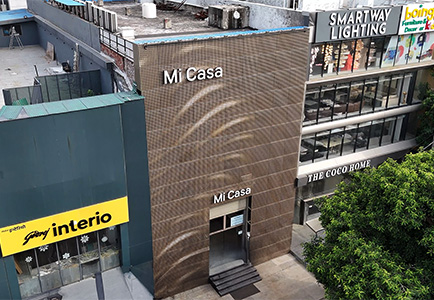
The Rise of Parametric facades: Designing with Algorithmic Elegance
A revolutionary parametric facade system designed to elevate architectural aesthetics. Crafted with premium metals and enhanced with MetaSurface finishes, MetaCoin offers unparalleled customizability, from the shape and size of each element to its color and arrangement. Its dynamic design reacts to light and perspective, creating ever-changing visual effects. Ideal for contemporary and iconic structures, MetaCoin transforms facades into captivating works of art that are sustainable, durable, and visually stunning.
01-04-25 | Facade Innovations
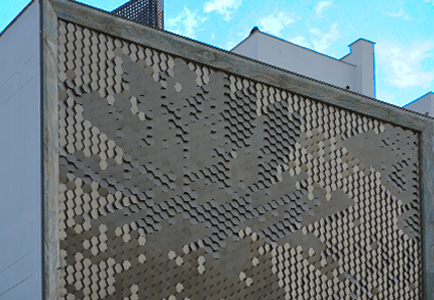
METABLOX™ by Metaguise: A Breakthrough in Parametric Facade Design
At the intersection of culture, craftsmanship, and cutting-edge geometry, METABLOX™ emerges as a bold new direction in architectural innovation. Introduced by Metaguise, this first-of-its-kind parametric facade technology makes its striking debut at the RJ Jewellers flagship store in Jaipur - setting a new benchmark in the world of metal design and modern Indian architecture.
09-04-25 | Facade Innovations
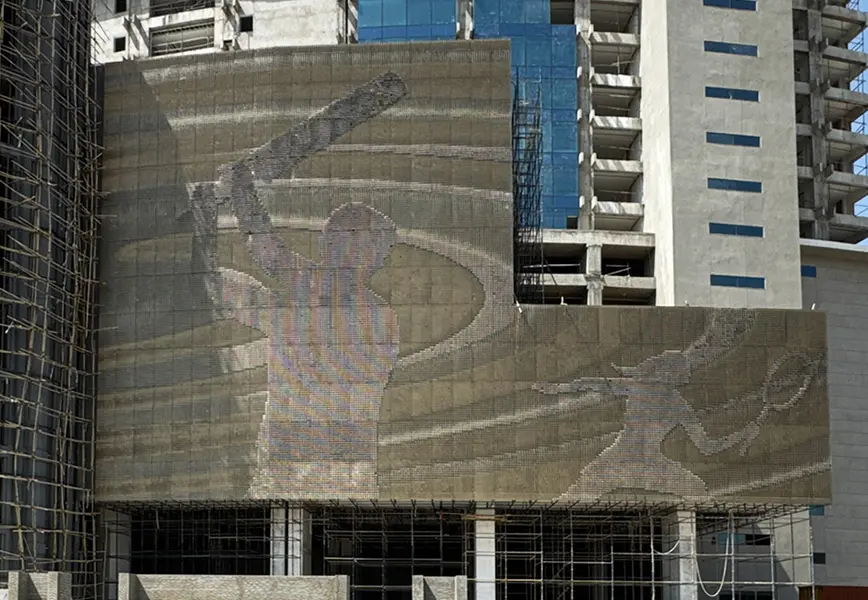
5 Landmark Projects That Used MetaCoin to Transform Facades
When it comes to parametric architecture, MetaCoin stands out as a revolutionary metal coin facade system. Crafted with precision, it offers dynamic aesthetics, adaptability, and a unique identity to structures. Let's delve into five notable projects where MetaCoin has redefined architectural facades.
13-05-25 | Facade Innovations
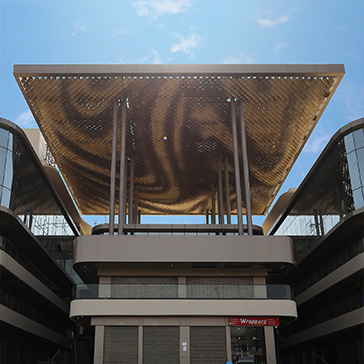
From Code to Construction: How Parametric Facades Are Built
Some buildings just make you look twice. Maybe it’s the way the facade curves. Or how the surface catches the light at different times of day. Often, what you’re seeing is more than just a design, it’s a parametric facade.
10-06-25 | Facade Innovations
Social
Legal
Privacy Policy|Terms & Conditions