






Duplex House Facade Design Ideas in India - Metal Elevation for G+1 Homes (2026)
12-05-26 | Architectural Insights
Key Takeaways
• Duplex and G+1 homes represent one of India's most architecturally underserved markets — immense investment, yet facades that rarely match the quality of the interior or the ambition of the owner. • Metal panels are uniquely well-suited to duplex elevations: lightweight, retrofit-compatible, available in a wide range of styles, and capable of visually unifying a G+1 composition that might otherwise read as two separate homes stacked on top of each other. • This blog covers the specific design constraints of duplex homes, the metal facade styles that work best at this scale, Metaguise's real G+1 project references, and a cost guide for duplex facade commissions. • Styles covered: modern, contemporary, tropical, Indo-contemporary — with system recommendations for each.
Why Duplex and G+1 Home Facades Deserve More Design Attention
India's duplex and independent floor market is in the middle of a remarkable moment. According to a February 2026 report by Golden Growth Fund, cited in Business Standard, prices of luxury independent floors in South Delhi's Category-A colonies — Chanakyapuri, Golf Links, Jor Bagh, Vasant Vihar, Panchsheel — rose 25–34% year-on-year in 2025. A 2,500 sq ft floor that was priced at ₹10–19 crore in 2024 is now selling for ₹14–25 crore. The redevelopment potential across South Delhi's colonies alone is estimated to exceed ₹6 lakh crore. Beyond Delhi, G+1 independent floors and duplexes are the dominant housing format in Chandigarh's sector bungalows, Ahmedabad's premium residential corridors, and Pune's Koregaon Park and Baner neighbourhoods. Despite this financial significance, the duplex house facade design India market remains remarkably underserved architecturally. Walk through any premium independent floor development and the pattern is consistent: exceptional interior design, thoughtful landscaping, state-of-the-art kitchen and bathroom specification — and a facade that is, at best, a coat of premium paint with a sandstone band. The disconnect is striking. A family will spend ₹15–30 crore on a South Delhi floor and ₹80–150 per sq ft on exterior paint that will begin fading within three years. The reason for this gap is partly habit, partly a lack of awareness of what metal facade systems can achieve at the scale and budget of a duplex home. This blog is designed to close that gap — to show what is genuinely possible on a G+1 or duplex elevation, what it costs, how long it lasts, and what Metaguise has already delivered for duplex homeowners across India.
Designing for the Specific Constraints of Duplex and G+1 Elevations
A duplex home presents specific design challenges that a standalone bungalow does not. Understanding these constraints is the starting point for any successful G+1 facade design. The Two-Floor Visual Problem The most common compositional failure on duplex elevations is the visual reading of two separate homes stacked vertically — ground floor and first floor with different materials, different window rhythms, and no architectural device that ties the composition together. The result is an elevation that looks like a renovation project rather than a designed building. Metal facade systems address this problem directly: a full-height MetaFlute panel that runs continuously from ground to parapet, or a perforated MetaCoin screen that wraps the facade from first floor to canopy, creates visual unity across the two floors through material continuity. Setback and Street Proportion Most duplex plots in Indian cities — whether in South Delhi colonies, Chandigarh sectors, or Pune's Baner — have relatively narrow frontage (typically 20–40 feet wide) but reasonable depth. This means the facade elevation is experienced more as a tall, narrow composition than the wide horizontal format of a large bungalow. Metal systems with strong vertical expression — MetaFlute's vertical channels, full-height SolidPanel compositions with tall window cuts — are particularly effective at this proportion. They reinforce the natural verticality of the building rather than fighting it. Shared Plot Boundaries and Neighbour Context Duplex homes on shared plot boundaries are constrained on side elevations. The street-facing primary elevation is therefore the dominant and often only fully visible facade. This concentrates the design opportunity — and demands that the primary elevation carries all the architectural weight of the composition. For a duplex plot where only 25–30 feet of frontage is visible from the street, precision of material, finish quality, and compositional intelligence matter more, not less. Retrofit Versus New-Build A significant proportion of duplex facade commissions in India are retrofit rather than new-build — homeowners who bought an existing floor in a redeveloped colony and want to bring the exterior up to the standard of their interior. Metaguise's MetaForm systems — MetaFlute, MetaCassette, MetaLouvers, and SolidPanel — are all designed for retrofit compatibility: lightweight sub-frame systems that anchor to existing masonry without structural intervention. The transformation of a DLF independent floor from 2008-era painted render to a precision metal elevation can be achieved without a single day of structural disruption, typically within 6–10 weeks.
Metal Panels: The Perfect Material for Duplex Elevations in India
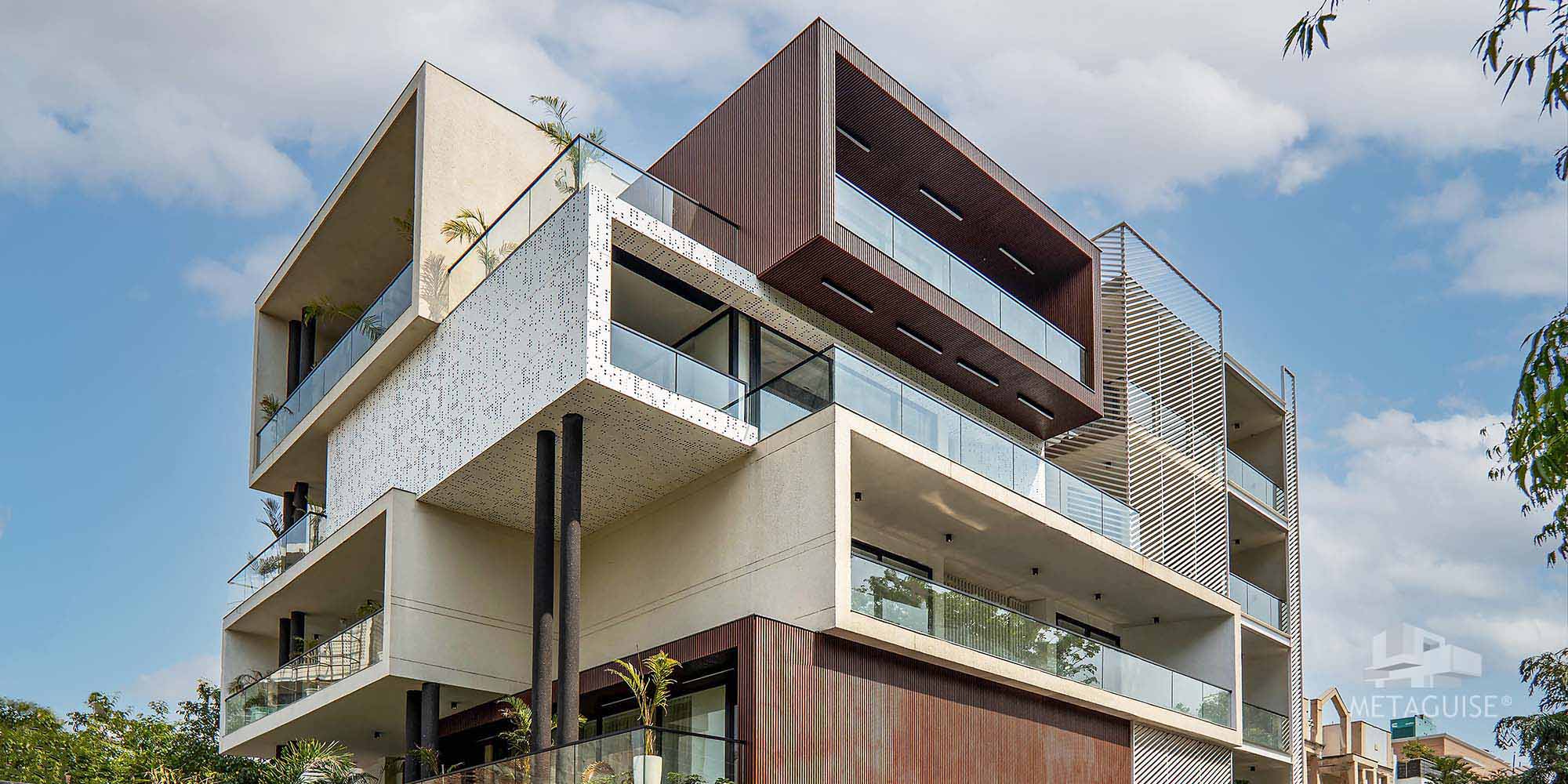
Metal panels outperform every alternative material category for duplex home exteriors in India on the combination of design flexibility, weight, longevity, and retrofit compatibility. Here is why each characteristic matters specifically for the G+1 context: Weight Advantage G+1 buildings in India — particularly those built in the 1980s–2000s — were not engineered for heavy cladding loads. Adding natural stone cladding (25–75 kg/m²) to an existing G+1 structure without structural assessment is a genuine risk. Metaguise's aluminium systems weigh 3–6 kg/m² — less than a tenth of stone — and place negligible additional load on existing walls and structures. This makes metal the safe, structurally responsible choice for duplex retrofit projects regardless of building age. Visual Continuity Across Floors A MetaFlute panel that runs from ground level to parapet without interruption at the first-floor slab level creates a single, coherent architectural gesture. A MetaCassette grid that maintains consistent joint spacing across both floors makes the composition read as a single building, not two. This visual unity — one of the most powerful architectural effects available on a duplex elevation — is uniquely achievable in metal, where panel dimensions and fixing systems can be designed to span floor-to-floor without interruption. Privacy and Street Management For duplex homes where the first floor sits close to the street — common in South Delhi's redeveloped colonies and Chandigarh's sector plots — perforated metal screens provide privacy for first-floor residents while maintaining visual richness from the street. Metaguise's MetaCoin perforated system and parametric perforated screens allow daylight and cross-ventilation from behind the screen while significantly reducing overlooking from street level. The screen reads as a decorative architectural feature from outside; from inside, it functions as a privacy filter. Solar Control on First Floor Exposures First-floor west-facing rooms in G+1 homes across NCR, Ahmedabad, and Hyderabad are among the most thermally challenged spaces in Indian residential architecture — high sun angle, direct afternoon exposure, and proximity to a flat roof above that generates additional heat. Metaguise's MetaFin architectural fin system, projected from the facade plane above first-floor west-facing windows, can reduce solar heat gain on those windows by 40–60% — translating directly into improved comfort and lower cooling costs for the rooms behind.
Style Guide: Modern, Contemporary, Tropical, and Indo-Contemporary Duplex Facades
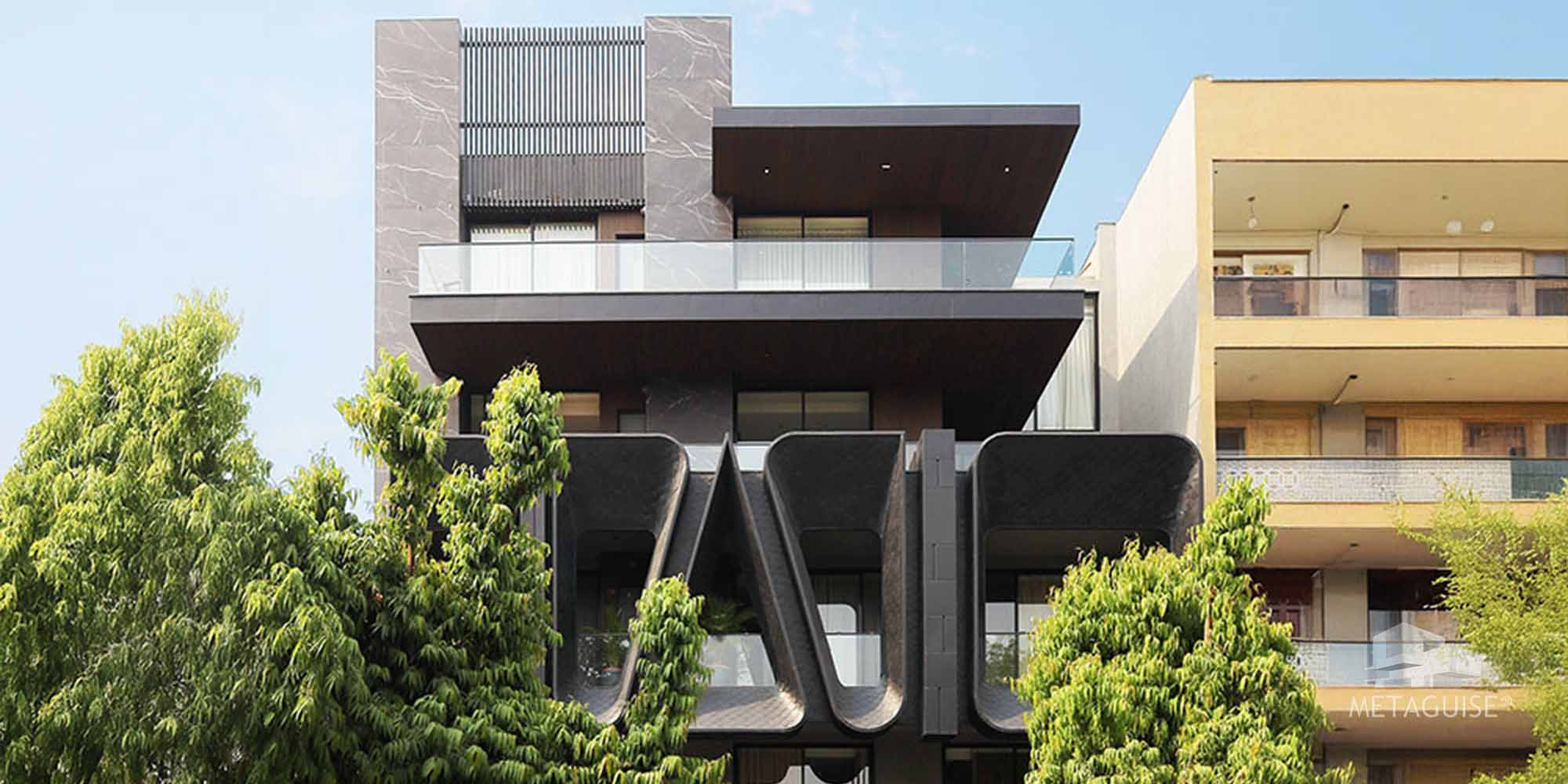
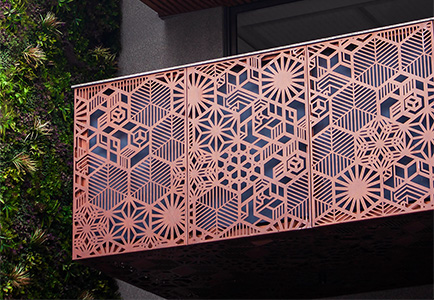
Duplex homeowners in India span a wide range of aesthetic sensibilities. The following style frameworks reflect the dominant design languages in each major market — with Metaguise system recommendations for each. Modern Minimalist — For the South Delhi, Gurgaon, and Bangalore Buyer The modern minimalist duplex facade is the most specified style in India's Tier 1 cities in 2026. It is defined by restraint: flush surfaces, concealed joints, monochromatic palette, and the absence of decorative ornament. In metal, this translates to SolidPanel or large-format MetaCassette in matte charcoal, warm white, or deep anthracite PVDF finishes, combined with dark-frame glazing and a recessed entrance. The composition is architectural in the truest sense: it achieves drama through proportion and precision, not through surface decoration. Suited to: South Delhi Category-A and B colonies, DLF Phase 1–3, Koregaon Park Pune, Indiranagar Bangalore. Contemporary Textured — For the Chandigarh, Ludhiana, and Ahmedabad Buyer The contemporary textured duplex elevation adds three-dimensional relief to the minimalist template — through fluted panels, folded geometry, or ribbed surfaces that create shadow play and visual depth. Metaguise's MetaFlute is the primary system for this style: vertical channel profiles in widths of 75mm–150mm create strong shadow lines and a tactile richness that painted or flat-panel surfaces cannot achieve. In Chandigarh's sector bungalows — where the grid-plan layout means homes are viewed from a uniform setback — MetaFlute elevations read with particular clarity and architectural authority. Suited to: Chandigarh Sectors 7–22, Ludhiana's Ansal Sushant City, Ahmedabad's Sindhu Bhavan Road. Tropical Biophilic — For the Bangalore, Pune, Kochi, and Goa Buyer The tropical biophilic duplex facade integrates planting and greenery with metal screen structures — creating an elevation where living walls, climbing plants, and lush planting are threaded through perforated metal frames. Metaguise's parametric perforated systems and MetaFin fin structures are the preferred scaffold for biophilic facade compositions. The metal provides the structural framework; the planting provides the life. At monsoon peak in Bangalore or Pune, a biophilic duplex facade becomes a genuinely extraordinary composition — deep green against warm metal, light filtering through leaf and perforation simultaneously. Suited to: Sarjapur Road and Whitefield Bangalore, Baner and Wakad Pune, Aluva and Kakkanad Kochi. Indo-Contemporary — For the Heritage-Context Buyer The Indo-contemporary style bridges traditional Indian material culture — jaali patterns, geometric ornament, warm terracotta and copper tones — with the precision of contemporary metal fabrication. Metaguise's MetaCoin circular modules and parametric perforated screens in patterns derived from Mughal geometry, Rajasthani lattice, or South Indian mandala forms are the most powerful tools for this compositional language. In a South Delhi Vasant Vihar duplex or a Jaipur Malviya Nagar G+1 home, an Indo-contemporary metal screen facade achieves something rare in residential architecture: it is unmistakably Indian, unmistakably contemporary, and unmistakably individual.
Real Projects: Duplex and G+1 Facades by Metaguise Across India
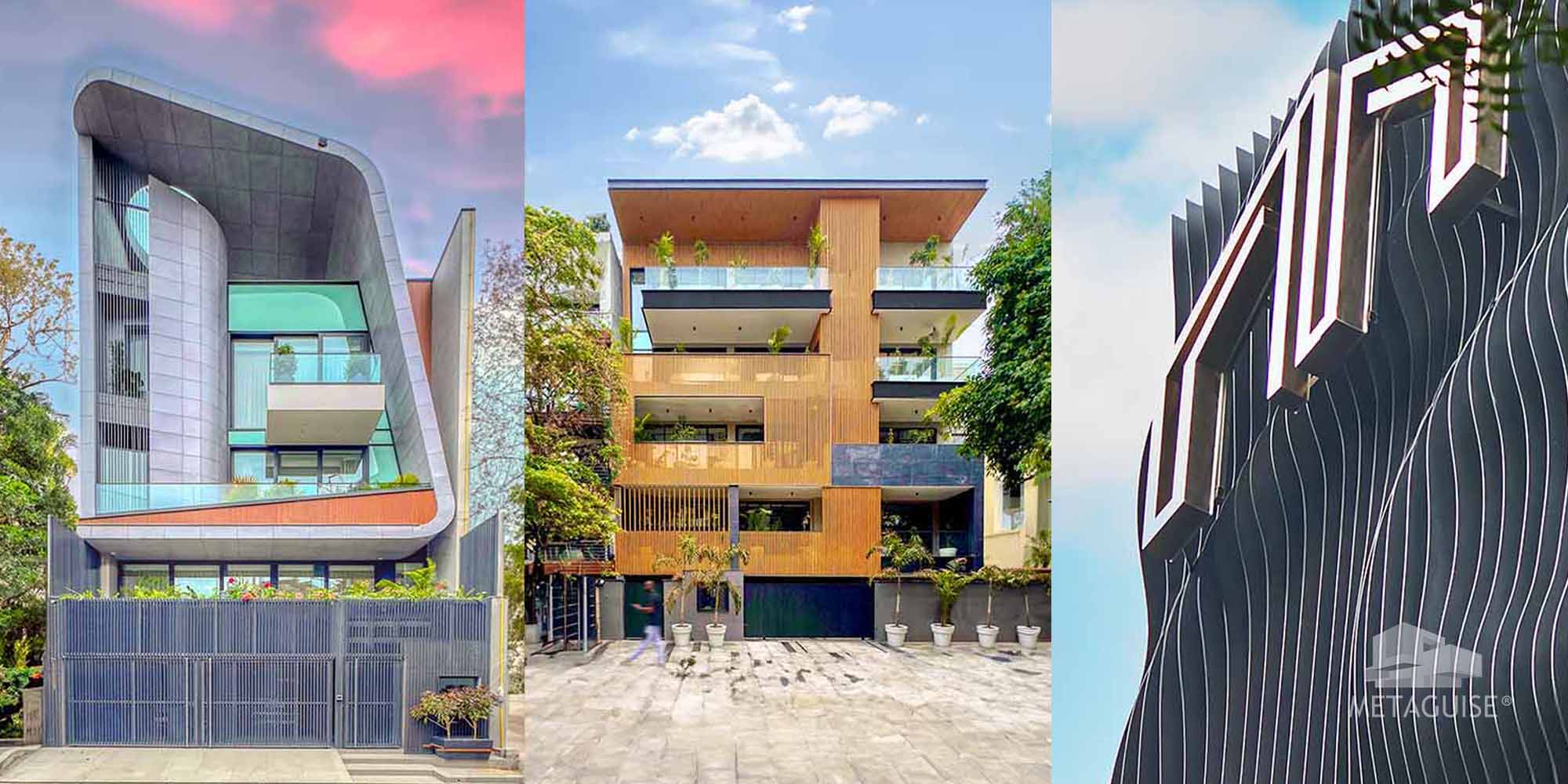
Metaguise's portfolio of duplex and G+1 residential facade projects spans every major market where this building type is prevalent. In South Delhi's Greater Kailash, a G+1 independent floor undergoing redevelopment commissioned Metaguise for a complete facade in MetaFlute vertical panels in a matte warm-grey PVDF finish, paired with a MetaCoin perforated first-floor screen that provides privacy for the master bedroom terrace while creating a visually rich street-facing composition. The project went from bare masonry to completed facade in eleven weeks — within the constraints of a live redevelopment site with ongoing interior fit-out simultaneously. In Chandigarh Sector 9, a bungalow conversion to an independent floor development used MetaCassette panels in a deep charcoal finish on the primary elevation, with a MetaFin brise-soleil system shading the west-facing living room bay. The composition was developed by Metaguise's design team in close collaboration with the resident architect — delivering a facade that honoured Chandigarh's modernist architectural legacy while bringing it unmistakably into 2026. In Ahmedabad's Sindhu Bhavan Road corridor, a newly constructed G+1 villa used Metaguise's MetaCorten weathering steel finish on the boundary wall and ground floor mass, contrasted with a MetaFlute first floor in champagne anodised aluminium. The warm rust-and-gold material palette suited both Gujarat's desert climate and the homeowner's preference for a facade with the warmth of traditional materials executed in a resolutely contemporary manner.
Frequently Asked Questions
1.Is metal cladding suitable for a standard G+1 duplex home, or is it only for larger bungalows?
Metal cladding is entirely suitable for standard G+1 duplex homes — and in many ways better suited to this scale than to large bungalows, because the lightweight nature of aluminium systems (3–6 kg/m²) means they can be installed on existing G+1 masonry without structural assessment or reinforcement in the vast majority of cases. Metaguise regularly delivers duplex facade projects on plots as small as 150 sq yards and facades as compact as 800 sq ft. The system range — from cost-efficient MetaFlute and MetaCassette to selective parametric feature panels — scales to every budget and facade area.2.How do I make a duplex elevation look like one unified building rather than two floors stacked?
Visual unity on a duplex elevation is achieved through three design strategies, all of which Metaguise's systems support: material continuity (running the same panel system across both floors without interruption at the slab joint); vertical rhythm (MetaFlute channels that span the full building height reinforce the vertical gesture rather than the horizontal division); and compositional hierarchy (a single large design element — a full-height perforated screen, an oversized entrance canopy, a wraparound first-floor fin system — that the eye reads as the building's defining feature rather than its floor count). Metaguise's design team develops 3D visualisations of all three strategies before any fabrication commitment is made.3. How long does a Metaguise duplex facade project take from consultation to completion?
For MetaForm modular systems on a standard duplex elevation (1,000–2,500 sq ft), the typical project timeline is 8–12 weeks from design approval to completed installation. This includes 2–3 weeks of design development and material approval, 4–6 weeks of fabrication, and 2–3 weeks of on-site installation. For duplex homes with ongoing interior construction or renovation, Metaguise coordinates installation to minimise overlap with interior trades — typically staging the facade work to follow structural and waterproofing completion.4. Can Metaguise help if I don't have an architect for my duplex facade project?
Yes. Metaguise's design team works directly with homeowners who are commissioning without an architect — developing facade design options based on a site visit, a design brief conversation, and the owner's reference images and aesthetic preferences. The team produces 3D visualisations, physical material samples, and a detailed specification before any commitment is made. For homeowners who do have an architect, Metaguise works within the architect's design framework as the facade specialist — contributing engineering expertise and material knowledge to a design that the architect has already conceived. Get In TouchDuplex House Facade Design Ideas in India - Metal Elevation for G+1 Homes (2026)
12-05-26 | Architectural Insights
Key Takeaways
• Duplex and G+1 homes represent one of India's most architecturally underserved markets — immense investment, yet facades that rarely match the quality of the interior or the ambition of the owner. • Metal panels are uniquely well-suited to duplex elevations: lightweight, retrofit-compatible, available in a wide range of styles, and capable of visually unifying a G+1 composition that might otherwise read as two separate homes stacked on top of each other. • This blog covers the specific design constraints of duplex homes, the metal facade styles that work best at this scale, Metaguise's real G+1 project references, and a cost guide for duplex facade commissions. • Styles covered: modern, contemporary, tropical, Indo-contemporary — with system recommendations for each.
Why Duplex and G+1 Home Facades Deserve More Design Attention
India's duplex and independent floor market is in the middle of a remarkable moment. According to a February 2026 report by Golden Growth Fund, cited in Business Standard, prices of luxury independent floors in South Delhi's Category-A colonies — Chanakyapuri, Golf Links, Jor Bagh, Vasant Vihar, Panchsheel — rose 25–34% year-on-year in 2025. A 2,500 sq ft floor that was priced at ₹10–19 crore in 2024 is now selling for ₹14–25 crore. The redevelopment potential across South Delhi's colonies alone is estimated to exceed ₹6 lakh crore. Beyond Delhi, G+1 independent floors and duplexes are the dominant housing format in Chandigarh's sector bungalows, Ahmedabad's premium residential corridors, and Pune's Koregaon Park and Baner neighbourhoods. Despite this financial significance, the duplex house facade design India market remains remarkably underserved architecturally. Walk through any premium independent floor development and the pattern is consistent: exceptional interior design, thoughtful landscaping, state-of-the-art kitchen and bathroom specification — and a facade that is, at best, a coat of premium paint with a sandstone band. The disconnect is striking. A family will spend ₹15–30 crore on a South Delhi floor and ₹80–150 per sq ft on exterior paint that will begin fading within three years. The reason for this gap is partly habit, partly a lack of awareness of what metal facade systems can achieve at the scale and budget of a duplex home. This blog is designed to close that gap — to show what is genuinely possible on a G+1 or duplex elevation, what it costs, how long it lasts, and what Metaguise has already delivered for duplex homeowners across India.
Designing for the Specific Constraints of Duplex and G+1 Elevations
A duplex home presents specific design challenges that a standalone bungalow does not. Understanding these constraints is the starting point for any successful G+1 facade design. The Two-Floor Visual Problem The most common compositional failure on duplex elevations is the visual reading of two separate homes stacked vertically — ground floor and first floor with different materials, different window rhythms, and no architectural device that ties the composition together. The result is an elevation that looks like a renovation project rather than a designed building. Metal facade systems address this problem directly: a full-height MetaFlute panel that runs continuously from ground to parapet, or a perforated MetaCoin screen that wraps the facade from first floor to canopy, creates visual unity across the two floors through material continuity. Setback and Street Proportion Most duplex plots in Indian cities — whether in South Delhi colonies, Chandigarh sectors, or Pune's Baner — have relatively narrow frontage (typically 20–40 feet wide) but reasonable depth. This means the facade elevation is experienced more as a tall, narrow composition than the wide horizontal format of a large bungalow. Metal systems with strong vertical expression — MetaFlute's vertical channels, full-height SolidPanel compositions with tall window cuts — are particularly effective at this proportion. They reinforce the natural verticality of the building rather than fighting it. Shared Plot Boundaries and Neighbour Context Duplex homes on shared plot boundaries are constrained on side elevations. The street-facing primary elevation is therefore the dominant and often only fully visible facade. This concentrates the design opportunity — and demands that the primary elevation carries all the architectural weight of the composition. For a duplex plot where only 25–30 feet of frontage is visible from the street, precision of material, finish quality, and compositional intelligence matter more, not less. Retrofit Versus New-Build A significant proportion of duplex facade commissions in India are retrofit rather than new-build — homeowners who bought an existing floor in a redeveloped colony and want to bring the exterior up to the standard of their interior. Metaguise's MetaForm systems — MetaFlute, MetaCassette, MetaLouvers, and SolidPanel — are all designed for retrofit compatibility: lightweight sub-frame systems that anchor to existing masonry without structural intervention. The transformation of a DLF independent floor from 2008-era painted render to a precision metal elevation can be achieved without a single day of structural disruption, typically within 6–10 weeks.
Metal Panels: The Perfect Material for Duplex Elevations in India
Metal panels outperform every alternative material category for duplex home exteriors in India on the combination of design flexibility, weight, longevity, and retrofit compatibility. Here is why each characteristic matters specifically for the G+1 context: Weight Advantage G+1 buildings in India — particularly those built in the 1980s–2000s — were not engineered for heavy cladding loads. Adding natural stone cladding (25–75 kg/m²) to an existing G+1 structure without structural assessment is a genuine risk. Metaguise's aluminium systems weigh 3–6 kg/m² — less than a tenth of stone — and place negligible additional load on existing walls and structures. This makes metal the safe, structurally responsible choice for duplex retrofit projects regardless of building age. Visual Continuity Across Floors A MetaFlute panel that runs from ground level to parapet without interruption at the first-floor slab level creates a single, coherent architectural gesture. A MetaCassette grid that maintains consistent joint spacing across both floors makes the composition read as a single building, not two. This visual unity — one of the most powerful architectural effects available on a duplex elevation — is uniquely achievable in metal, where panel dimensions and fixing systems can be designed to span floor-to-floor without interruption. Privacy and Street Management For duplex homes where the first floor sits close to the street — common in South Delhi's redeveloped colonies and Chandigarh's sector plots — perforated metal screens provide privacy for first-floor residents while maintaining visual richness from the street. Metaguise's MetaCoin perforated system and parametric perforated screens allow daylight and cross-ventilation from behind the screen while significantly reducing overlooking from street level. The screen reads as a decorative architectural feature from outside; from inside, it functions as a privacy filter. Solar Control on First Floor Exposures First-floor west-facing rooms in G+1 homes across NCR, Ahmedabad, and Hyderabad are among the most thermally challenged spaces in Indian residential architecture — high sun angle, direct afternoon exposure, and proximity to a flat roof above that generates additional heat. Metaguise's MetaFin architectural fin system, projected from the facade plane above first-floor west-facing windows, can reduce solar heat gain on those windows by 40–60% — translating directly into improved comfort and lower cooling costs for the rooms behind.
Style Guide: Modern, Contemporary, Tropical, and Indo-Contemporary Duplex Facades
Duplex homeowners in India span a wide range of aesthetic sensibilities. The following style frameworks reflect the dominant design languages in each major market — with Metaguise system recommendations for each. Modern Minimalist — For the South Delhi, Gurgaon, and Bangalore Buyer The modern minimalist duplex facade is the most specified style in India's Tier 1 cities in 2026. It is defined by restraint: flush surfaces, concealed joints, monochromatic palette, and the absence of decorative ornament. In metal, this translates to SolidPanel or large-format MetaCassette in matte charcoal, warm white, or deep anthracite PVDF finishes, combined with dark-frame glazing and a recessed entrance. The composition is architectural in the truest sense: it achieves drama through proportion and precision, not through surface decoration. Suited to: South Delhi Category-A and B colonies, DLF Phase 1–3, Koregaon Park Pune, Indiranagar Bangalore. Contemporary Textured — For the Chandigarh, Ludhiana, and Ahmedabad Buyer The contemporary textured duplex elevation adds three-dimensional relief to the minimalist template — through fluted panels, folded geometry, or ribbed surfaces that create shadow play and visual depth. Metaguise's MetaFlute is the primary system for this style: vertical channel profiles in widths of 75mm–150mm create strong shadow lines and a tactile richness that painted or flat-panel surfaces cannot achieve. In Chandigarh's sector bungalows — where the grid-plan layout means homes are viewed from a uniform setback — MetaFlute elevations read with particular clarity and architectural authority. Suited to: Chandigarh Sectors 7–22, Ludhiana's Ansal Sushant City, Ahmedabad's Sindhu Bhavan Road. Tropical Biophilic — For the Bangalore, Pune, Kochi, and Goa Buyer The tropical biophilic duplex facade integrates planting and greenery with metal screen structures — creating an elevation where living walls, climbing plants, and lush planting are threaded through perforated metal frames. Metaguise's parametric perforated systems and MetaFin fin structures are the preferred scaffold for biophilic facade compositions. The metal provides the structural framework; the planting provides the life. At monsoon peak in Bangalore or Pune, a biophilic duplex facade becomes a genuinely extraordinary composition — deep green against warm metal, light filtering through leaf and perforation simultaneously. Suited to: Sarjapur Road and Whitefield Bangalore, Baner and Wakad Pune, Aluva and Kakkanad Kochi. Indo-Contemporary — For the Heritage-Context Buyer The Indo-contemporary style bridges traditional Indian material culture — jaali patterns, geometric ornament, warm terracotta and copper tones — with the precision of contemporary metal fabrication. Metaguise's MetaCoin circular modules and parametric perforated screens in patterns derived from Mughal geometry, Rajasthani lattice, or South Indian mandala forms are the most powerful tools for this compositional language. In a South Delhi Vasant Vihar duplex or a Jaipur Malviya Nagar G+1 home, an Indo-contemporary metal screen facade achieves something rare in residential architecture: it is unmistakably Indian, unmistakably contemporary, and unmistakably individual.
Real Projects: Duplex and G+1 Facades by Metaguise Across India
Metaguise's portfolio of duplex and G+1 residential facade projects spans every major market where this building type is prevalent. In South Delhi's Greater Kailash, a G+1 independent floor undergoing redevelopment commissioned Metaguise for a complete facade in MetaFlute vertical panels in a matte warm-grey PVDF finish, paired with a MetaCoin perforated first-floor screen that provides privacy for the master bedroom terrace while creating a visually rich street-facing composition. The project went from bare masonry to completed facade in eleven weeks — within the constraints of a live redevelopment site with ongoing interior fit-out simultaneously. In Chandigarh Sector 9, a bungalow conversion to an independent floor development used MetaCassette panels in a deep charcoal finish on the primary elevation, with a MetaFin brise-soleil system shading the west-facing living room bay. The composition was developed by Metaguise's design team in close collaboration with the resident architect — delivering a facade that honoured Chandigarh's modernist architectural legacy while bringing it unmistakably into 2026. In Ahmedabad's Sindhu Bhavan Road corridor, a newly constructed G+1 villa used Metaguise's MetaCorten weathering steel finish on the boundary wall and ground floor mass, contrasted with a MetaFlute first floor in champagne anodised aluminium. The warm rust-and-gold material palette suited both Gujarat's desert climate and the homeowner's preference for a facade with the warmth of traditional materials executed in a resolutely contemporary manner.
Frequently Asked Questions
1.Is metal cladding suitable for a standard G+1 duplex home, or is it only for larger bungalows?
Metal cladding is entirely suitable for standard G+1 duplex homes — and in many ways better suited to this scale than to large bungalows, because the lightweight nature of aluminium systems (3–6 kg/m²) means they can be installed on existing G+1 masonry without structural assessment or reinforcement in the vast majority of cases. Metaguise regularly delivers duplex facade projects on plots as small as 150 sq yards and facades as compact as 800 sq ft. The system range — from cost-efficient MetaFlute and MetaCassette to selective parametric feature panels — scales to every budget and facade area.2.How do I make a duplex elevation look like one unified building rather than two floors stacked?
Visual unity on a duplex elevation is achieved through three design strategies, all of which Metaguise's systems support: material continuity (running the same panel system across both floors without interruption at the slab joint); vertical rhythm (MetaFlute channels that span the full building height reinforce the vertical gesture rather than the horizontal division); and compositional hierarchy (a single large design element — a full-height perforated screen, an oversized entrance canopy, a wraparound first-floor fin system — that the eye reads as the building's defining feature rather than its floor count). Metaguise's design team develops 3D visualisations of all three strategies before any fabrication commitment is made.3. How long does a Metaguise duplex facade project take from consultation to completion?
For MetaForm modular systems on a standard duplex elevation (1,000–2,500 sq ft), the typical project timeline is 8–12 weeks from design approval to completed installation. This includes 2–3 weeks of design development and material approval, 4–6 weeks of fabrication, and 2–3 weeks of on-site installation. For duplex homes with ongoing interior construction or renovation, Metaguise coordinates installation to minimise overlap with interior trades — typically staging the facade work to follow structural and waterproofing completion.4. Can Metaguise help if I don't have an architect for my duplex facade project?
Yes. Metaguise's design team works directly with homeowners who are commissioning without an architect — developing facade design options based on a site visit, a design brief conversation, and the owner's reference images and aesthetic preferences. The team produces 3D visualisations, physical material samples, and a detailed specification before any commitment is made. For homeowners who do have an architect, Metaguise works within the architect's design framework as the facade specialist — contributing engineering expertise and material knowledge to a design that the architect has already conceived. Get In TouchRelated Articles
Related Articles
Architectural Luxury, Within Reach: Why MetaFlutes and MetaLouvers Are the Smartest Investment in Metal Facades
In today’s built environment, luxury is no longer defined by extravagance - it’s defined by intention. It’s about refined details, enduring finishes, and design that performs as beautifully as it looks. At Metaguise, our metal facade systems - MetaFlutes, MetaLouvers, and MetaCassette Perforated - are crafted to bring that standard of architectural luxury within reach...
07-04-25 | Architectural Insights
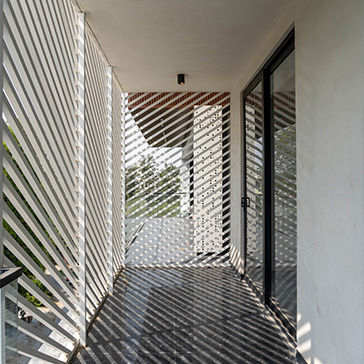
Why Architects Are Turning to Custom Metal Louvers in 2025
There’s something quietly brilliant happening in architecture right now. As buildings become more responsive and designers look for ways to merge aesthetics with performance, one feature is making a serious comeback, custom metal louvers.
03-06-25 | Architectural Insights
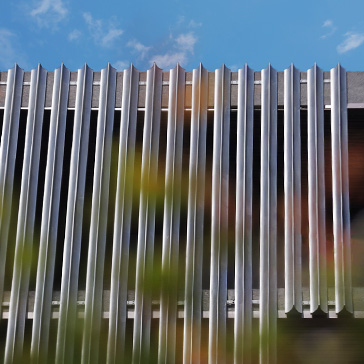
The Science of Shadows: How Facade Design Shapes Light and Mood
Architecture has always been about more than structure - it’s about rhythm, reflection, and the way light interacts with space.At Metaguise, we see every innovative facade as a living canvas, one that transforms not just how a building looks, but how it feels. Light becomes our material, and shadow becomes our tool.This is the art and the science behind MetaLouvers, MetaCassette, and the entire Metaguise facade family.
13-10-25 | Architectural Insights
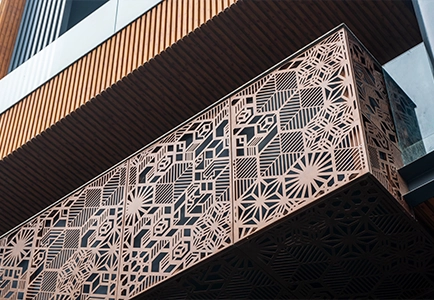
Custom Metal Facade Cladding in 2026: Design, Cost, Materials & Architect Guide
Explore how commercial spaces are using Metaguise facades to express identity and elevate perception.
24-11-25 | Architectural Insights
Social
Legal
Privacy Policy|Terms & Conditions