






Corten Steel Facade India: The Rustic Metal Trend Taking Over in 2026
07-07-26 | Facade Innovations
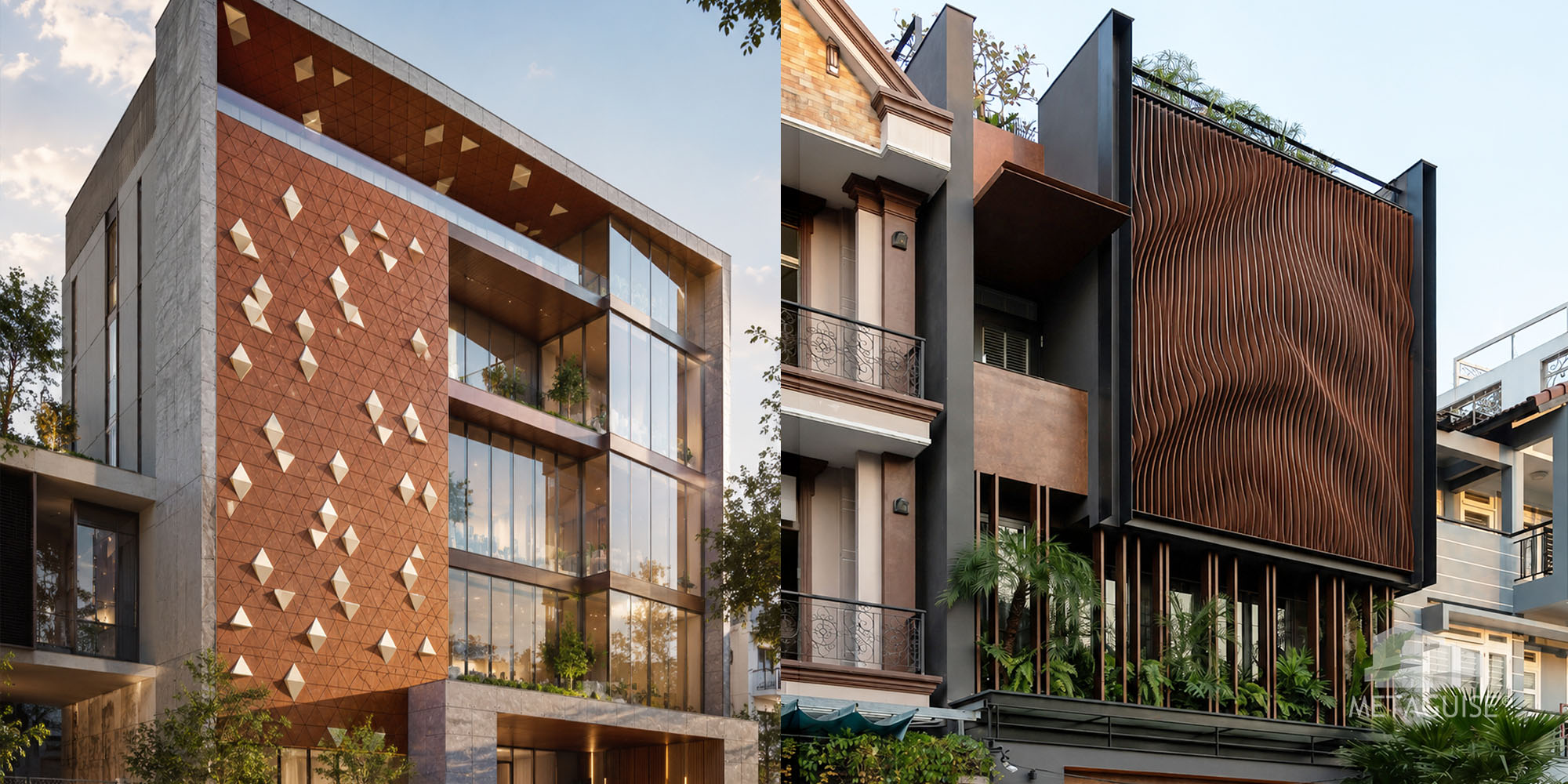
Key Takeaways
• Corten steel is the most culturally resonant metal facade material for inland Indian architecture. Its warm rust-brown patina echoes India's terracotta traditions, red laterite soils, and the warm iron tones of traditional craft in a way that no painted or coated surface can authentically replicate. • The Indian green building materials market was valued at USD 15.5 billion in 2025, growing at an 11.3% CAGR. Corten's zero-paint lifecycle, 50-plus year design life in appropriate inland climates, and full recyclability make it one of the most sustainable facade material choices for inland Indian projects. • Corten is NOT suitable for coastal locations within 5 km of the sea. In salt-air environments, the protective patina does not form correctly and active corrosion results. Metaguise's MetaCorten finish system delivers the Corten aesthetic on aluminium for coastal projects where actual Corten steel cannot be used. • This guide covers what Corten is, why it is trending in India, where to use it, coastal versus inland performance, Corten projects by Metaguise, and what a correct specification looks like.
What Is Corten / Weathering Steel?
There is a particular quality that Corten develops over time that no painted surface ever achieves. In its first season, it is bright orange, the colour of fresh rust on a farm gate. Through the second monsoon, it deepens to a warm chestnut. By the third or fourth year, it has settled into the dark warm brown of aged iron, of terracotta left in the rain, of the red-ochre soil that runs through Rajasthan and the laterite hillsides of the Western Ghats. This is not weathering in the sense of deterioration. It is weathering steel doing exactly what its chemistry was designed to do: forming a dense, stable rust layer that seals the underlying metal from further oxidation and makes the material, in the right environment, effectively permanent. The visual result is a surface that cannot be faked. You can apply a rust-tone paint and it will look like rust-tone paint. Corten looks like something that earned its colour by standing in the weather for years, because that is exactly what happened.
Why Corten Is Trending in Indian Architecture
The Corten trend in Indian architecture is driven by a cultural and material alignment that has been building for a decade. According to the India Green Building Materials Market report by PS Market Research 2025, the Indian green building materials market is valued at USD 15.5 billion in 2025 and growing at an 11.3% CAGR toward USD 32.2 billion by 2032. Corten steel with its zero-paint lifecycle, 50-plus year design life in appropriate inland climates, and full recyclability is increasingly specified as a sustainable facade material that aligns with ESG-conscious developer briefs. Beyond sustainability, Corten's primary appeal in India is cultural resonance. The warm rust-brown tones of stabilised Corten patina are deeply embedded in India's material vocabulary. The red laterite soil of Goa and Kerala. The warm terracotta of Rajasthani and Gujarati craft. The oxidised iron of traditional farm implements and compound gates. The warm brown of aged timber. These are not coincidental associations. They are the reason Corten facades on farmhouses, rural retreats, and landscape-integrated residential projects in India feel materially honest in a way that painted steel or aluminium panels in similar contexts do not.
Where to Use Corten in India: Best Application Contexts
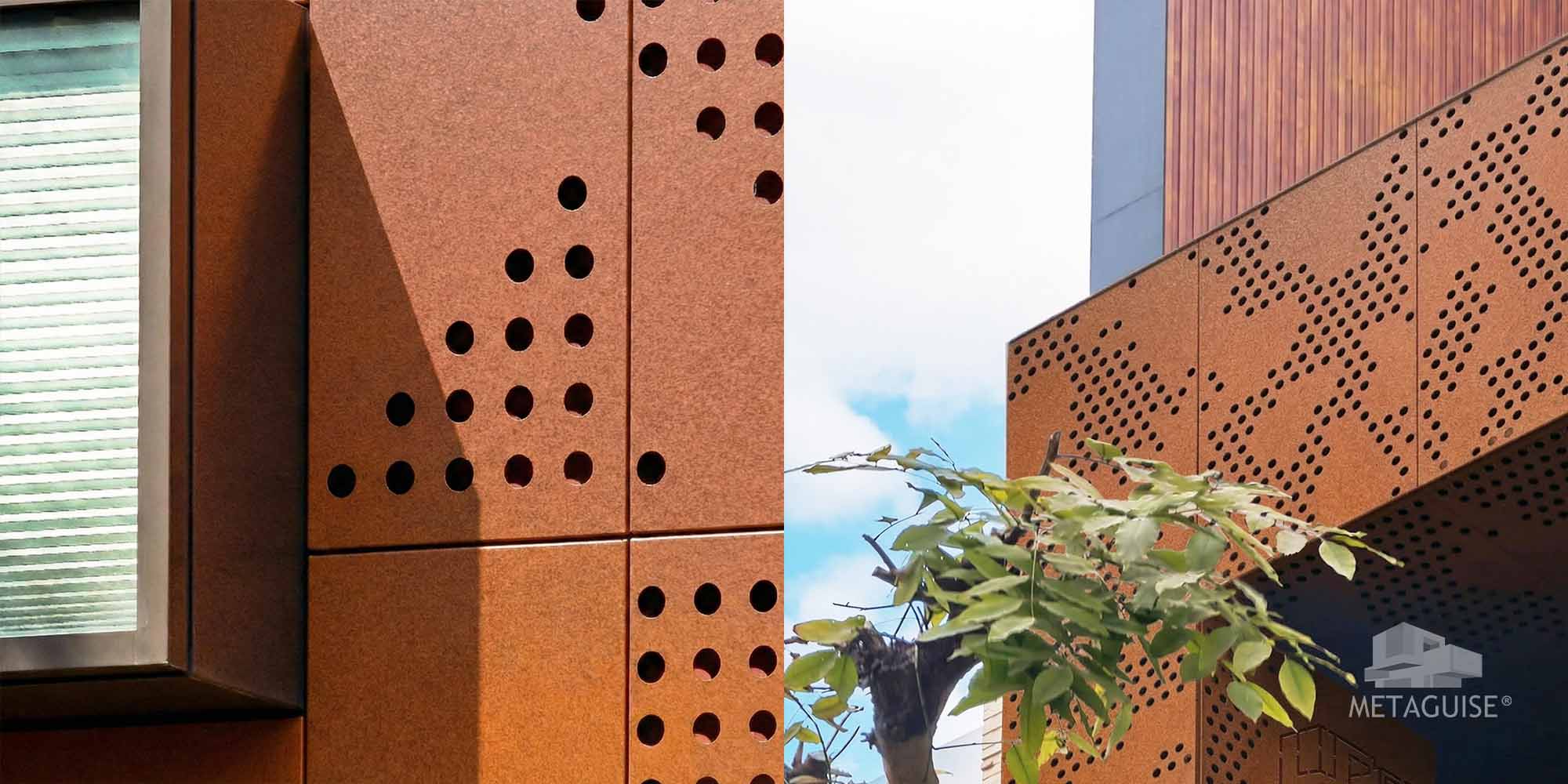
Farmhouses and Rural Retreats The Mehrauli-Gurgaon farmhouse belt, Maharashtra's Karjat and Lonavala corridor, Rajasthan's rural villa developments, and Karnataka's Ghats-edge retreats are Corten's natural habitat in Indian architecture. On these projects, Corten boundary walls, entrance gate structures, and primary building mass elements read as materially rooted in the landscape — buildings that belong to the earth rather than being imposed on it. Inland Luxury Bungalows For luxury bungalows in inland cities — NCR, Ahmedabad, Jaipur, Nagpur, Indore — Corten on boundary walls and entrance features paired with MetaFlute or MetaCassette on the primary building elevation creates a material hierarchy that is simultaneously contemporary and culturally grounded. The Corten warm-earth tone of the boundary is the landscape; the precision PVDF metal of the building is the architecture. Commercial and Institutional Buildings For commercial headquarters in inland India — particularly agricultural and industrial companies whose brand identity is rooted in the land — Corten on building plinths, feature walls, and landscape elements communicates material honesty and permanence that contemporary glass-and-metal commercial architecture rarely achieves. Resort and Hospitality Architecture Boutique hotels in Rajasthan, eco-resorts in Kerala, and heritage hospitality properties across India's culturally rich destinations are among Corten's most successful application contexts. The material's reference to aged, crafted, and regionally specific surfaces resonates perfectly with the heritage hospitality brief — 'a property that feels as though it has always been here.'
Coastal vs Inland: Corten Limitations and Metaguise's Solution
The Coastal Prohibition Corten steel's performance requires the alternating wet-dry cycles that drive the protective patina formation. In heavy salt-air environments — within approximately 5 km of India's coastlines — the chloride ions in the air disrupt this process, causing the rust to remain active rather than forming a stable protective layer. The result is accelerating pitting corrosion rather than a protective patina. For coastal projects, actual Corten steel is not appropriate as a facade material. MetaCorten: The Coastal-Safe Corten Aesthetic Metaguise's MetaCorten finish system — a PVDF coating applied to solid aluminium panels that precisely renders the warm rust-brown tone of stabilised Corten patina — provides the Corten aesthetic in a substrate that performs without constraint in coastal salt-air environments. MetaCorten aluminium delivers the visual warmth of weathering steel without Corten's performance limitation in coastal and high-humidity applications. It is specified on Metaguise coastal projects in Mumbai, Goa, Chennai, and Kerala wherever the design brief calls for a warm earth-metal palette.
Corten Projects by Metaguise
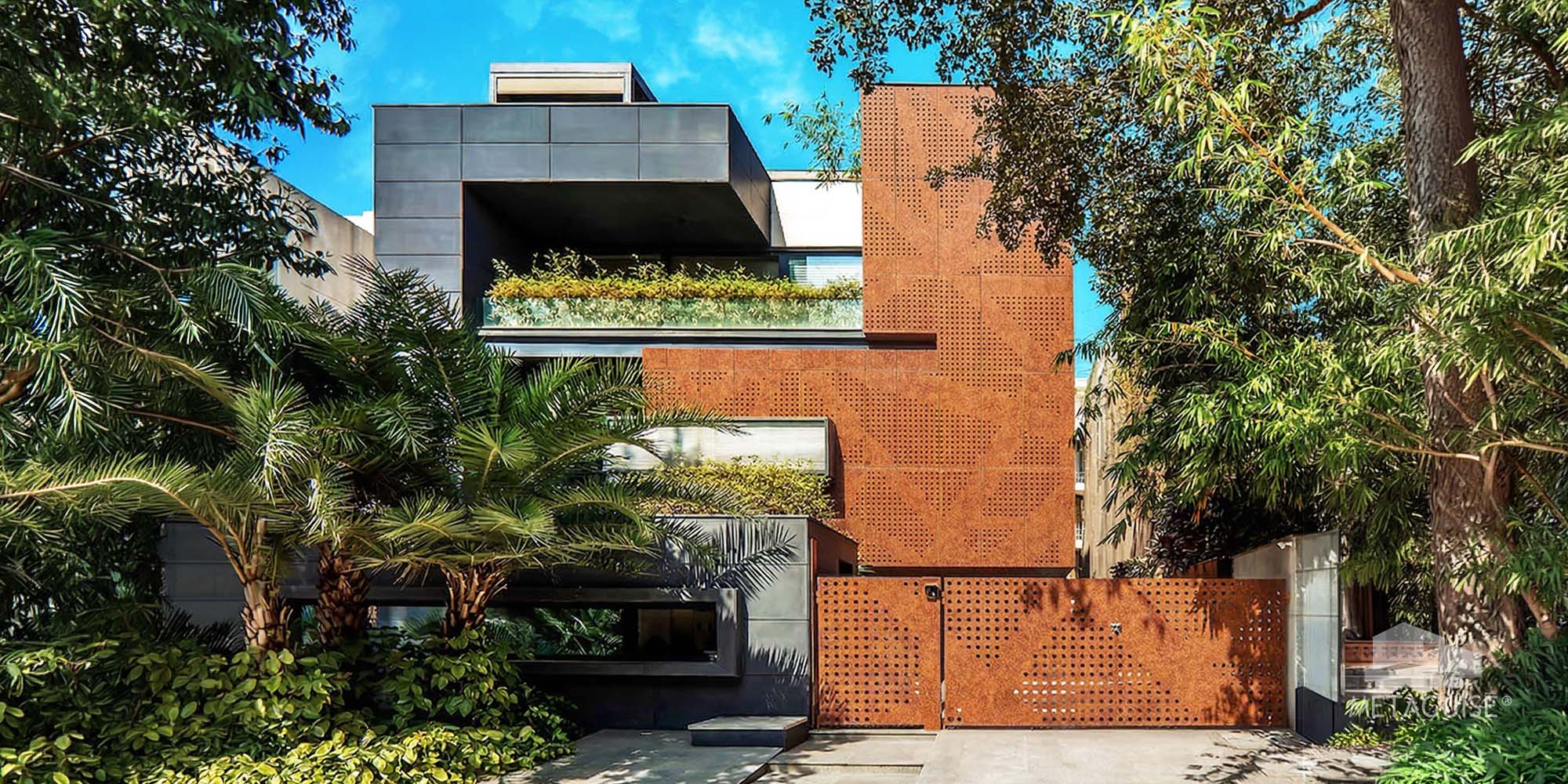
Farmhouse Estate, Karjat — Corten Boundary and MetaWood Primary Building A weekend retreat in Karjat's hill belt used actual Corten steel panels on the compound boundary wall and entrance gate structure, combined with MetaWood finish aluminium on the primary building's covered terrace elements. The Corten boundary patinated through the first two Karjat monsoons into a warm chestnut brown that deepened with each wet season — creating a boundary that appeared to have been part of the landscape for decades. The project received publication in an architecture journal six months after completion. Luxury Villa, Jaipur — MetaCorten Entrance Feature A luxury villa in Jaipur's Ajmer Road premium corridor used MetaCorten PVDF on a MetaPyramid three-dimensional relief entrance feature — warm rust-brown pyramid panels flanking the entrance gate, resonating with Rajasthan's terracotta and sandstone material traditions. The MetaCorten specification was chosen over actual Corten because the client's property shares a wall with an adjacent project in a lightly salt-influenced zone — and MetaCorten's aluminium substrate eliminated any corrosion risk. Corporate Headquarters, Nagpur — Corten Plinth and SolidPanel Tower A Nagpur industrial group's headquarters used actual Corten steel on the ground-floor plinth element — a 600mm-high horizontal band that meets the ground plane with the warmth of aged iron — above which SolidPanel in deep charcoal PVDF clad the tower floors. The contrast between the warm, textured Corten base and the cool, precise charcoal metal above created an architectural composition that referenced both the company's industrial heritage and its contemporary ambitions.
Corten Specifications: What to Know
• Standard Corten grades: ASTM A588 and ASTM A242 are the primary architectural Corten grades — specified for facade and cladding applications • Panel thickness: Typically 3mm or 4mm for facade panel applications — sufficient structural stiffness for standard facade spans • Fixing systems: All fixings in Corten applications must be stainless steel Grade 316 — galvanised or mild steel fixings will corrode when in contact with Corten's wet patina surface • Drainage detailing: Critical — Corten runoff (orange-brown water from the patinating surface) will stain any porous material (stone, concrete, render) it contacts. Drainage must be designed to direct Corten runoff away from all stainable surfaces • Patination timeline: Initial orange-rust (months 1–6); warm chestnut development (year 1–2); stabilised deep warm brown (years 3–5). The timeline varies by climate — high-humidity monsoon zones accelerate patination; arid zones slow it • Maintenance: Zero maintenance required after patina stabilisation — annual fresh-water rinsing to remove debris from drainage channels; no painting, sealing, or chemical treatment
Frequently Asked Questions
1.Will Corten steel stain my driveway or stone paving?
Yes — this is the most common Corten installation error and the source of most homeowner dissatisfaction with the material. Corten runoff from the patinating surface during the first 2–3 years is orange-brown and will stain concrete, sandstone, limestone, and any other porous material it contacts. All Corten facade and boundary installations must have designed drainage provision that routes runoff away from paving, planting beds, and adjacent walls. Metaguise specifies stainless steel drainage channels at the base of all Corten installations as standard. For projects where drainage is constrained, MetaCorten PVDF on aluminium is recommended — the aluminium substrate produces no runoff.2. Can I accelerate the patination process so the Corten looks aged faster?
Patination can be encouraged by increasing the surface's exposure to moisture and oxygen — regular light misting in dry seasons, or leaving the surface exposed to rain without protective covering, will accelerate the process. Commercial patination accelerators are available but must be used with caution — accelerated patination can produce an uneven finish if applied incorrectly. Metaguise's recommendation is to allow natural patination to proceed at its own pace — the gradual deepening of the rust tone is part of the material's architectural character, and forcing it can produce a less stable and less aesthetically consistent result.3.How does Corten compare to MetaCorten — which should I specify?
Actual Corten steel is appropriate for: inland projects where coastal salt-air is not a risk; projects where the patination process (and its timeline) is valued as an architectural narrative; and projects where the heavier gauge and natural surface texture of weathering steel is part of the design intent. MetaCorten PVDF on aluminium is appropriate for: coastal and humidity-sensitive locations; projects where drainage constraints make Corten runoff staining a risk; projects where the Corten palette is required alongside other MetaSurface finishes in a unified system; and retrofit projects where the substrate structure cannot carry the weight of thick steel panels. Contact Metaguise to discuss which specification is correct for your specific project and site.4.Is Corten steel appropriate for a roofing application in India?
Corten steel can be used for sloped roofing applications — it has been widely used for agricultural and industrial roofing internationally. For residential and commercial premium roofing in India, however, MetaShingles in MetaCorten tone PVDF is Metaguise's preferred specification: the aluminium substrate is significantly lighter (reducing structural load), easier to fabricate into shingle profile, and eliminates the drainage staining risk that makes actual Corten runoff problematic on residential properties.Corten Steel Facade India: The Rustic Metal Trend Taking Over in 2026
07-07-26 | Facade Innovations
Key Takeaways
• Corten steel is the most culturally resonant metal facade material for inland Indian architecture. Its warm rust-brown patina echoes India's terracotta traditions, red laterite soils, and the warm iron tones of traditional craft in a way that no painted or coated surface can authentically replicate. • The Indian green building materials market was valued at USD 15.5 billion in 2025, growing at an 11.3% CAGR. Corten's zero-paint lifecycle, 50-plus year design life in appropriate inland climates, and full recyclability make it one of the most sustainable facade material choices for inland Indian projects. • Corten is NOT suitable for coastal locations within 5 km of the sea. In salt-air environments, the protective patina does not form correctly and active corrosion results. Metaguise's MetaCorten finish system delivers the Corten aesthetic on aluminium for coastal projects where actual Corten steel cannot be used. • This guide covers what Corten is, why it is trending in India, where to use it, coastal versus inland performance, Corten projects by Metaguise, and what a correct specification looks like.
What Is Corten / Weathering Steel?
There is a particular quality that Corten develops over time that no painted surface ever achieves. In its first season, it is bright orange, the colour of fresh rust on a farm gate. Through the second monsoon, it deepens to a warm chestnut. By the third or fourth year, it has settled into the dark warm brown of aged iron, of terracotta left in the rain, of the red-ochre soil that runs through Rajasthan and the laterite hillsides of the Western Ghats. This is not weathering in the sense of deterioration. It is weathering steel doing exactly what its chemistry was designed to do: forming a dense, stable rust layer that seals the underlying metal from further oxidation and makes the material, in the right environment, effectively permanent. The visual result is a surface that cannot be faked. You can apply a rust-tone paint and it will look like rust-tone paint. Corten looks like something that earned its colour by standing in the weather for years, because that is exactly what happened.
Why Corten Is Trending in Indian Architecture
The Corten trend in Indian architecture is driven by a cultural and material alignment that has been building for a decade. According to the India Green Building Materials Market report by PS Market Research 2025, the Indian green building materials market is valued at USD 15.5 billion in 2025 and growing at an 11.3% CAGR toward USD 32.2 billion by 2032. Corten steel with its zero-paint lifecycle, 50-plus year design life in appropriate inland climates, and full recyclability is increasingly specified as a sustainable facade material that aligns with ESG-conscious developer briefs. Beyond sustainability, Corten's primary appeal in India is cultural resonance. The warm rust-brown tones of stabilised Corten patina are deeply embedded in India's material vocabulary. The red laterite soil of Goa and Kerala. The warm terracotta of Rajasthani and Gujarati craft. The oxidised iron of traditional farm implements and compound gates. The warm brown of aged timber. These are not coincidental associations. They are the reason Corten facades on farmhouses, rural retreats, and landscape-integrated residential projects in India feel materially honest in a way that painted steel or aluminium panels in similar contexts do not.
Where to Use Corten in India: Best Application Contexts
Farmhouses and Rural Retreats The Mehrauli-Gurgaon farmhouse belt, Maharashtra's Karjat and Lonavala corridor, Rajasthan's rural villa developments, and Karnataka's Ghats-edge retreats are Corten's natural habitat in Indian architecture. On these projects, Corten boundary walls, entrance gate structures, and primary building mass elements read as materially rooted in the landscape — buildings that belong to the earth rather than being imposed on it. Inland Luxury Bungalows For luxury bungalows in inland cities — NCR, Ahmedabad, Jaipur, Nagpur, Indore — Corten on boundary walls and entrance features paired with MetaFlute or MetaCassette on the primary building elevation creates a material hierarchy that is simultaneously contemporary and culturally grounded. The Corten warm-earth tone of the boundary is the landscape; the precision PVDF metal of the building is the architecture. Commercial and Institutional Buildings For commercial headquarters in inland India — particularly agricultural and industrial companies whose brand identity is rooted in the land — Corten on building plinths, feature walls, and landscape elements communicates material honesty and permanence that contemporary glass-and-metal commercial architecture rarely achieves. Resort and Hospitality Architecture Boutique hotels in Rajasthan, eco-resorts in Kerala, and heritage hospitality properties across India's culturally rich destinations are among Corten's most successful application contexts. The material's reference to aged, crafted, and regionally specific surfaces resonates perfectly with the heritage hospitality brief — 'a property that feels as though it has always been here.'
Coastal vs Inland: Corten Limitations and Metaguise's Solution
The Coastal Prohibition Corten steel's performance requires the alternating wet-dry cycles that drive the protective patina formation. In heavy salt-air environments — within approximately 5 km of India's coastlines — the chloride ions in the air disrupt this process, causing the rust to remain active rather than forming a stable protective layer. The result is accelerating pitting corrosion rather than a protective patina. For coastal projects, actual Corten steel is not appropriate as a facade material. MetaCorten: The Coastal-Safe Corten Aesthetic Metaguise's MetaCorten finish system — a PVDF coating applied to solid aluminium panels that precisely renders the warm rust-brown tone of stabilised Corten patina — provides the Corten aesthetic in a substrate that performs without constraint in coastal salt-air environments. MetaCorten aluminium delivers the visual warmth of weathering steel without Corten's performance limitation in coastal and high-humidity applications. It is specified on Metaguise coastal projects in Mumbai, Goa, Chennai, and Kerala wherever the design brief calls for a warm earth-metal palette.
Corten Projects by Metaguise
Farmhouse Estate, Karjat — Corten Boundary and MetaWood Primary Building A weekend retreat in Karjat's hill belt used actual Corten steel panels on the compound boundary wall and entrance gate structure, combined with MetaWood finish aluminium on the primary building's covered terrace elements. The Corten boundary patinated through the first two Karjat monsoons into a warm chestnut brown that deepened with each wet season — creating a boundary that appeared to have been part of the landscape for decades. The project received publication in an architecture journal six months after completion. Luxury Villa, Jaipur — MetaCorten Entrance Feature A luxury villa in Jaipur's Ajmer Road premium corridor used MetaCorten PVDF on a MetaPyramid three-dimensional relief entrance feature — warm rust-brown pyramid panels flanking the entrance gate, resonating with Rajasthan's terracotta and sandstone material traditions. The MetaCorten specification was chosen over actual Corten because the client's property shares a wall with an adjacent project in a lightly salt-influenced zone — and MetaCorten's aluminium substrate eliminated any corrosion risk. Corporate Headquarters, Nagpur — Corten Plinth and SolidPanel Tower A Nagpur industrial group's headquarters used actual Corten steel on the ground-floor plinth element — a 600mm-high horizontal band that meets the ground plane with the warmth of aged iron — above which SolidPanel in deep charcoal PVDF clad the tower floors. The contrast between the warm, textured Corten base and the cool, precise charcoal metal above created an architectural composition that referenced both the company's industrial heritage and its contemporary ambitions.
Corten Specifications: What to Know
• Standard Corten grades: ASTM A588 and ASTM A242 are the primary architectural Corten grades — specified for facade and cladding applications • Panel thickness: Typically 3mm or 4mm for facade panel applications — sufficient structural stiffness for standard facade spans • Fixing systems: All fixings in Corten applications must be stainless steel Grade 316 — galvanised or mild steel fixings will corrode when in contact with Corten's wet patina surface • Drainage detailing: Critical — Corten runoff (orange-brown water from the patinating surface) will stain any porous material (stone, concrete, render) it contacts. Drainage must be designed to direct Corten runoff away from all stainable surfaces • Patination timeline: Initial orange-rust (months 1–6); warm chestnut development (year 1–2); stabilised deep warm brown (years 3–5). The timeline varies by climate — high-humidity monsoon zones accelerate patination; arid zones slow it • Maintenance: Zero maintenance required after patina stabilisation — annual fresh-water rinsing to remove debris from drainage channels; no painting, sealing, or chemical treatment
Frequently Asked Questions
1.Will Corten steel stain my driveway or stone paving?
Yes — this is the most common Corten installation error and the source of most homeowner dissatisfaction with the material. Corten runoff from the patinating surface during the first 2–3 years is orange-brown and will stain concrete, sandstone, limestone, and any other porous material it contacts. All Corten facade and boundary installations must have designed drainage provision that routes runoff away from paving, planting beds, and adjacent walls. Metaguise specifies stainless steel drainage channels at the base of all Corten installations as standard. For projects where drainage is constrained, MetaCorten PVDF on aluminium is recommended — the aluminium substrate produces no runoff.2. Can I accelerate the patination process so the Corten looks aged faster?
Patination can be encouraged by increasing the surface's exposure to moisture and oxygen — regular light misting in dry seasons, or leaving the surface exposed to rain without protective covering, will accelerate the process. Commercial patination accelerators are available but must be used with caution — accelerated patination can produce an uneven finish if applied incorrectly. Metaguise's recommendation is to allow natural patination to proceed at its own pace — the gradual deepening of the rust tone is part of the material's architectural character, and forcing it can produce a less stable and less aesthetically consistent result.3.How does Corten compare to MetaCorten — which should I specify?
Actual Corten steel is appropriate for: inland projects where coastal salt-air is not a risk; projects where the patination process (and its timeline) is valued as an architectural narrative; and projects where the heavier gauge and natural surface texture of weathering steel is part of the design intent. MetaCorten PVDF on aluminium is appropriate for: coastal and humidity-sensitive locations; projects where drainage constraints make Corten runoff staining a risk; projects where the Corten palette is required alongside other MetaSurface finishes in a unified system; and retrofit projects where the substrate structure cannot carry the weight of thick steel panels. Contact Metaguise to discuss which specification is correct for your specific project and site.4.Is Corten steel appropriate for a roofing application in India?
Corten steel can be used for sloped roofing applications — it has been widely used for agricultural and industrial roofing internationally. For residential and commercial premium roofing in India, however, MetaShingles in MetaCorten tone PVDF is Metaguise's preferred specification: the aluminium substrate is significantly lighter (reducing structural load), easier to fabricate into shingle profile, and eliminates the drainage staining risk that makes actual Corten runoff problematic on residential properties.Related Articles
Related Articles
The Rise of Parametric facades: Designing with Algorithmic Elegance
A revolutionary parametric facade system designed to elevate architectural aesthetics. Crafted with premium metals and enhanced with MetaSurface finishes, MetaCoin offers unparalleled customizability, from the shape and size of each element to its color and arrangement. Its dynamic design reacts to light and perspective, creating ever-changing visual effects. Ideal for contemporary and iconic structures, MetaCoin transforms facades into captivating works of art that are sustainable, durable, and visually stunning.
01-04-25 | Facade Innovations
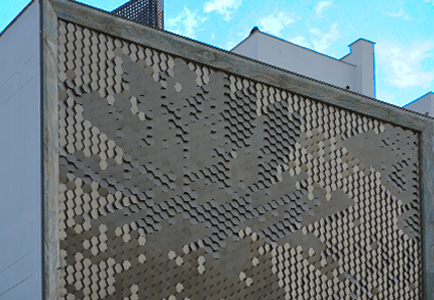
METABLOX™ by Metaguise: A Breakthrough in Parametric Facade Design
At the intersection of culture, craftsmanship, and cutting-edge geometry, METABLOX™ emerges as a bold new direction in architectural innovation. Introduced by Metaguise, this first-of-its-kind parametric facade technology makes its striking debut at the RJ Jewellers flagship store in Jaipur - setting a new benchmark in the world of metal design and modern Indian architecture.
09-04-25 | Facade Innovations
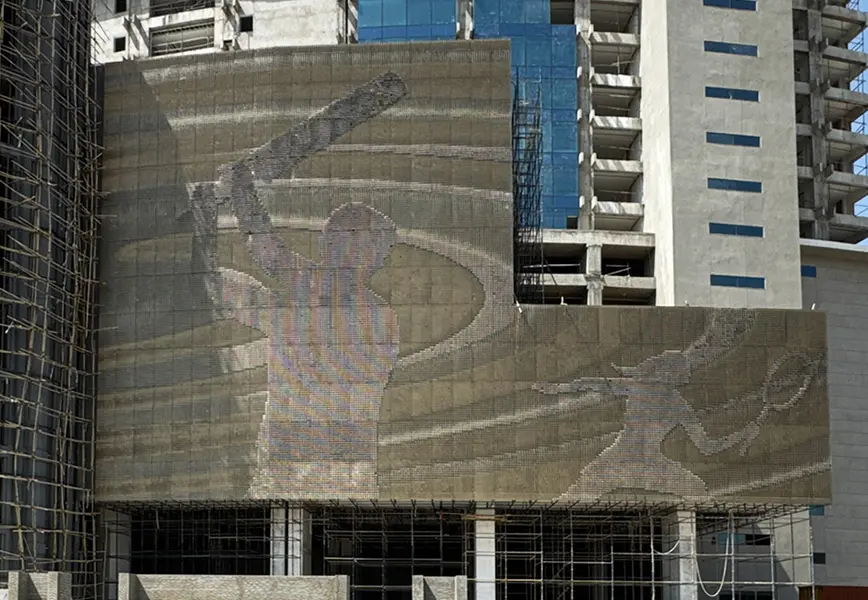
5 Landmark Projects That Used MetaCoin to Transform Facades
When it comes to parametric architecture, MetaCoin stands out as a revolutionary metal coin facade system. Crafted with precision, it offers dynamic aesthetics, adaptability, and a unique identity to structures. Let's delve into five notable projects where MetaCoin has redefined architectural facades.
13-05-25 | Facade Innovations
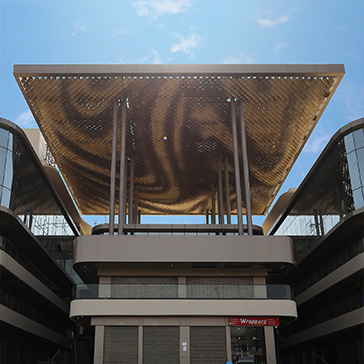
From Code to Construction: How Parametric Facades Are Built
Some buildings just make you look twice. Maybe it’s the way the facade curves. Or how the surface catches the light at different times of day. Often, what you’re seeing is more than just a design, it’s a parametric facade.
10-06-25 | Facade Innovations
Social
Legal
Privacy Policy|Terms & Conditions