





AI-Designed Facades: How Machine Learning Is Reshaping Building Design in India
05-07-26 | Facade Innovations
Key Takeaways
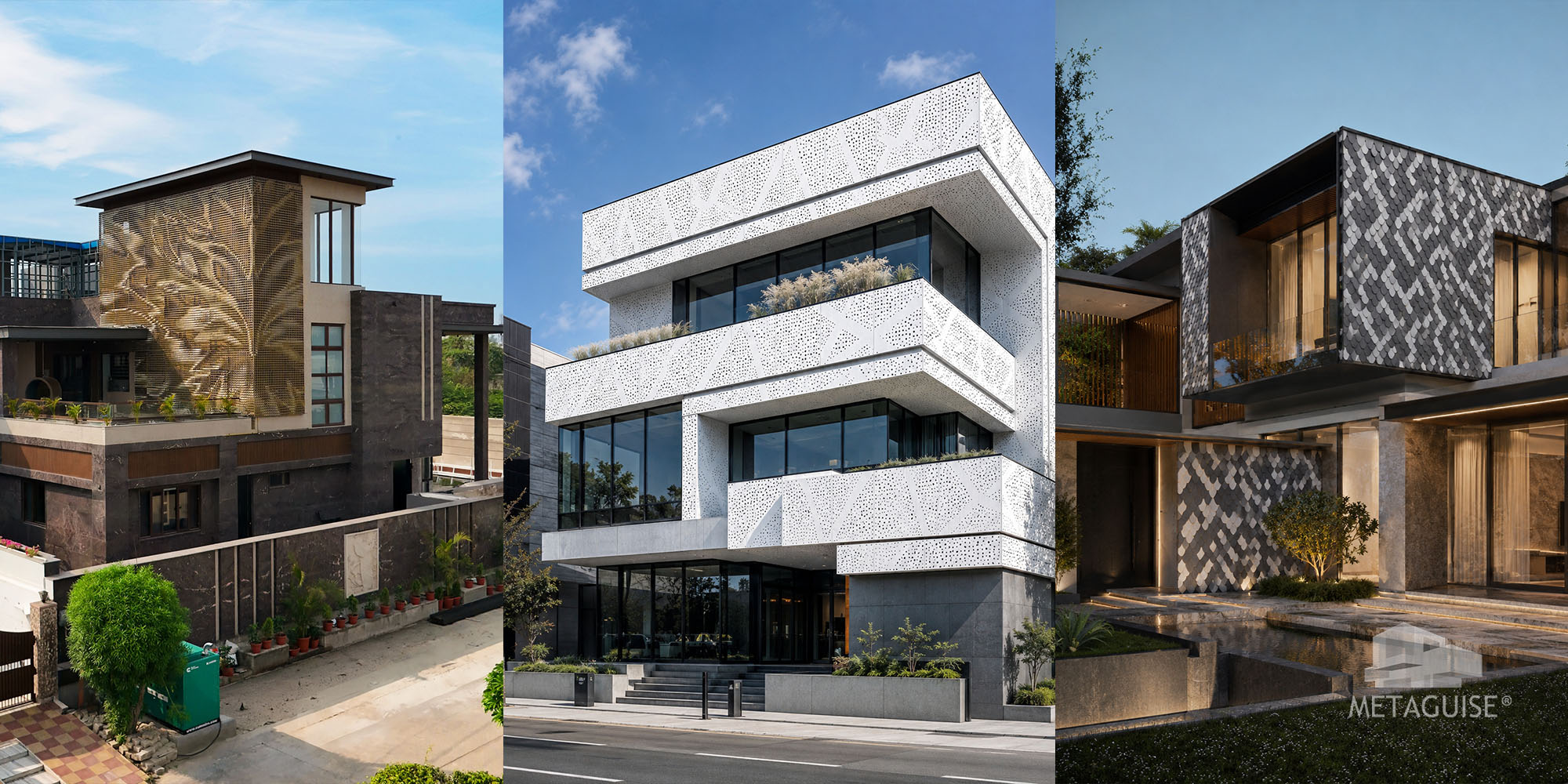
• AI and computational design are transforming Indian architecture. The Council of Architecture's Faculty Development Programme in August 2025 bundled Grasshopper, Rhino, and AI design thinking as a unified curriculum, reflecting how inseparable the two have become in professional practice. • The distinction that matters most for architects: parametric design uses algorithmic rules to govern form, while AI-assisted design uses machine learning to generate or optimise solutions from data. They are different tools with different applications. Knowing which is which determines how effectively you can use either. • Metaguise's in-house computational design team uses Grasshopper and Rhino parametric scripting to generate every bespoke facade composition — making Metaguise one of the few Indian facade companies with genuine in-house parametric capability rather than outsourced design. • This guide covers what AI-driven facade design actually means, the tools in use, Indian firms at the frontier, the benefits and honest limitations, Metaguise's position, and the outlook to 2030.
What Is AI-Driven Facade Design? Separating the Real from the Hype
Something strange has happened to the conversation about AI in architecture. The word gets applied to everything now. Midjourney renders, Grasshopper scripts, energy simulation software, generative massing tools. They are all described as "AI in architecture" and they are all doing entirely different things. A studio that publishes daily AI facade visualisations and a practice that runs machine learning energy optimisation are both technically using AI. They are not doing the same work, and the buildings that result are not the same buildings. This distinction matters for anyone commissioning a parametric facade in India in 2026 because a facade rendered in Midjourney and a facade scripted in Grasshopper, fabricated on a CNC machine, and installed by a specialist team are not the same product. One is a picture. The other is a building.
Tools: Grasshopper, Rhino, Midjourney, and AI — How Each Contributes
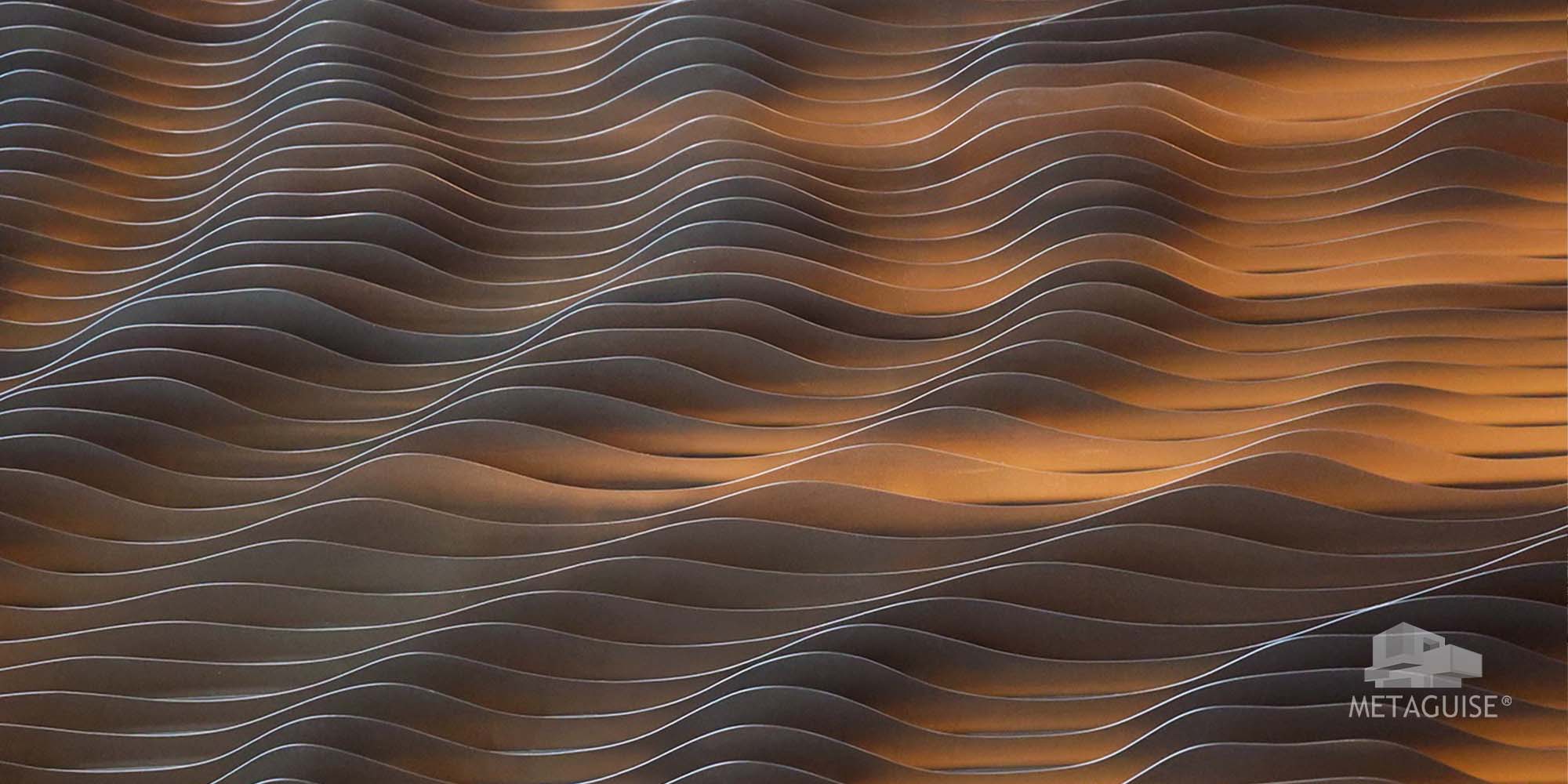
Grasshopper (Parametric Scripting) Grasshopper is a visual programming environment embedded in Rhino 3D. It is the industry-standard tool for parametric facade design. In Grasshopper, the designer constructs a node-based script that defines mathematical rules governing the facade geometry. For Metaguise's MetaSequin installations, the Grasshopper script governs the angle of each individual sequin module, calculating the optimal angle for each module's position on the facade to produce the intended shimmer gradient as the viewer approaches the building. For MetaCoin arrays, the script governs module size and spacing density across the facade, producing parametric gradients that are mathematically unrepeatable. Rhino 3D (Geometry Engine) Rhino is the 3D modelling environment within which Grasshopper scripts execute. The facade geometry generated by the parametric script exists as a Rhino model, a precise 3D representation of every panel, every module, and every fixing point in the installation. From this model, Metaguise's engineering team extracts the panel geometry for CNC fabrication programming, the fixing point coordinates for sub-frame engineering, and the installation sequence drawings for the site team. The Rhino model is the bridge between parametric design and physical fabrication. Midjourney and Image AI (Visualisation Reference) Image generation AI tools like Midjourney, Stable Diffusion, and Adobe Firefly are increasingly used by architects and facade designers to rapidly generate visualisation references for client briefing. A client who struggles to articulate their aesthetic intent can review a set of AI-generated facade images and select the directions that resonate. This provides the designer with a visual brief that would take days of reference image curation to assemble manually. To be clear: these AI-generated images are not buildable designs. They are visualisation references that the parametric designer then translates into a specification. But as a briefing tool, they have shortened the time required to align client and designer on aesthetic direction significantly. Autodesk Forma and Energy Optimisation AI For commercial facade projects where energy performance is a primary brief requirement, including IGBC or LEED certification targets, ECBC compliance, or operational cost reduction, AI-powered massing and energy simulation tools like Autodesk Forma can test thousands of facade configurations against energy performance metrics in hours rather than weeks. The output is not a design. It is an optimised set of parameters, including glazing ratio, shading coefficient, and facade orientation, that the architect then implements in the facade design. For MetaFin solar shading specifications on commercial Hyderabad or NCR projects, energy optimisation AI provides the input data that makes the fin geometry calculation more precise and more defensible in certification submissions.
Indian Firms and Projects Using Computational Design for Facades
India's computational design community is concentrated in a small number of architectural practices with the technical training and software infrastructure to deploy these tools effectively. Their work is defining what Indian building facades look like at the frontier. Morphogenesis (New Delhi) Morphogenesis is India's most internationally recognised computational design practice, the firm behind the Surat Diamond Bourse and the Infosys campus in Nagpur. Their facade designs consistently demonstrate parametric intelligence: facades that respond to solar orientation, manage thermal gain, and create architectural identity through the logic of their geometry rather than applied decoration. Sanjay Puri Architects (Mumbai) Sanjay Puri Architects has built an international reputation for contextually responsive computational design. The firm's facades and building forms respond to site, climate, and programme through algorithmic thinking. Their 2026 Nagpur project demonstrates parametric facade composition at the scale of civic architecture. Metaguise's In-House Computational Design Metaguise occupies a unique position in India's computational design landscape. It is not an architectural practice that designs buildings. It is a facade specialist that deploys parametric design tools to develop fabricable facade compositions for projects designed by others. Metaguise's Grasshopper and Rhino team generates the parametric scripts that govern every MetaSequin, MetaCoin, MetaFold, and custom parametric installation the company delivers. The work translates the architect's design intent into a mathematically precise, CNC-fabricable panel specification. This in-house computational capability is what distinguishes Metaguise from facade contractors who work from product catalogues.
Benefits and Limitations: An Honest Assessment
Benefits • Design specificity: Parametric design generates compositions that are mathematically unique — no two Metaguise parametric installations are identical, because the governing script is always specific to the project's geometry and brief • Fabrication precision: The parametric model produces the exact CNC toolpath data for every panel — eliminating the dimensional errors that arise when a contractor interprets a 2D drawing manually • Solar performance optimisation: Computational tools can test thousands of fin geometry configurations against energy performance targets in hours — making performance-optimised facade design practical rather than aspirational • Speed at scale: For large parametric installations (thousands of modules), the parametric script executes in seconds what manual design would take months to produce Limitations • Expertise threshold: Grasshopper and Rhino require significant training to use effectively — the tools are powerful but not intuitive; the quality of the parametric design is directly proportional to the expertise of the designer using the tools • Not a replacement for architectural judgment: AI and parametric tools generate options; they do not evaluate them. The judgment of which option is architecturally right for the project remains a human responsibility • Render ≠ reality: AI-generated visualisations (Midjourney) are not buildable designs; they are mood board images that can mislead clients about what is achievable in fabrication if not carefully contextualised • Cost of computational design: Parametric design capability adds to the design phase cost relative to catalogue-based specification — a cost that is justified for bespoke commissions but not always appropriate for straightforward modular system projects
Frequently Asked Questions
1.Can I use Midjourney to design my facade and then ask Metaguise to build it?
Midjourney can generate an inspirational reference image that communicates your aesthetic direction — and that reference is a useful briefing tool. What it cannot generate is a buildable specification: the panel geometry, material specification, fixing detail, and structural engineering that a fabricable facade requires. Metaguise's design team will work from your Midjourney references to develop a buildable parametric design in Grasshopper and Rhino — translating the visual intent of the AI image into a facade that can be fabricated and installed.2. Is parametric design significantly more expensive than standard facade design?
Parametric design adds to the design phase timeline and cost relative to modular catalogue-based specification — because the Grasshopper script must be developed and the parametric model must be built for each project. For large parametric installations (MetaSequin, MetaCoin, MetaFold on significant facade areas), the design phase cost is a proportionally small component of the total project investment. For smaller projects where the brief calls for a modular MetaForm system, parametric design is not required — and Metaguise's standard design consultation process produces a fully specified result without parametric scripting.3.Which Indian architects are best positioned to specify parametric facades?
Architectural practices with dedicated computational design teams — including Morphogenesis, Sanjay Puri Architects, and a growing number of practices trained through CoA and FOAID computational design programmes — are best positioned to specify and review parametric facade work. For projects where the principal architect does not have computational design capability, Metaguise's in-house team provides the parametric design function directly, working within the architect's design framework.4.Will AI replace the architect's role in facade design?
No — and this is an important clarification for the current AI discourse in architecture. AI tools generate options from data; they do not evaluate options against the full complexity of a specific project's cultural context, client relationship, site conditions, and architectural ambition. The judgment of which option is right for a specific building, a specific family, a specific street, remains a human responsibility. AI and parametric tools make the generation of options faster and the optimisation of specific parameters more precise — they make the architect more capable, not unnecessary.AI-Designed Facades: How Machine Learning Is Reshaping Building Design in India
05-07-26 | Facade Innovations
Key Takeaways
• AI and computational design are transforming Indian architecture. The Council of Architecture's Faculty Development Programme in August 2025 bundled Grasshopper, Rhino, and AI design thinking as a unified curriculum, reflecting how inseparable the two have become in professional practice. • The distinction that matters most for architects: parametric design uses algorithmic rules to govern form, while AI-assisted design uses machine learning to generate or optimise solutions from data. They are different tools with different applications. Knowing which is which determines how effectively you can use either. • Metaguise's in-house computational design team uses Grasshopper and Rhino parametric scripting to generate every bespoke facade composition — making Metaguise one of the few Indian facade companies with genuine in-house parametric capability rather than outsourced design. • This guide covers what AI-driven facade design actually means, the tools in use, Indian firms at the frontier, the benefits and honest limitations, Metaguise's position, and the outlook to 2030.
What Is AI-Driven Facade Design? Separating the Real from the Hype
Something strange has happened to the conversation about AI in architecture. The word gets applied to everything now. Midjourney renders, Grasshopper scripts, energy simulation software, generative massing tools. They are all described as "AI in architecture" and they are all doing entirely different things. A studio that publishes daily AI facade visualisations and a practice that runs machine learning energy optimisation are both technically using AI. They are not doing the same work, and the buildings that result are not the same buildings. This distinction matters for anyone commissioning a parametric facade in India in 2026 because a facade rendered in Midjourney and a facade scripted in Grasshopper, fabricated on a CNC machine, and installed by a specialist team are not the same product. One is a picture. The other is a building.
Tools: Grasshopper, Rhino, Midjourney, and AI — How Each Contributes
Grasshopper (Parametric Scripting) Grasshopper is a visual programming environment embedded in Rhino 3D. It is the industry-standard tool for parametric facade design. In Grasshopper, the designer constructs a node-based script that defines mathematical rules governing the facade geometry. For Metaguise's MetaSequin installations, the Grasshopper script governs the angle of each individual sequin module, calculating the optimal angle for each module's position on the facade to produce the intended shimmer gradient as the viewer approaches the building. For MetaCoin arrays, the script governs module size and spacing density across the facade, producing parametric gradients that are mathematically unrepeatable. Rhino 3D (Geometry Engine) Rhino is the 3D modelling environment within which Grasshopper scripts execute. The facade geometry generated by the parametric script exists as a Rhino model, a precise 3D representation of every panel, every module, and every fixing point in the installation. From this model, Metaguise's engineering team extracts the panel geometry for CNC fabrication programming, the fixing point coordinates for sub-frame engineering, and the installation sequence drawings for the site team. The Rhino model is the bridge between parametric design and physical fabrication. Midjourney and Image AI (Visualisation Reference) Image generation AI tools like Midjourney, Stable Diffusion, and Adobe Firefly are increasingly used by architects and facade designers to rapidly generate visualisation references for client briefing. A client who struggles to articulate their aesthetic intent can review a set of AI-generated facade images and select the directions that resonate. This provides the designer with a visual brief that would take days of reference image curation to assemble manually. To be clear: these AI-generated images are not buildable designs. They are visualisation references that the parametric designer then translates into a specification. But as a briefing tool, they have shortened the time required to align client and designer on aesthetic direction significantly. Autodesk Forma and Energy Optimisation AI For commercial facade projects where energy performance is a primary brief requirement, including IGBC or LEED certification targets, ECBC compliance, or operational cost reduction, AI-powered massing and energy simulation tools like Autodesk Forma can test thousands of facade configurations against energy performance metrics in hours rather than weeks. The output is not a design. It is an optimised set of parameters, including glazing ratio, shading coefficient, and facade orientation, that the architect then implements in the facade design. For MetaFin solar shading specifications on commercial Hyderabad or NCR projects, energy optimisation AI provides the input data that makes the fin geometry calculation more precise and more defensible in certification submissions.
Indian Firms and Projects Using Computational Design for Facades
India's computational design community is concentrated in a small number of architectural practices with the technical training and software infrastructure to deploy these tools effectively. Their work is defining what Indian building facades look like at the frontier. Morphogenesis (New Delhi) Morphogenesis is India's most internationally recognised computational design practice, the firm behind the Surat Diamond Bourse and the Infosys campus in Nagpur. Their facade designs consistently demonstrate parametric intelligence: facades that respond to solar orientation, manage thermal gain, and create architectural identity through the logic of their geometry rather than applied decoration. Sanjay Puri Architects (Mumbai) Sanjay Puri Architects has built an international reputation for contextually responsive computational design. The firm's facades and building forms respond to site, climate, and programme through algorithmic thinking. Their 2026 Nagpur project demonstrates parametric facade composition at the scale of civic architecture. Metaguise's In-House Computational Design Metaguise occupies a unique position in India's computational design landscape. It is not an architectural practice that designs buildings. It is a facade specialist that deploys parametric design tools to develop fabricable facade compositions for projects designed by others. Metaguise's Grasshopper and Rhino team generates the parametric scripts that govern every MetaSequin, MetaCoin, MetaFold, and custom parametric installation the company delivers. The work translates the architect's design intent into a mathematically precise, CNC-fabricable panel specification. This in-house computational capability is what distinguishes Metaguise from facade contractors who work from product catalogues.
Benefits and Limitations: An Honest Assessment
Benefits • Design specificity: Parametric design generates compositions that are mathematically unique — no two Metaguise parametric installations are identical, because the governing script is always specific to the project's geometry and brief • Fabrication precision: The parametric model produces the exact CNC toolpath data for every panel — eliminating the dimensional errors that arise when a contractor interprets a 2D drawing manually • Solar performance optimisation: Computational tools can test thousands of fin geometry configurations against energy performance targets in hours — making performance-optimised facade design practical rather than aspirational • Speed at scale: For large parametric installations (thousands of modules), the parametric script executes in seconds what manual design would take months to produce Limitations • Expertise threshold: Grasshopper and Rhino require significant training to use effectively — the tools are powerful but not intuitive; the quality of the parametric design is directly proportional to the expertise of the designer using the tools • Not a replacement for architectural judgment: AI and parametric tools generate options; they do not evaluate them. The judgment of which option is architecturally right for the project remains a human responsibility • Render ≠ reality: AI-generated visualisations (Midjourney) are not buildable designs; they are mood board images that can mislead clients about what is achievable in fabrication if not carefully contextualised • Cost of computational design: Parametric design capability adds to the design phase cost relative to catalogue-based specification — a cost that is justified for bespoke commissions but not always appropriate for straightforward modular system projects
Frequently Asked Questions
1.Can I use Midjourney to design my facade and then ask Metaguise to build it?
Midjourney can generate an inspirational reference image that communicates your aesthetic direction — and that reference is a useful briefing tool. What it cannot generate is a buildable specification: the panel geometry, material specification, fixing detail, and structural engineering that a fabricable facade requires. Metaguise's design team will work from your Midjourney references to develop a buildable parametric design in Grasshopper and Rhino — translating the visual intent of the AI image into a facade that can be fabricated and installed.2. Is parametric design significantly more expensive than standard facade design?
Parametric design adds to the design phase timeline and cost relative to modular catalogue-based specification — because the Grasshopper script must be developed and the parametric model must be built for each project. For large parametric installations (MetaSequin, MetaCoin, MetaFold on significant facade areas), the design phase cost is a proportionally small component of the total project investment. For smaller projects where the brief calls for a modular MetaForm system, parametric design is not required — and Metaguise's standard design consultation process produces a fully specified result without parametric scripting.3.Which Indian architects are best positioned to specify parametric facades?
Architectural practices with dedicated computational design teams — including Morphogenesis, Sanjay Puri Architects, and a growing number of practices trained through CoA and FOAID computational design programmes — are best positioned to specify and review parametric facade work. For projects where the principal architect does not have computational design capability, Metaguise's in-house team provides the parametric design function directly, working within the architect's design framework.4.Will AI replace the architect's role in facade design?
No — and this is an important clarification for the current AI discourse in architecture. AI tools generate options from data; they do not evaluate options against the full complexity of a specific project's cultural context, client relationship, site conditions, and architectural ambition. The judgment of which option is right for a specific building, a specific family, a specific street, remains a human responsibility. AI and parametric tools make the generation of options faster and the optimisation of specific parameters more precise — they make the architect more capable, not unnecessary.Related Articles
Related Articles
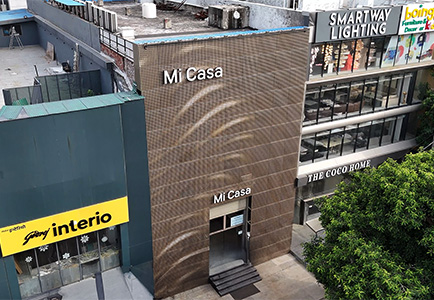
The Rise of Parametric facades: Designing with Algorithmic Elegance
A revolutionary parametric facade system designed to elevate architectural aesthetics. Crafted with premium metals and enhanced with MetaSurface finishes, MetaCoin offers unparalleled customizability, from the shape and size of each element to its color and arrangement. Its dynamic design reacts to light and perspective, creating ever-changing visual effects. Ideal for contemporary and iconic structures, MetaCoin transforms facades into captivating works of art that are sustainable, durable, and visually stunning.
01-04-25 | Facade Innovations
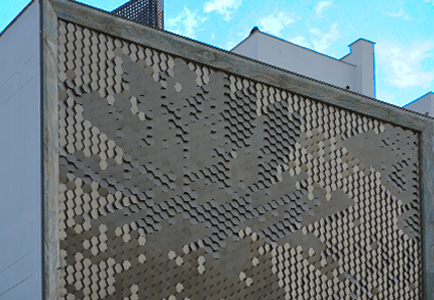
METABLOX™ by Metaguise: A Breakthrough in Parametric Facade Design
At the intersection of culture, craftsmanship, and cutting-edge geometry, METABLOX™ emerges as a bold new direction in architectural innovation. Introduced by Metaguise, this first-of-its-kind parametric facade technology makes its striking debut at the RJ Jewellers flagship store in Jaipur - setting a new benchmark in the world of metal design and modern Indian architecture.
09-04-25 | Facade Innovations
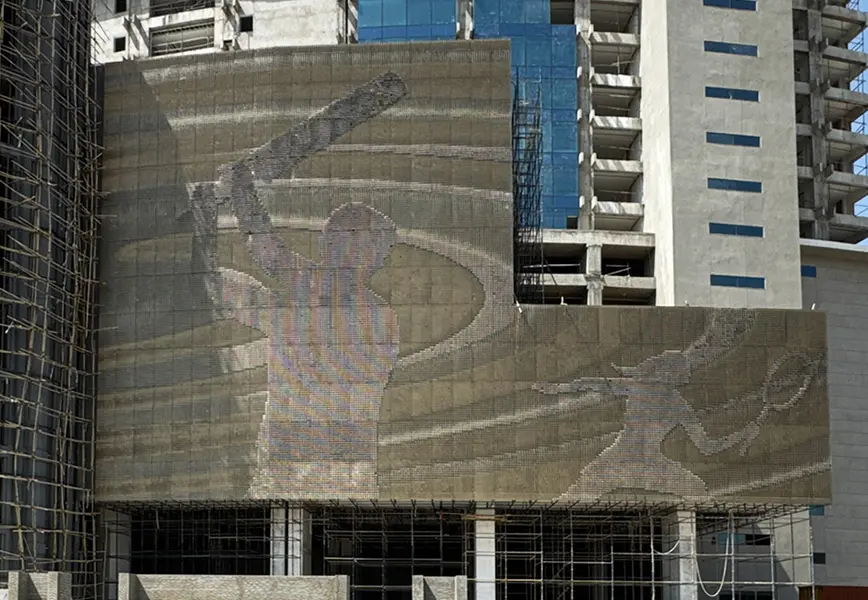
5 Landmark Projects That Used MetaCoin to Transform Facades
When it comes to parametric architecture, MetaCoin stands out as a revolutionary metal coin facade system. Crafted with precision, it offers dynamic aesthetics, adaptability, and a unique identity to structures. Let's delve into five notable projects where MetaCoin has redefined architectural facades.
13-05-25 | Facade Innovations
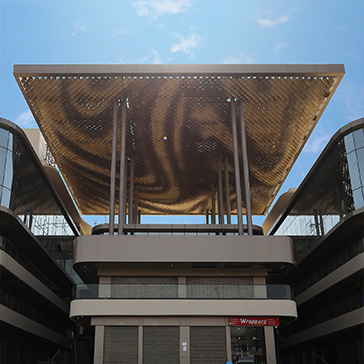
From Code to Construction: How Parametric Facades Are Built
Some buildings just make you look twice. Maybe it’s the way the facade curves. Or how the surface catches the light at different times of day. Often, what you’re seeing is more than just a design, it’s a parametric facade.
10-06-25 | Facade Innovations
Social
Legal
Privacy Policy|Terms & Conditions