



A Portrait of Lord Krishna, Built From Metal Discs
20-09-26 | Project Highlights
A Facade That Belongs Only to Vrindavan
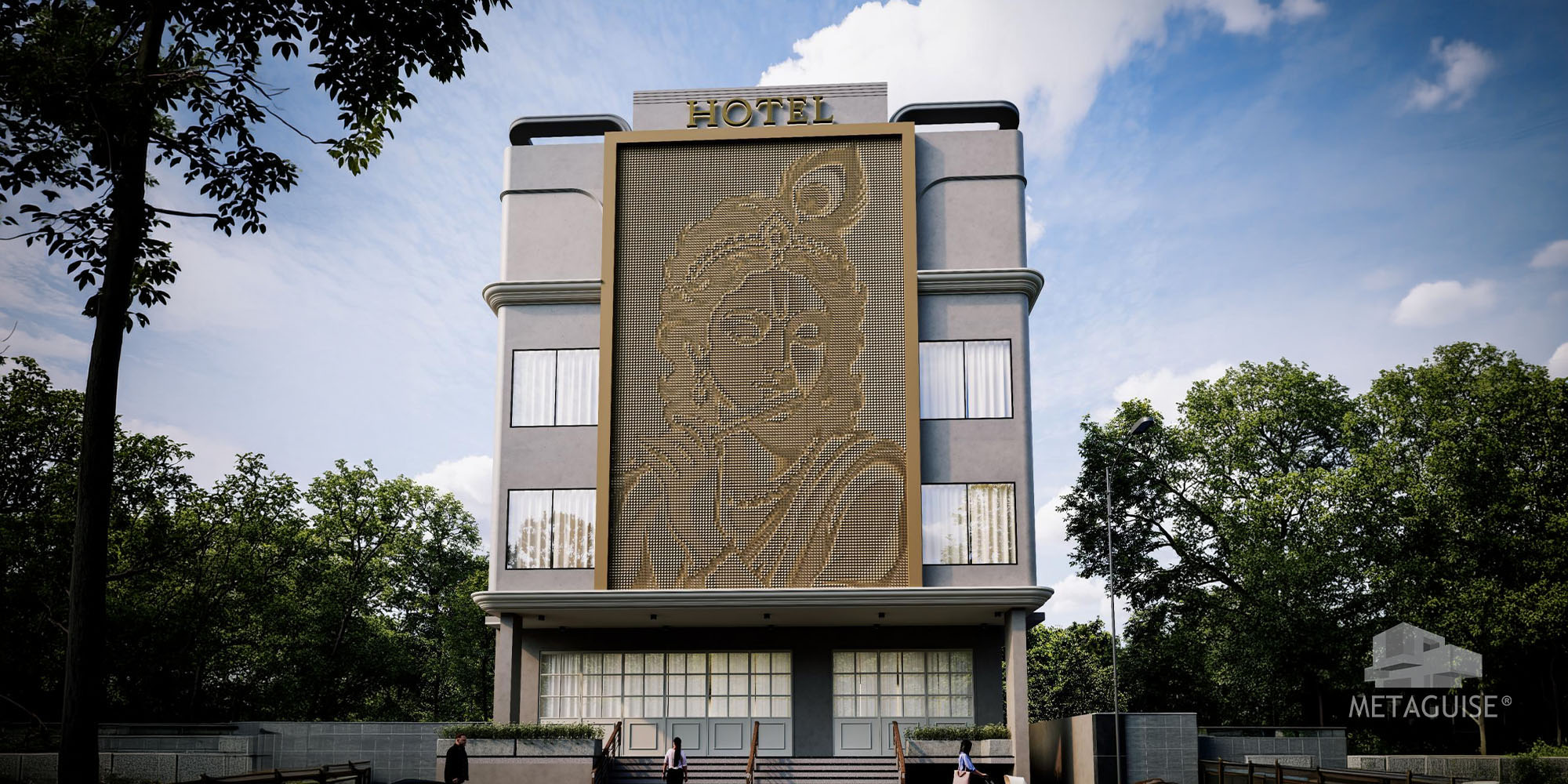
Vrindavan is a town where almost every surface tells a story. Temple walls carry murals, shopfronts carry devotional imagery, and even the everyday architecture of the town leans toward narrative rather than pure function. So when a new hotel here needed a facade, a decorative pattern borrowed from anywhere else was never going to be enough. The building needed an elevation that belonged specifically to this town, not one that could have been dropped in from any city in India.
The answer the design team arrived at is direct rather than decorative. The hotel's facade carries a portrait of Lord Krishna. Not painted. Not printed. Built from thousands of individual aluminium discs, each one angled to catch or reject light in exactly the amount needed to resolve, from a distance, into a face.
MetaCoin in Champagne Gold, Angled by Algorithm
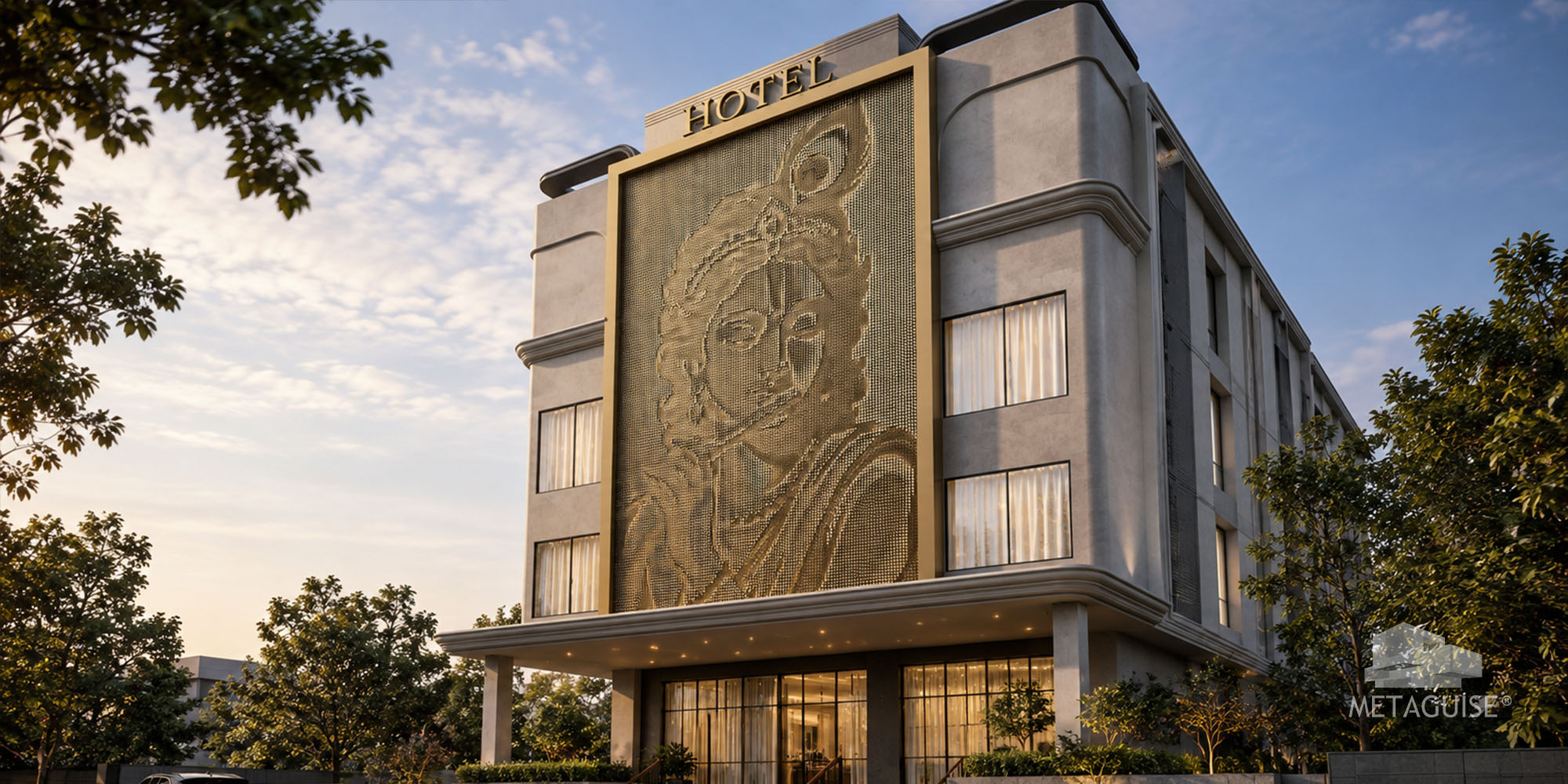
The elevation uses MetaCoin, Metaguise's parametric disc system, fabricated in aluminium and finished in a champagne gold powder coat. Each individual disc mounts onto the panel behind it and rotates to a specific angle, and that angle is not chosen by eye or by hand. It is calculated computationally, disc by disc, across the entire portrait.
This is the core mechanism worth understanding before anything else about the facade makes sense. A flat disc reflects light differently depending on how it is tilted relative to the viewer and the sun. Turn a disc toward the light source and it reads bright, almost luminous. Turn the same disc away and it reads dark, receding into shadow. Neither disc has changed colour. Neither has been painted differently from its neighbour. The entire image exists purely as a function of angle and light.
Multiply that single relationship across thousands of discs, each independently angled according to what a source image requires at that exact point on the facade, and the result is a portrait built entirely from reflected and rejected light rather than from pigment. This is fundamentally different from a printed or painted mural, where colour value sits fixed on the surface regardless of the time of day or the angle a viewer approaches from. A MetaCoin portrait genuinely changes character as the sun moves, since the discs that read brightest at ten in the morning are not necessarily the same discs that read brightest at four in the afternoon.
Why the Portrait Only Appears From a Distance
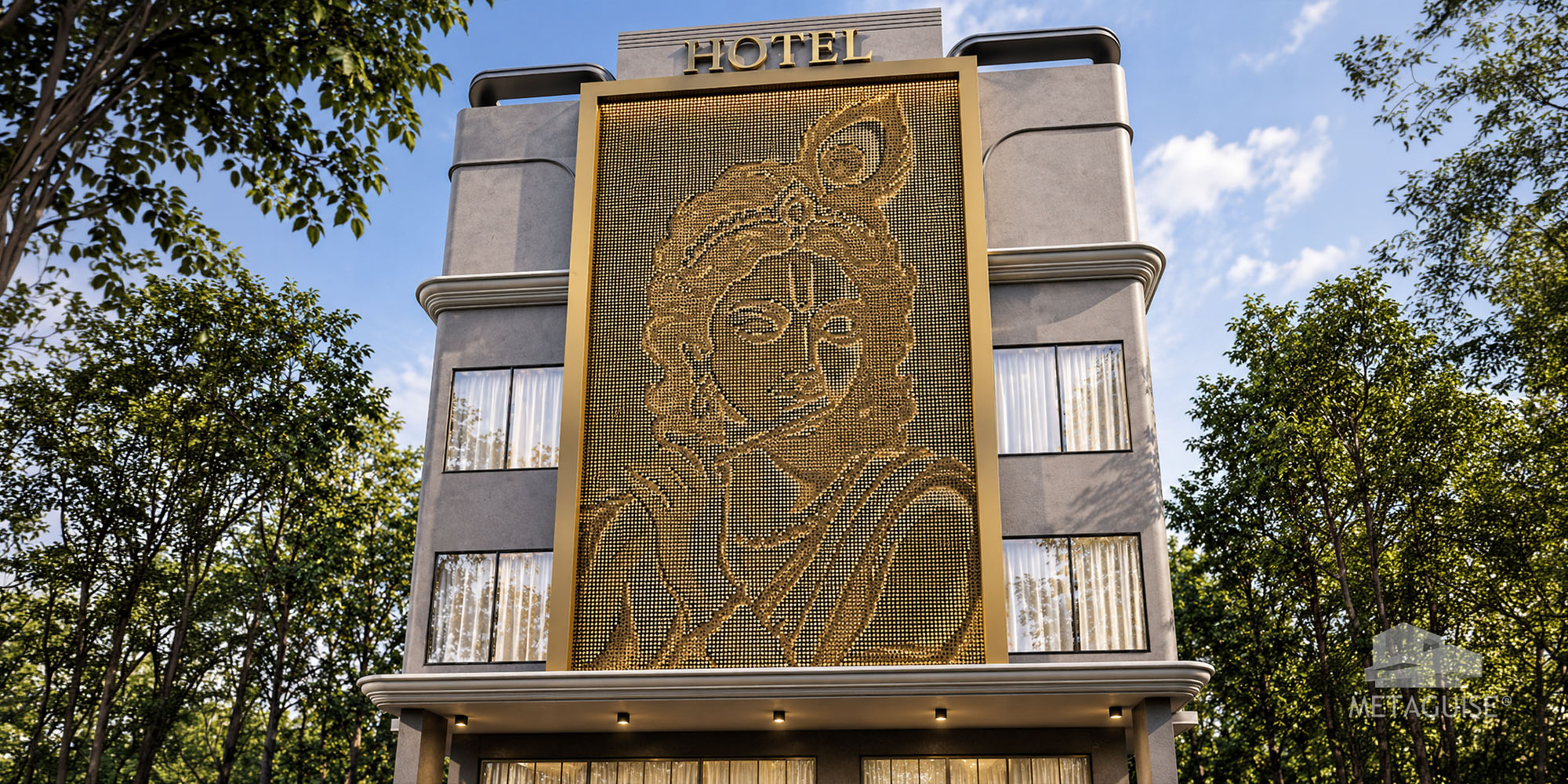
Stand close to the hotel's facade and the portrait effectively disappears. What you see instead is metalwork, a dense field of individual gold discs, each one distinct, each one a small, self-contained object with its own edge and its own shadow. There is no single moment up close where the image becomes obviously legible, because the eye at that range is reading discs, not pixels.
Step back, and the portrait assembles itself, seemingly all at once. This is the same underlying logic that makes a halftone print work, the technique newspapers and early photographic reproduction relied on long before digital screens, where an image is broken into a grid of dots varying only in size or density, and the eye and brain reconstruct continuous tone from what is actually a field of discrete marks. MetaCoin applies that exact principle, translated from ink dots on paper into physical, light-reflecting discs at genuine building scale.
The practical effect is that the facade rewards two entirely different kinds of looking. Someone walking directly past the hotel, close enough to touch the wall, experiences a rich, tactile field of individually crafted metalwork, each disc catching the light slightly differently from its neighbour. Someone viewing the hotel from across the street, or approaching from a distance along the road, experiences the portrait itself, a recognisable image resolving out of what would otherwise just read as texture. Few facade systems manage to deliver two genuinely different, both worthwhile experiences depending purely on where the viewer happens to be standing.
Champagne Gold, and Why the Finish Was the Right One
Gold, in a devotional context, is an obvious colour choice and also a genuinely risky one. Used too directly, too brightly, or too uniformly, gold on a building facade can tip quickly into something that reads as heavy or ostentatious rather than reverent, particularly at the scale of an entire hotel elevation rather than a small devotional object.
Champagne gold sits deliberately softer than a pure, saturated gold tone. It carries warmth without full brightness, which changes how the facade behaves through the day. In the soft light of early morning, the champagne tone reads warm and inviting, without the harshness a brighter gold can carry under low, angled sun. At midday, under the flattest and most intense light of the day, the same finish restrains itself rather than glaring back at the viewer. And in the hour around dusk, as the sky itself moves through warm oranges and pinks, the champagne gold discs pick up and reflect that ambient colour shift, so the facade genuinely takes on something of the sky's own tone at exactly the time of day many visitors are likely to be arriving or stepping outside.
There is also a straightforwardly practical reason champagne gold, delivered as a powder coating on aluminium, was the right specification here, separate from its purely visual qualities. Powder coating is a dry finish, applied as powder and cured under heat to bond as a durable protective layer across the metal's surface, and it holds its colour reliably through the kind of climate extremes Uttar Pradesh delivers across a full year, intense summer heat followed by a genuine monsoon season bringing sustained humidity and heavy rainfall. A plated or directly painted finish would need considerably more active maintenance to hold its appearance through that same climate cycle, repainting, recoating, or repolishing on a schedule that a hotel operating continuously would rather not have to plan around. Powder-coated aluminium, by contrast, needs comparatively little beyond periodic cleaning to keep its appearance consistent year after year, a durability point explored further in why architects specify MetaCoin for its texture and durability.
What This Approach Suits
MetaCoin's ability to render a genuine image, rather than a repeating decorative pattern, opens up a category of facade brief that most cladding systems cannot address at all. Any building where the elevation needs to carry a specific identity, rather than simply a texture or a mood, is a candidate for this approach. Hotels wanting a facade tied specifically to their location, rather than an interchangeable contemporary surface that could belong to any city, are an obvious fit, as this Vrindavan project demonstrates directly.
Temples and other religious or cultural buildings represent an equally natural application, since these buildings frequently already carry a strong visual or narrative identity that a MetaCoin elevation can translate directly onto the exterior rather than confining it to interior murals or carvings. Cultural institutions more broadly, museums, performance venues, civic buildings wanting to communicate something specific about their regional or historical context, can use the same underlying technique to put a recognisable image on a scale that a painted mural would struggle to achieve with the same durability and light-responsive quality, as seen across other landmark projects that have used MetaCoin to transform facades.
Retail projects with a genuine story to tell, rather than a purely commercial brief, are the fourth clear application. A brand or a business built around a specific narrative, a heritage, a founder, a regional identity, can use a MetaCoin facade to put that story directly on the building's exterior in a way that a sign or a printed banner never could, since the image itself is built into the permanent material of the elevation rather than applied as a temporary or replaceable layer on top of it.
The underlying requirement across all of these applications is the same. If a subject can be described convincingly in terms of light and shadow, in the way a black and white photograph or a strong halftone print can carry an image using only tonal contrast, MetaCoin can very likely build it. Bold, high-contrast subjects with clear tonal separation between light and dark areas translate most successfully into disc angles, since the system is fundamentally working with a two-value logic at the level of any individual disc, reflecting or not reflecting, even though the cumulative effect across thousands of discs can render considerably more visual nuance than that simple description suggests.
How a Facade Like This Actually Gets Built
Translating a portrait into a physical facade is not a purely artistic decision made once and then handed to a fabrication team. It moves through a defined technical process, starting with a source image that gets analysed for its tonal range, the spread of light and dark values across the composition, since that tonal map is what ultimately drives the angle calculation for every single disc position on the elevation. This is the same underlying discipline behind parametric facade design using algorithmic and computational tools.
From there, the image is mapped onto the actual grid of the building's facade, accounting for the real dimensions of the wall, the spacing between individual disc mounting points, and the viewing distances the portrait needs to read correctly from, whether that is a road running past the hotel or a courtyard set back from the main structure. This mapping stage is where a purely digital image becomes a genuinely architectural one, since the same portrait would need a different disc grid and a different angle calculation if it were being built at a different scale or for a different typical viewing distance.
Fabrication itself follows standard MetaCoin production, forming and finishing each disc to the specified champagne gold powder coat before the angle-setting stage, where each disc is mounted and rotated to its calculated position. Quality control at this stage checks disc angles against the design model, since a portrait built from thousands of individually positioned elements only resolves correctly if a very high proportion of those positions match the calculation closely, a single disc set to the wrong angle is invisible on its own but a systematic drift across a section of the elevation would visibly distort the image in that area.
Why This Approach Matters for a Town Like Vrindavan
Vrindavan's built environment carries an unusually direct relationship between architecture and narrative, more so than most Indian towns, given the town's central place in Krishna devotion and pilgrimage. A hotel built here sits inside that context whether or not its design acknowledges it, and a facade that ignores the town's visual language entirely, defaulting to a generic contemporary glass and metal aesthetic that could belong to any Indian city, would represent a missed opportunity specific to this location. Building a facade that speaks the town's own visual language, translated into a genuinely contemporary fabrication technique rather than an imitation of traditional mural painting, lets the hotel participate in Vrindavan's character rather than sitting apart from it. This is precisely the kind of location-specific design thinking that a generic cladding pattern, applied without reference to where the building actually stands, could never achieve.
Frequently Asked Questions
Can MetaCoin reproduce any image on a facade?
MetaCoin can translate a wide range of images and patterns into facade compositions through computationally angled discs. Bold subjects with clear tonal contrast are particularly effective at architectural scale, since the system fundamentally works through reflected versus rejected light at each disc.
What is MetaCoin made from?
Aluminium, finished with a powder coating. This particular elevation uses a champagne gold finish, chosen specifically for how it behaves in devotional and cultural contexts without tipping into an overly heavy or ostentatious appearance.
Does the facade need maintenance?
Powder-coated aluminium needs only periodic cleaning to maintain its appearance. The finish holds its colour reliably through sustained heat and monsoon humidity without the more active maintenance schedule a plated or directly painted surface would need.
See More Facade Storytelling
MetaCoin's disc system has been used to render figures, textiles and architectural motifs on facades well beyond this hotel. Explore MetaCoin as a product to see the system's full range, or browse our project archive for other elevations built around a specific story rather than a generic pattern. To discuss a facade for your own site, you can build your facade with Metaguise or get in touch with the team.
20-09-26 | Project Highlights
A Facade That Belongs Only to Vrindavan
Vrindavan is a town where almost every surface tells a story. Temple walls carry murals, shopfronts carry devotional imagery, and even the everyday architecture of the town leans toward narrative rather than pure function. So when a new hotel here needed a facade, a decorative pattern borrowed from anywhere else was never going to be enough. The building needed an elevation that belonged specifically to this town, not one that could have been dropped in from any city in India.
The answer the design team arrived at is direct rather than decorative. The hotel's facade carries a portrait of Lord Krishna. Not painted. Not printed. Built from thousands of individual aluminium discs, each one angled to catch or reject light in exactly the amount needed to resolve, from a distance, into a face.
MetaCoin in Champagne Gold, Angled by Algorithm
The elevation uses MetaCoin, Metaguise's parametric disc system, fabricated in aluminium and finished in a champagne gold powder coat. Each individual disc mounts onto the panel behind it and rotates to a specific angle, and that angle is not chosen by eye or by hand. It is calculated computationally, disc by disc, across the entire portrait.
This is the core mechanism worth understanding before anything else about the facade makes sense. A flat disc reflects light differently depending on how it is tilted relative to the viewer and the sun. Turn a disc toward the light source and it reads bright, almost luminous. Turn the same disc away and it reads dark, receding into shadow. Neither disc has changed colour. Neither has been painted differently from its neighbour. The entire image exists purely as a function of angle and light.
Multiply that single relationship across thousands of discs, each independently angled according to what a source image requires at that exact point on the facade, and the result is a portrait built entirely from reflected and rejected light rather than from pigment. This is fundamentally different from a printed or painted mural, where colour value sits fixed on the surface regardless of the time of day or the angle a viewer approaches from. A MetaCoin portrait genuinely changes character as the sun moves, since the discs that read brightest at ten in the morning are not necessarily the same discs that read brightest at four in the afternoon.
Why the Portrait Only Appears From a Distance
Stand close to the hotel's facade and the portrait effectively disappears. What you see instead is metalwork, a dense field of individual gold discs, each one distinct, each one a small, self-contained object with its own edge and its own shadow. There is no single moment up close where the image becomes obviously legible, because the eye at that range is reading discs, not pixels.
Step back, and the portrait assembles itself, seemingly all at once. This is the same underlying logic that makes a halftone print work, the technique newspapers and early photographic reproduction relied on long before digital screens, where an image is broken into a grid of dots varying only in size or density, and the eye and brain reconstruct continuous tone from what is actually a field of discrete marks. MetaCoin applies that exact principle, translated from ink dots on paper into physical, light-reflecting discs at genuine building scale.
The practical effect is that the facade rewards two entirely different kinds of looking. Someone walking directly past the hotel, close enough to touch the wall, experiences a rich, tactile field of individually crafted metalwork, each disc catching the light slightly differently from its neighbour. Someone viewing the hotel from across the street, or approaching from a distance along the road, experiences the portrait itself, a recognisable image resolving out of what would otherwise just read as texture. Few facade systems manage to deliver two genuinely different, both worthwhile experiences depending purely on where the viewer happens to be standing.
Champagne Gold, and Why the Finish Was the Right One
Gold, in a devotional context, is an obvious colour choice and also a genuinely risky one. Used too directly, too brightly, or too uniformly, gold on a building facade can tip quickly into something that reads as heavy or ostentatious rather than reverent, particularly at the scale of an entire hotel elevation rather than a small devotional object.
Champagne gold sits deliberately softer than a pure, saturated gold tone. It carries warmth without full brightness, which changes how the facade behaves through the day. In the soft light of early morning, the champagne tone reads warm and inviting, without the harshness a brighter gold can carry under low, angled sun. At midday, under the flattest and most intense light of the day, the same finish restrains itself rather than glaring back at the viewer. And in the hour around dusk, as the sky itself moves through warm oranges and pinks, the champagne gold discs pick up and reflect that ambient colour shift, so the facade genuinely takes on something of the sky's own tone at exactly the time of day many visitors are likely to be arriving or stepping outside.
There is also a straightforwardly practical reason champagne gold, delivered as a powder coating on aluminium, was the right specification here, separate from its purely visual qualities. Powder coating is a dry finish, applied as powder and cured under heat to bond as a durable protective layer across the metal's surface, and it holds its colour reliably through the kind of climate extremes Uttar Pradesh delivers across a full year, intense summer heat followed by a genuine monsoon season bringing sustained humidity and heavy rainfall. A plated or directly painted finish would need considerably more active maintenance to hold its appearance through that same climate cycle, repainting, recoating, or repolishing on a schedule that a hotel operating continuously would rather not have to plan around. Powder-coated aluminium, by contrast, needs comparatively little beyond periodic cleaning to keep its appearance consistent year after year, a durability point explored further in why architects specify MetaCoin for its texture and durability.
What This Approach Suits
MetaCoin's ability to render a genuine image, rather than a repeating decorative pattern, opens up a category of facade brief that most cladding systems cannot address at all. Any building where the elevation needs to carry a specific identity, rather than simply a texture or a mood, is a candidate for this approach. Hotels wanting a facade tied specifically to their location, rather than an interchangeable contemporary surface that could belong to any city, are an obvious fit, as this Vrindavan project demonstrates directly.
Temples and other religious or cultural buildings represent an equally natural application, since these buildings frequently already carry a strong visual or narrative identity that a MetaCoin elevation can translate directly onto the exterior rather than confining it to interior murals or carvings. Cultural institutions more broadly, museums, performance venues, civic buildings wanting to communicate something specific about their regional or historical context, can use the same underlying technique to put a recognisable image on a scale that a painted mural would struggle to achieve with the same durability and light-responsive quality, as seen across other landmark projects that have used MetaCoin to transform facades.
Retail projects with a genuine story to tell, rather than a purely commercial brief, are the fourth clear application. A brand or a business built around a specific narrative, a heritage, a founder, a regional identity, can use a MetaCoin facade to put that story directly on the building's exterior in a way that a sign or a printed banner never could, since the image itself is built into the permanent material of the elevation rather than applied as a temporary or replaceable layer on top of it.
The underlying requirement across all of these applications is the same. If a subject can be described convincingly in terms of light and shadow, in the way a black and white photograph or a strong halftone print can carry an image using only tonal contrast, MetaCoin can very likely build it. Bold, high-contrast subjects with clear tonal separation between light and dark areas translate most successfully into disc angles, since the system is fundamentally working with a two-value logic at the level of any individual disc, reflecting or not reflecting, even though the cumulative effect across thousands of discs can render considerably more visual nuance than that simple description suggests.
How a Facade Like This Actually Gets Built
Translating a portrait into a physical facade is not a purely artistic decision made once and then handed to a fabrication team. It moves through a defined technical process, starting with a source image that gets analysed for its tonal range, the spread of light and dark values across the composition, since that tonal map is what ultimately drives the angle calculation for every single disc position on the elevation. This is the same underlying discipline behind parametric facade design using algorithmic and computational tools.
From there, the image is mapped onto the actual grid of the building's facade, accounting for the real dimensions of the wall, the spacing between individual disc mounting points, and the viewing distances the portrait needs to read correctly from, whether that is a road running past the hotel or a courtyard set back from the main structure. This mapping stage is where a purely digital image becomes a genuinely architectural one, since the same portrait would need a different disc grid and a different angle calculation if it were being built at a different scale or for a different typical viewing distance.
Fabrication itself follows standard MetaCoin production, forming and finishing each disc to the specified champagne gold powder coat before the angle-setting stage, where each disc is mounted and rotated to its calculated position. Quality control at this stage checks disc angles against the design model, since a portrait built from thousands of individually positioned elements only resolves correctly if a very high proportion of those positions match the calculation closely, a single disc set to the wrong angle is invisible on its own but a systematic drift across a section of the elevation would visibly distort the image in that area.
Why This Approach Matters for a Town Like Vrindavan
Vrindavan's built environment carries an unusually direct relationship between architecture and narrative, more so than most Indian towns, given the town's central place in Krishna devotion and pilgrimage. A hotel built here sits inside that context whether or not its design acknowledges it, and a facade that ignores the town's visual language entirely, defaulting to a generic contemporary glass and metal aesthetic that could belong to any Indian city, would represent a missed opportunity specific to this location. Building a facade that speaks the town's own visual language, translated into a genuinely contemporary fabrication technique rather than an imitation of traditional mural painting, lets the hotel participate in Vrindavan's character rather than sitting apart from it. This is precisely the kind of location-specific design thinking that a generic cladding pattern, applied without reference to where the building actually stands, could never achieve.
Frequently Asked Questions
Can MetaCoin reproduce any image on a facade?
MetaCoin can translate a wide range of images and patterns into facade compositions through computationally angled discs. Bold subjects with clear tonal contrast are particularly effective at architectural scale, since the system fundamentally works through reflected versus rejected light at each disc.
What is MetaCoin made from?
Aluminium, finished with a powder coating. This particular elevation uses a champagne gold finish, chosen specifically for how it behaves in devotional and cultural contexts without tipping into an overly heavy or ostentatious appearance.
Does the facade need maintenance?
Powder-coated aluminium needs only periodic cleaning to maintain its appearance. The finish holds its colour reliably through sustained heat and monsoon humidity without the more active maintenance schedule a plated or directly painted surface would need.
See More Facade Storytelling
MetaCoin's disc system has been used to render figures, textiles and architectural motifs on facades well beyond this hotel. Explore MetaCoin as a product to see the system's full range, or browse our project archive for other elevations built around a specific story rather than a generic pattern. To discuss a facade for your own site, you can build your facade with Metaguise or get in touch with the team.
Related Articles

How Kinetic Facades Improve Building Performance and User Experience
Kinetic facades are changing the way buildings behave. Instead of being fixed and static, these facades respond. To sunlight. To wind. Even to how people use the space. They’re not just eye-catching, they’re smart. And when done right, they make buildings more comfortable, more energy-efficient, and honestly, a lot more interesting to be around.
25-05-25 | Project Highlights

Before There Were Copies, There Was Metaguise: The Story of India’s Facade Pioneer
In the world of facade design, trends may come and go, but trailblazers are remembered forever. Metaguise stands as the original pioneer in India’s facade architecture landscape - long before metal facades became a mainstream aesthetic. With over 1800+ projects delivered, Metaguise has set the benchmark for what excellence in metal design truly means.
29-09-25 | Project Highlights
.webp)
Why Metaguise’s Facade Process Is the Benchmark for Architectural Excellence
In a world of shortcuts and surface-level solutions, Metaguise stands alone with a commitment to excellence so precise, it’s been engineered into a 47-step process. This isn’t just project management - it’s a performance ritual that transforms buildings into timeless expressions of facade architecture.
06-10-25 | Project Highlights

Then and Now: How Metaguise Facades from Years Ago Still Stand Flawless Today
At Metaguise, we believe the facade of a building isn’t just its outer layer - it’s its identity. And in today’s design landscape
14-11-25 | Project Highlights
Social
Legal
Privacy Policy|Terms & Conditions